


Can a Ductless Mini Split Handle a Southern Ontario Winter?
Can a ductless mini split handle a Southern Ontario winter? Yes — but only if you choose the right type of unit. A standard mini split will struggle once temperatures dip well below freezing. A cold-climate model, however, is specifically engineered to keep delivering strong, reliable heat through the kind of winters Hamilton and the GTA regularly see.
Here’s a quick summary before we dig into the details:
| Factor | What You Need to Know |
|---|---|
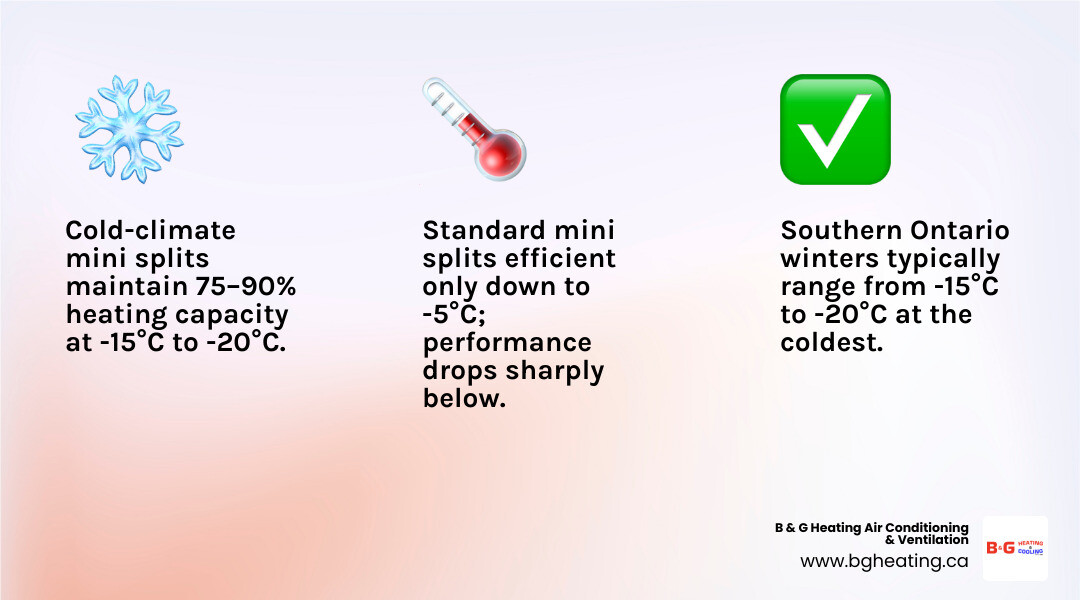
| Standard mini splits | Efficient down to about -5°C; performance drops sharply below that |
| Cold-climate models | Rated to -25°C or lower; maintain 75–90% heating capacity at -15°C to -20°C |
| Southern Ontario winters | Typically range from -15°C to -20°C at the coldest; occasional dips lower |
| Backup heat | Recommended for rare extreme cold snaps, but not required for most of the season |
| Professional installation | Critical — proper sizing, refrigerant charge, and unit placement directly affect winter performance |
Southern Ontario sits in climate zone 6, which means your heating system faces real sub-zero demands for weeks at a time each winter. The good news is that modern cold-climate ductless technology has caught up with those demands. Hundreds of thousands of Canadian homes now use these systems as their primary heat source — and homeowners in Hamilton and the surrounding area are increasingly making the switch.
That said, the technology only works well when the right unit is matched to your home’s actual heating load and installed correctly. This guide walks you through everything you need to know: how cold-climate mini splits perform at Southern Ontario temperatures, how to size and design your system, when backup heat makes sense, and how to keep your unit running reliably all winter long.

For most homes in Hamilton, Burlington, Oakville, Brantford, Stoney Creek, Grimsby, Hannon, and nearby Southern Ontario communities, the honest answer is yes, a ductless mini split can handle winter heating. But there is one big condition: it should be a cold-climate system, not a basic fair-weather model.
Modern cold-climate mini splits use inverter-driven compressors and low-temperature heating technology to keep extracting heat from outdoor air even when it feels like there should be nothing left to grab. They do not create heat the way electric baseboards do. Instead, they move heat, which is why they can remain much more efficient in normal winter conditions.
If you are still getting familiar with ductless options, our page on ductless mini split systems gives a good overview of how these systems work in real homes.
A simple way to think about it:
- Standard mini splits are usually fine for milder shoulder-season heating
- Cold-climate mini splits are designed for real Ontario winter duty
- The colder it gets, the more important sizing and installation become
- “It runs” is not the same as “it heats well”
That last point matters. A unit may technically operate at a low temperature, but the real question is whether it can still deliver enough BTUs to match your home’s heat loss.
| Feature | Standard Mini Split | Cold-Climate Mini Split |
|---|---|---|
| Typical low-temp efficiency range | Around -5°C | Down to -15°C, -20°C, -25°C or lower depending on model |
| Capacity retention in deep cold | Often drops quickly | Often keeps 75-90% of rated capacity at -15°C to -20°C |
| Best use in Southern Ontario | Supplemental heat, milder spaces | Primary heat in properly designed systems |
| Defrost performance | More basic | Better low-temp logic and cold-weather controls |
| Suitability for Hamilton-area winters | Limited | Strong choice when sized correctly |
Performance ratings for Hamilton and the GTA
When we evaluate winter performance, we look at published low-ambient heating data, not just marketing labels. For Southern Ontario, that usually means checking capacity at temperatures such as -15°C, -20°C, and sometimes -25°C.
In general:
- Many standard units work efficiently only to about 5°F, or roughly -15°C, and some fall off before that
- Cold-climate models are commonly rated for operation down to about -25°C
- Better-performing units may still deliver 80-90% of rated heating output at -15°C
- In the GTA and Hamilton area, that range is often enough to cover the bulk of the heating season
Research used for this article shows that cold-climate units in Southern Ontario conditions commonly retain about 75-90% of capacity during the kind of -15°C to -20°C weather we actually see. That is why they can work as reliable primary heating in many local homes.
A real-world example from the research: a home with a heating demand of about 12,000 BTU/hr at 0°F needed a unit that could still produce close to that output at design temperature. One cold-climate 9k model was able to deliver roughly 10,000 BTU/hr at 0°F, which shows why model-by-model data matters so much.
If you are comparing systems for your home, we recommend starting with professional ductless mini split HVAC services so the equipment is matched to the actual winter load rather than just room size.
Why professional installation matters for winter performance
A cold-climate mini split is only as good as its installation. This is where many winter problems begin.
If the refrigerant charge is off, the line set is poorly installed, the outdoor unit is placed in a wind tunnel, or the condenser sits too low and gets buried in snow, performance drops fast. In some cases, the system may still run but deliver weak heat, more frequent defrost cycles, or annoying ice buildup.
Professional installation matters because we need to get all of this right:
- Heat loss calculation for the home and zone
- Correct equipment pairing
- Proper refrigerant charge and commissioning
- Good condensate management for winter defrost melt
- Outdoor unit elevation above expected snow levels
- Sensible placement away from blocked airflow or drifting snow
This is also why we do not recommend treating a mini split like an online weekend gadget. DIY kits may look simple on a screen, but Southern Ontario winters are excellent at exposing shortcuts. Poor installation often shows up first during the coldest week of the year, which is terrible timing for a home comfort lesson.
If you are in the Hamilton area, our ductless mini split HVAC services in Hannon, ON page shows the kind of local support homeowners should look for when planning winter-ready ductless heating.
How Performance Changes During Extreme Cold Snaps
Even the best mini split does not behave exactly the same at -2°C and -22°C. As outdoor temperature drops, heating performance changes in predictable ways.
Here is what usually happens during a cold snap:
- The unit runs longer and harder
- Heating capacity declines compared with mild-weather rating
- Efficiency falls as the compressor works harder
- Frost builds on the outdoor coil more easily
- Defrost cycles become more frequent in cold, damp weather
Defrost cycles are normal. The outdoor unit can accumulate frost because it is pulling heat from cold outdoor air. To clear that frost, the system briefly reverses operation. During that time, indoor heating pauses or drops. Homeowners sometimes think something is wrong because they see steam or feel a short interruption. Usually, it is just the system doing its job.
Southern Ontario’s damp winter air can make defrosting more frequent than in colder, drier climates. That does not mean the unit is failing. It means it is working in real humidity, not a laboratory.
If you are comparing heating options overall, our guide on which type of heater is best for a cold winter can help put ductless performance in context.
Can a ductless mini split handle a southern ontario winter without backup?
Often yes, but not always, and that depends on the house more than many people expect.
A well-insulated, reasonably open home with a properly sized cold-climate single-zone or multi-zone system may get through most or all of winter without needing backup heat. But homes with any of the following may still benefit from a backup plan:
- Older construction with higher heat loss
- Drafty rooms or poor insulation
- Closed-off bedrooms on upper floors
- Large two-story layouts with one head trying to do too much
- Rare deep cold events below the unit’s strong-performance range
Research suggests cold-climate mini splits can independently cover about 85-90% of the heating season, with backup needed mainly for the coldest slice of winter. That is often a smart design choice, not a failure.
Common backup arrangements in Southern Ontario include:
- Existing gas furnace in a hybrid setup
- Electric baseboards in isolated rooms
- Supplemental electric heat in additions or basements
- Retaining a secondary system for emergency cold snaps
We often remind homeowners that backup heat is like winter boots in the trunk. You may not need them every day, but you will be glad they are there when February decides to show off.
For more ways to prep your house for heating season, see preparing your Hamilton home for winter heating.
Real-world expectations: can a ductless mini split handle a southern ontario winter?
In real homes, yes, many cold-climate ductless systems do very well in this region. But real-world expectations should be practical:
- One main-floor head will not magically heat every closed bedroom upstairs
- A unit sized for cooling only may struggle badly in winter
- A drafty home can overwhelm even good equipment
- Single-zone systems often perform better in deep cold than shared-capacity multi-zone setups
Research examples showed that in a zone 6 home with about 12,000 BTU/hr heating demand at 0°F, the right cold-climate unit could match that load closely enough to serve as primary heat. That is encouraging, but it is not a universal rule for every house.
We also see a common homeowner assumption: “If heat rises, one unit downstairs should do the whole house.” Sometimes it helps. It rarely solves everything. Open stairwells help. Closed doors do not. Physics, sadly, never takes a snow day.
If you are planning around a specific local property, our Hannon, ON heating and air conditioning services page is one example of the local support available for proper system planning.
Designing Your System for Maximum Efficiency
The best winter mini split system is not just about brand or brochure specs. It is about design.
The biggest factors affecting cold-weather efficiency are:
- Actual heat loss of the home
- Insulation levels in walls and attic
- Air leakage around doors, windows, and penetrations
- Number of floors and room layout
- Indoor head placement
- Outdoor unit placement
- Whether the system is single-zone or multi-zone
- Refrigerant and compressor technology
Cold-climate systems using enhanced low-temperature compression strategies can hold capacity better in deep cold. But even a great outdoor unit cannot compensate for major envelope problems.
Before installing any heat pump, we strongly recommend improving the home itself where practical. Air sealing and insulation upgrades often make as much difference as equipment selection.
You can find homeowner-friendly ideas in 10 winter hacks for a warmer house without cranking up the heat.
Single-zone vs. multi-zone is another important design choice.
Single-zone advantages often include:
- Better low-end modulation
- Stronger deep-cold performance per indoor unit
- Simpler control
- Less shared-capacity compromise
Multi-zone advantages often include:
- More rooms served
- Better comfort in closed-off spaces
- Cleaner whole-home zoning strategy
For a two-story home, a single main-floor wall unit is usually not enough if you want even comfort everywhere. In open layouts, one unit may handle much of the main floor well. But upstairs bedrooms usually need their own zone or a separate plan.
Sizing for Southern Ontario homes in 2026
Sizing should be based on a proper load calculation, not rough square-foot rules. In the HVAC world, this is often called a Manual J-style heat loss calculation.
For Southern Ontario, we look closely at design temperatures around 0°F, or roughly -18°C, because that is the range where winter sizing decisions really matter. The goal is to know how many BTUs your home loses at that condition and then match equipment that can still deliver that output at that temperature.
A good sizing process considers:
- Square footage
- Ceiling height
- Window area and quality
- Insulation levels
- Air leakage
- Number of stories
- Orientation and sun exposure
- Basement conditions
- Occupancy and room usage
- Desired room-by-room temperature
A small but important point: rated capacity at 47°F is not the number that decides winter comfort in Hamilton. Low-ambient capacity is.
Indoor head placement also matters more than people think. We want clear throw across the room, good air mixing, and minimal obstruction from furniture, corners, or awkward hallway layouts.
If you are getting your home ready for heating season, our complete guide on preparing your heating and cooling system for winter is a helpful next read.
Maintenance Tips for Reliable Winter Heating
A mini split that is perfect on installation day can still lose performance if it is not maintained.
For reliable winter operation, we recommend:
- Cleaning filters regularly during heating season
- Keeping the outdoor unit clear of snow, leaves, and drifting debris
- Checking that airflow around the condenser stays open
- Watching for unusual ice buildup under or around the outdoor unit
- Scheduling annual professional maintenance
Filter cleaning is especially important. Dirty filters restrict airflow, reduce heating output, and can make the system work harder than it should. In winter, that can show up as poor comfort just when you need the most heat.
Outdoor unit care matters too:
- Do not let snow block the coil
- Do not stack items around the condenser
- Do not build a tight enclosure that traps discharge air
- Make sure meltwater from defrost can drain properly
Some systems use drain pan heaters or other cold-weather features to reduce freezing risk. These are not optional nice-to-haves in every installation, but they can be very helpful depending on location and design.
For broader seasonal prep, revisit preparing your Hamilton home for winter heating.
Frequently Asked Questions about Mini Splits in Ontario
Do mini splits work at -30°C?
Some cold-climate models may continue operating near that range, but capacity will be reduced, and that is beyond what we would consider routine Southern Ontario winter weather. For Hamilton and surrounding areas, choosing a unit rated to at least -25°C is usually the more practical benchmark.
At -30°C:
- Some premium units may still run
- Output is usually much lower than mild-weather rating
- Backup heat becomes much more important
- Home insulation and heat loss become critical
So yes, some units can operate there. No, we would not design most local homes on the assumption that -30°C performance alone solves everything.
Is one unit enough for a two-story home?
Usually not, at least not if you expect even temperatures in multiple closed rooms.
One unit may be enough when:
- The home is small
- The layout is very open
- The stairwell allows easy airflow
- You are mainly conditioning one area
You likely need multiple zones when:
- Bedrooms are upstairs behind closed doors
- The home has separate wings or long hallways
- The basement is part of the comfort plan
- Family members like different temperatures
For many two-story Southern Ontario homes, multi-zone systems or separate single-zone units by floor are the better answer.
How often do defrost cycles occur?
It varies with outdoor temperature and humidity. In cold, damp Southern Ontario weather, defrost cycles may happen more often than many first-time owners expect.
A few key facts:
- Defrost is normal
- The unit may pause heating briefly during defrost
- Steam from the outdoor unit can be normal
- Frequent or excessive defrost may indicate airflow, drainage, or maintenance issues
If your system seems to be defrosting constantly or struggling to recover, it is worth having it inspected.
Conclusion
So, can a ductless mini split handle a Southern Ontario winter? In many homes, absolutely. The key is choosing a true cold-climate model, sizing it for the home’s real heat loss, and installing it properly for Hamilton-area winter conditions.
A standard mini split is usually not enough for dependable primary heat in this region. A professionally selected and installed cold-climate system, on the other hand, can provide efficient, comfortable heating through most or all of the winter season, with backup heat reserved for the harshest cold snaps when needed.
At B & G Heating, we help homeowners across Hamilton and surrounding areas plan ductless systems that are built for real winter performance, not just a nice-looking spec sheet. If you are considering a mini split for your home, explore our professional ductless mini split HVAC services to learn more about reliable design, installation, and long-term comfort.