


The Smartest Way to Heat and Cool Your Home Year-Round
Understanding how does a heat pump work for heating and cooling is simpler than you might think — and it could change how you think about home comfort forever.
Quick Answer: How a Heat Pump Works
- In summer (cooling mode): The heat pump pulls warm air from inside your home, moves it outside, and circulates cool air back in — just like an air conditioner.
- In winter (heating mode): It reverses the process, extracting heat energy from outdoor air (even in freezing temperatures) and moving it inside to warm your home.
- The key difference from a furnace: A heat pump moves heat rather than generating it by burning fuel — which is why it can deliver up to 300% efficiency compared to a gas furnace’s maximum of about 98%.
- The key difference from an air conditioner: A standard AC can only cool. A heat pump can do both, using the same system year-round.
Unlike a gas furnace that burns fuel to create heat, or an air conditioner that only removes it, a heat pump does both jobs using electricity and a refrigerant cycle. The result is one versatile system that keeps your Hamilton home comfortable in every season — while using significantly less energy than traditional heating and cooling equipment.
In fact, a typical heat pump can transfer up to 4 kWh of thermal energy for every 1 kWh of electricity it uses. That’s the kind of efficiency that adds up fast on your energy bills.
Whether you’re exploring your options for the first time or thinking about upgrading an older system, knowing how heat pumps work helps you make a smarter, more confident decision for your home.
How Does a Heat Pump Work for Heating and Cooling?
To understand how does a heat pump work for heating and cooling, it helps to think of it as a “heat transporter.” It doesn’t create heat out of thin air or by burning fossil fuels; instead, it uses the laws of physics and thermodynamics to move existing heat from one place to another. This process relies on a continuous loop of refrigerant—a special fluid that changes from liquid to gas at very low temperatures.
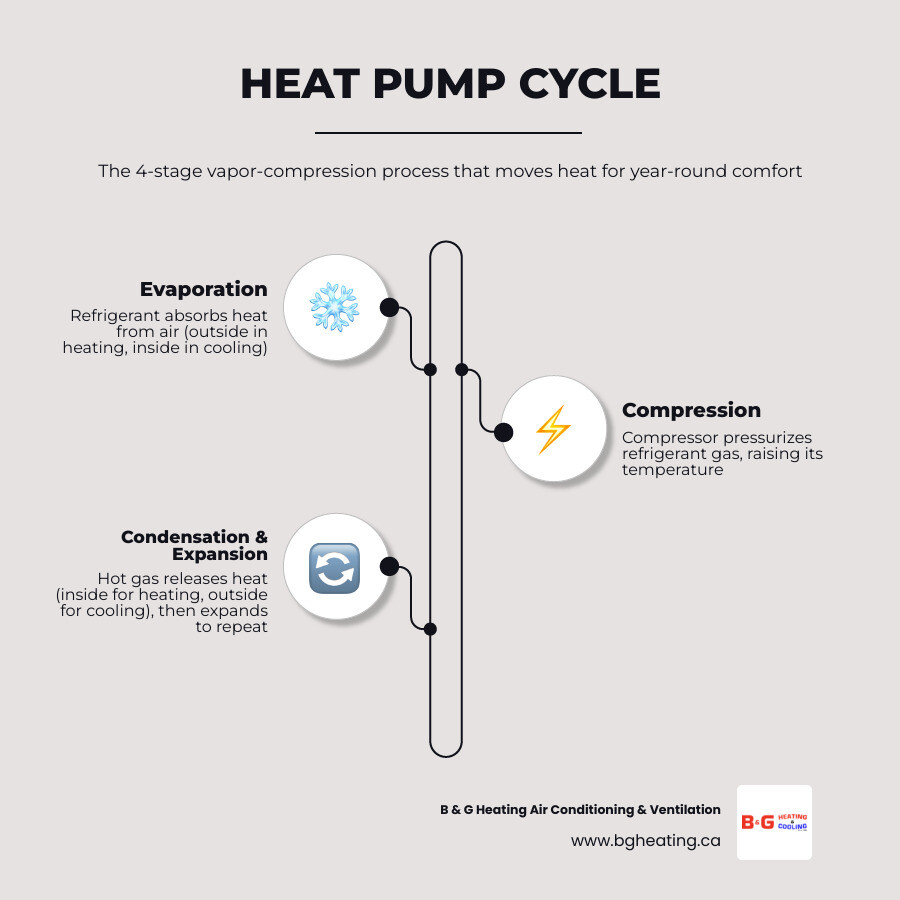
The system operates through a vapor-compression cycle involving four primary stages:
- Evaporation: The cold liquid refrigerant passes through a coil and absorbs heat from its surroundings (either indoor air or outdoor air). As it warms up, it evaporates into a low-pressure gas.
- Compression: This gas travels to the compressor. By squeezing the gas, the compressor dramatically increases its pressure and temperature. Think of a bicycle pump getting hot while you use it—that’s the same principle in action.
- Condensation: The hot, high-pressure gas moves to the second coil. Here, it releases its heat to the air being blown across the coil, causing the refrigerant to cool down and turn back into a liquid.
- Expansion: The liquid refrigerant passes through an expansion valve, which drops the pressure and temperature even further, readying it to start the cycle all over again.
By mastering this cycle, a heat pump can maintain precise comfort levels. To dive deeper into how these systems are rated for performance, you can Understand Heat Pump Efficiency Seer Rating Explained to see how they stack up against traditional units.

How Does a Heat Pump Work for Heating and Cooling in the Summer?
In the heat of a July afternoon in Burlington or Oakville, a heat pump acts exactly like a high-efficiency air conditioner. The goal is to remove thermal energy from inside your home and dump it outside.
The indoor coil acts as the evaporator. As warm indoor air is blown over these cold coils, the refrigerant inside absorbs the heat. This process doesn’t just lower the temperature; it also provides essential dehumidification. As the air cools, moisture condenses on the coils and is drained away, leaving your home feeling crisp and comfortable. The now-warmed refrigerant travels to the outdoor unit (the condenser), where the heat is released into the outside air.
How Does a Heat Pump Work for Heating and Cooling in the Winter?
This is where the “magic” happens. You might wonder, “How can there be heat outside when it’s freezing in Hamilton?” In reality, heat energy exists in all air down to absolute zero (-273°C). Modern heat pumps are designed to find and extract that energy even when it’s very cold.
In winter, the cycle reverses. The outdoor coil becomes the evaporator, and the indoor coil becomes the condenser. The refrigerant is sent outside at a temperature much colder than the outdoor air. Because heat naturally moves from “warmer” areas to “colder” areas, the refrigerant soaks up the thermal energy from the winter air.
Once compressed, this refrigerant becomes hot enough to provide cozy warmth for your living room. While older models used to struggle in Canadian winters, today’s cold-climate heat pumps can operate effectively down to -22°F (-30°C), making them a viable solution for our region.
Key Components and the Role of the Reversing Valve
The most critical component that allows a heat pump to perform its dual role is the reversing valve. This is a four-way valve that literally switches the direction of the refrigerant flow. When you flip your thermostat from “cool” to “heat,” this valve slides into a new position, swapping the roles of the indoor and outdoor coils.
Other essential parts include:
- The Compressor: The “heart” of the system located in the outdoor unit.
- The Air Handler: The indoor component that circulates the conditioned air through your ducts.
- The Defrost Control: In winter, ice can sometimes form on the outdoor coils. The system automatically enters a brief “defrost mode” to melt the ice and maintain efficiency.
If you notice your system isn’t switching modes correctly or is making strange noises during the transition, it might be one of the signs you need heat pump repair to ensure the reversing valve is functioning properly.
Understanding Efficiency: COP and Energy Savings
When we talk about heat pump efficiency, we often use the Coefficient of Performance (COP). This is a simple ratio of energy out versus energy in.
- A traditional electric furnace has a COP of 1.0 (100% efficiency). For every 1 unit of electricity used, you get 1 unit of heat.
- A modern heat pump typically has a COP of 3.0 to 4.0. This means for every 1 kWh of electricity consumed, it delivers 3 to 4 kWh of heat to your home.
| System Type | Efficiency (Approx.) | Energy Source |
|---|---|---|
| Standard Gas Furnace | 80% – 95% | Natural Gas |
| High-Efficiency Furnace | 96% – 98% | Natural Gas |
| Electric Baseboard | 100% | Electricity |
| Air-Source Heat Pump | 250% – 400% | Electricity |
By moving heat instead of creating it, heat pumps significantly reduce carbon emissions. In areas like Ontario with a relatively clean electricity grid, switching to a heat pump can reduce your home’s heating-related emissions by over 45% to 80% compared to a high-efficiency gas boiler.
Common Types of Heat Pump Systems for Ontario Homes
Every home in the Hamilton and Niagara regions is unique, which is why there are several types of systems available:
- Air-Source Heat Pumps (ASHP): The most common type. They extract heat from the outside air and are available in ducted versions (connecting to your existing vents) or ductless versions.
- Ductless Mini-Splits: Ideal for homes without ductwork or for specific additions like a sunroom or renovated garage. They allow for “zoned” comfort, where you can set different temperatures for different rooms.
- Ground-Source (Geothermal): These systems use a loop of pipes buried underground. Since the ground stays at a constant temperature (around 10°C) year-round, these are the most efficient systems available, though they require more space for installation.
- Hybrid (Dual-Fuel) Systems: We often install these in colder parts of Ontario. The system pairs a heat pump with a gas furnace. The heat pump handles the heating for most of the year, and the furnace only kicks in as a backup during the “deep freeze” nights when temperatures drop below the heat pump’s optimal range.
If you already have a system and need a tune-up or fix, our team provides expert Heat Pump Repair Hamilton to keep things running smoothly.
Essential Maintenance for Year-Round Performance
Because a heat pump works hard during both the summer and winter, regular maintenance is the key to a long lifespan (usually 15+ years).
To keep your system at peak performance, we recommend:
- Filter Changes: Check your filters every month and replace them at least every three months. Clogged filters restrict airflow and force the compressor to work harder.
- Keep the Outdoor Unit Clear: Ensure that leaves, snow, and debris aren’t blocking the outdoor coils. The system needs “room to breathe” to exchange heat effectively.
- Clean the Coils: Dirt on the coils acts as insulation—but the wrong kind! It prevents the refrigerant from absorbing or releasing heat efficiently.
- Professional Inspections: We suggest a professional tune-up twice a year—once before the cooling season and once before the heating season.
For residents in the Hannon area, our Heat Pumps Services Hannon On cover everything from deep coil cleaning to refrigerant level checks.
Frequently Asked Questions about Heat Pump Operation
Do heat pumps work in extreme cold?
Yes! While older technology struggled below freezing, modern cold-climate models use variable-speed inverter compressors to maintain high efficiency even at -20°C or lower. Many models are rated to provide 100% of their heating capacity down to 5°F.
Is a heat pump better than an air conditioner?
In many ways, yes. A heat pump provides the exact same cooling performance and efficiency as a high-end AC, but it has the added benefit of being a primary heating source in the winter. It’s an all-in-one solution that simplifies your HVAC setup.
Why does my heat pump run constantly in winter?
Unlike a furnace that blasts hot air and then shuts off, heat pumps are designed to run for longer periods at lower speeds. This is actually more energy-efficient and provides a more consistent, even temperature throughout the home, eliminating the “cold spots” often associated with traditional furnaces.
Conclusion
As we look toward May 2026 and beyond, the shift toward sustainable, efficient home comfort is clear. Understanding how does a heat pump work for heating and cooling is the first step in deciding if this technology is right for your family. By moving heat rather than burning fuel, you can enjoy a more comfortable home, lower energy bills, and a smaller carbon footprint.
At B & G Heating Air Conditioning & Ventilation, we’ve spent decades helping homeowners in Hamilton, Stoney Creek, Ancaster, and across the Niagara region find the perfect indoor comfort solutions. Whether you need a new installation, a quick repair, or just some expert advice, our family-owned team is here to help.
Ready to see how a heat pump can transform your home comfort? Schedule your professional heat pump consultation today and let our experts design a system tailored to your needs.