


Why Four-Season Canadian Climates Make AC Maintenance So Critical
Understanding how maintenance extends AC life in a four-season Canadian climate starts with one simple truth: your air conditioner faces more stress in Hamilton than almost anywhere else. Freezing winters, humid summers, heavy snowfall, and dramatic freeze-thaw cycles all take a toll on your system year after year. A well-maintained central AC can last 15 years or longer. A neglected one often fails before the 10-year mark. The difference comes down to what you do — and when you do it — across all four seasons.
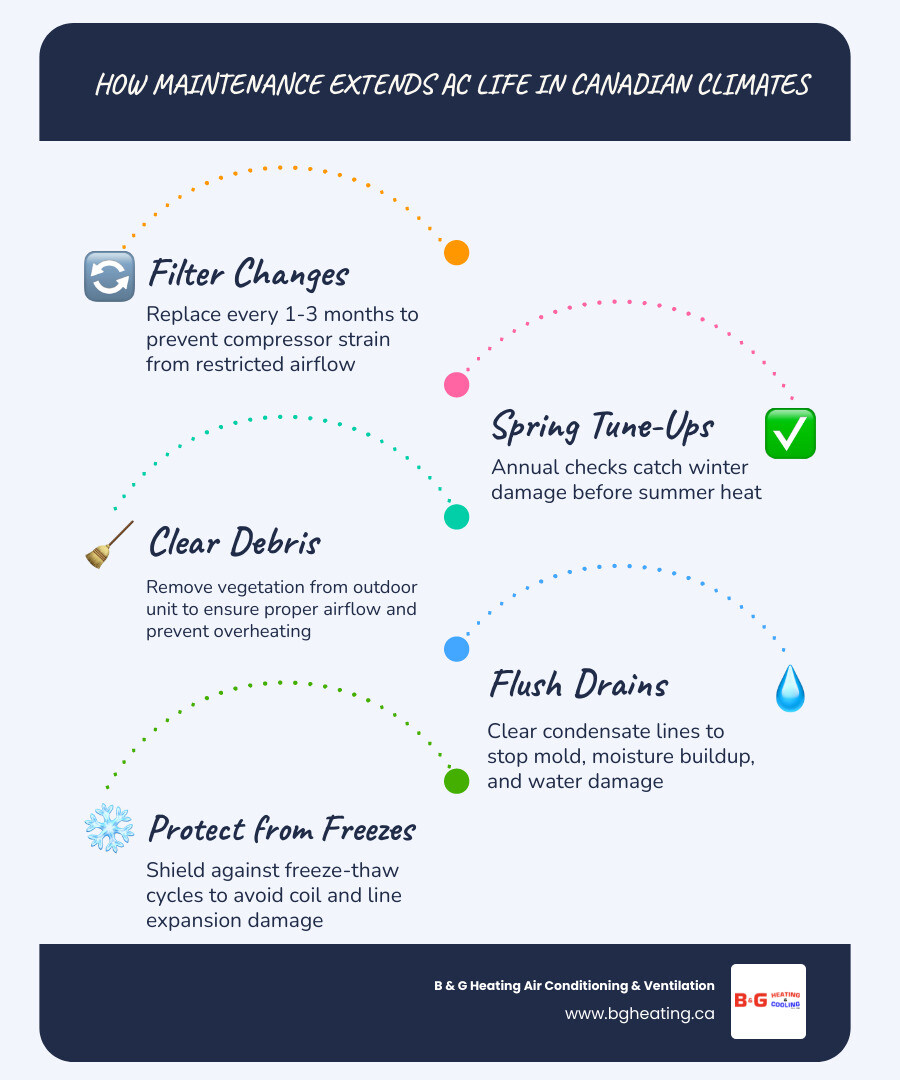
Here’s a quick summary of how maintenance extends AC life in Canada:
- Filter changes every 1-3 months prevent restricted airflow that strains the compressor
- Annual spring tune-ups catch damage caused by winter idleness before the first hot day hits
- Clearing debris and vegetation from the outdoor unit protects airflow and prevents overheating
- Flushing the condensate drain stops moisture buildup, mold, and water damage
- Professional refrigerant and electrical checks keep the system running at peak efficiency
- Protecting against freeze-thaw cycles prevents expansion damage to coils and refrigerant lines
- Consistent thermostat habits reduce wear from repeated startup cycles
Together, these steps can add 3-5 years to your AC’s service life, according to industry guidance from HRAI — and they significantly reduce the risk of a costly mid-summer breakdown.
Understanding how maintenance extends ac life in a four season canadian climate
In regions like Burlington, Oakville, and Hamilton, our HVAC systems are essentially “marathon runners” that take a six-month nap every winter. This cycle of heavy use followed by long periods of idleness is actually harder on the machinery than constant, moderate use. When a system sits idle, seals can dry out, pests can nest in the outdoor unit, and dust can settle deep into the sensitive components.
The data is clear: prolonging AC system lifespan is directly tied to how well you manage these environmental stressors. A central AC unit in Ontario typically has a service life of 12 to 15 years with reasonable care, but we often see well-maintained units pushing past the 20-year mark. Conversely, neglected systems often see their efficiency drop noticeably after just 10 years, even if they haven’t “broken” yet.
| System Type | Maintained Lifespan | Neglected Lifespan |
|---|---|---|
| Central Air Conditioner | 15 – 20 Years | 8 – 10 Years |
| Air-Source Heat Pump | 12 – 15 Years | 8 – 10 Years |
| Room/Window AC | 10 – 12 Years | 5 – 7 Years |
There are immense benefits of preventive AC maintenance. Beyond just adding years to the clock, regular service maintains the manufacturer’s warranty. Most major brands require documented annual professional maintenance to keep your coverage valid. In May 2026, as we look at modern high-efficiency units, protecting that warranty is more important than ever.
Seasonal timing: How maintenance extends ac life in a four season canadian climate
Timing is everything in Southern Ontario. You don’t want to wait until the first 30°C day in June to find out your capacitor died in January. The time for AC tune up is early spring—ideally late March or April. This allows us to inspect the unit after the “Big Freeze” and ensure no ice damage occurred to the delicate aluminum fins or refrigerant lines.
Scheduling an AC tune up in Hamilton, ON before the rush ensures your system achieves peak performance when the humidity hits. Our local climate’s erratic patterns—like a record cold May followed by a brutal July heatwave—demand a system that is resilient and ready to switch gears instantly.
Professional vs DIY: How maintenance extends ac life in a four season canadian climate
While homeowners can handle basic tasks, there is a significant importance of air conditioner servicing performed by a pro. A certified technician does things you simply can’t do safely at home, such as checking refrigerant levels. In Canada, handling refrigerant requires federal certification; if your levels are low, it indicates a leak that needs professional repair, not just a “top-up.”
Technical inspections like an AC maintenance tune up in Hannon, ON include testing electrical connections and measuring the “draw” of the motor. This can predict a part failure before it happens, saving you from an emergency mid-summer outage.
Essential Spring and Summer Preparation
As the snow melts, your AC needs a “wake-up call.” Following a spring air conditioner tune up checklist is the best way to ensure a smooth transition. The goal during this phase is airflow optimization. If your system can’t breathe, it has to work twice as hard, which generates excess heat and wears out the compressor prematurely.
Use these essential spring AC maintenance tips to get ahead of the heat. Start by doing a visual walk-around. Look for any wires that might have been chewed by wintering rodents or any signs of oil spots on the refrigerant lines, which could indicate a leak.
Cleaning and Clearing Debris
Your outdoor unit (the condenser) is essentially a giant heat exchanger. It needs to “dump” the heat from your home into the outside air. To prepare your air conditioner for summer, you must ensure the area around it is clear.
We recommend a 2-foot clearance on all sides. During your central HVAC maintenance, we often find that weeds, decorative tall grass, or even stored firewood have crowded the unit. This traps hot air around the condenser, forcing it to run longer cycles. You can gently rinse the condenser coils with a garden hose (never a pressure washer!) to remove the dust, pollen, and “cottonwood fuzz” that acts like a blanket, suffocating your system.
Filter Management and Airflow
One of the greatest benefits of regular AC maintenance is the protection of the indoor evaporator coil. This coil lives inside your furnace cabinet or air handler. If you don’t change your air filter, dust bypasses the filter and cakes onto this moist coil. This leads to “Dirty Sock Syndrome”—a musty smell—and eventually causes the coil to freeze into a block of ice.
To get your air conditioner ready for summer, check your filter monthly. If you have pets or live in a high-dust area like a new construction zone in Binbrook or Brampton, you might need to change it every 30 days. High MERV-rated pleated filters are great for air quality, but make sure your system is powerful enough to pull air through them; otherwise, you might be accidentally strangling your AC.
Protecting Your System During Harsh Winters
In Canada, “winterizing” is just as important as spring cleaning. Our complete guide on how to prepare your heating cooling system for winter emphasizes protection from physical damage. The biggest threat isn’t the cold itself—AC units are built for cold—it’s the falling ice from your roof and the freeze-thaw cycle.
When snow melts during a sunny January day and then freezes at night, it expands. If that water is inside your unit’s fins, it can cause “expansion damage,” bending the metal and even cracking the delicate copper tubing. While you should never wrap your unit airtight (which traps moisture and causes rust), a simple plywood cover or a breathable top-cover can prevent heavy ice chunks from smashing the fan blades.
Managing Humidity and Condensation
Air conditioning isn’t just about cooling; it’s about dehumidification. As your AC pulls moisture out of the air, that water has to go somewhere. This is where enhancing the lifespan of your AC involves a bit of plumbing knowledge.
The condensate drain line can become a breeding ground for algae and slime during a humid Hamilton summer. If this line clogs, water can back up into your furnace, damaging the circuit board or flooding your basement. A simple DIY tip is to flush the drain line with a cup of white vinegar once a year to keep the path clear. If you have a condensate pump, we’ll check that during our visit to ensure the float switch is working correctly.
Thermostat Habits and System Strain
Did you know that “playing DJ” with your thermostat can actually shorten your AC’s life? Every time an AC starts up, it uses a massive surge of electricity and puts the most stress on the compressor. To maximize efficiency with preventative HVAC maintenance tips, we recommend “setting it and forgetting it.”
A smart thermostat is a great investment for four-season climates. Instead of turning the AC off when you leave for work in Milton or Mississauga and coming home to a 30°C house, a smart thermostat can raise the temperature by 3-4 degrees. This prevents the system from having to run for five hours straight to “catch up,” which is much harder on the components than maintaining a steady, slightly higher temperature.
Recognizing Warning Signs and Efficiency Drops
You shouldn’t ignore the small signs. There are many benefits of preventive HVAC maintenance, and one of the biggest is catching “silent killers.” For example, a failing capacitor—a small part that helps the motor start—might cause your AC to hum or struggle to turn on. If you ignore that hum, the motor will eventually burn out, turning a simple repair into a major expense.
Watch for these warning signs:
- Strange Noises: Grinding, squealing, or loud banging.
- Weak Airflow: Even with a clean filter, this could mean a failing blower motor.
- Utility Spikes: If your bill jumps 20% compared to last July, your system is losing efficiency.
- Short Cycling: The unit turns on and off every few minutes.
Refrigerant and Compressor Health
The compressor is the “heart” of your AC. It’s also the most expensive part to replace. Compressor longevity is tied directly to refrigerant health. If your system has a small leak, the compressor has to work harder to move the remaining refrigerant, causing it to overheat.
Furthermore, we are currently in a transition period for refrigerants. R-22 has been phased out, and R-410A is beginning its own transition. Proper maintenance ensures that your existing system stays sealed and efficient, avoiding the high costs associated with obsolete refrigerants.
When to Repair vs Replace
Eventually, every machine reaches the end of its road. We often use the “5,000 Rule” to help our customers in areas like Grimsby or Caledonia decide. Multiply the age of the unit by the repair cost. If the number is higher than $5,000, it’s usually time to look at a replacement.
| Age of Unit | Repair Cost | Decision |
|---|---|---|
| 5 Years | $400 | Repair ($2,000 total) |
| 12 Years | $600 | Consider Replacement ($7,200 total) |
| 15 Years | $350 | Replace ($5,250 total) |
Modern units are significantly more efficient. Moving from an old SEER 10 unit to a new SEER2 16 or 18 model can reduce your summer cooling costs by 30-40%, which helps the new unit pay for itself over time.
Frequently Asked Questions about AC Longevity
How long does a central AC typically last in Ontario?
In our local climate, you can expect 12 to 15 years with average maintenance. However, with consistent professional care and by following the seasonal tips mentioned above, many homeowners in the Hamilton area see their units last 20 years or more.
Does snow accumulation damage my outdoor AC unit?
Snow itself isn’t the enemy, as the units are designed for outdoor use. The danger comes from falling ice from your roof or the expansion of water during freeze-thaw cycles. Keeping the top of the unit clear of heavy ice is the best way to prevent winter damage.
How often should I change my air filter during a Canadian summer?
During the peak cooling months (June, July, and August), we recommend checking it every month. If you see a grey layer of dust, change it. At a minimum, it should be replaced every three months to ensure your AC doesn’t struggle for air.
Conclusion
At B & G Heating Air Conditioning & Ventilation, we believe that a little bit of proactive care goes a long way. As a family-owned business serving Hamilton, Stoney Creek, Burlington, and the surrounding regions, we’ve seen how how maintenance extends AC life in a four-season Canadian climate. Our goal is to keep your family comfortable while ensuring you get every possible year of service out of your cooling investment.
Don’t wait for the next heatwave to test your system’s limits. From cleaning coils to checking refrigerant levels, we provide the expert touch your HVAC system needs to survive the harsh Ontario seasons.
Book your professional air conditioning service in Hannon today and enjoy the peace of mind that comes with a reliable, well-maintained home.