


How a Mini Split Is Installed Step by Step: What Every Homeowner Should Know
Understanding how is a mini split installed step by step can save you from costly mistakes and help you make smarter decisions about your home’s comfort system. Whether you’re considering a ductless system for a room addition, a garage, or a whole-home upgrade, the installation process involves more than just mounting a unit on the wall.
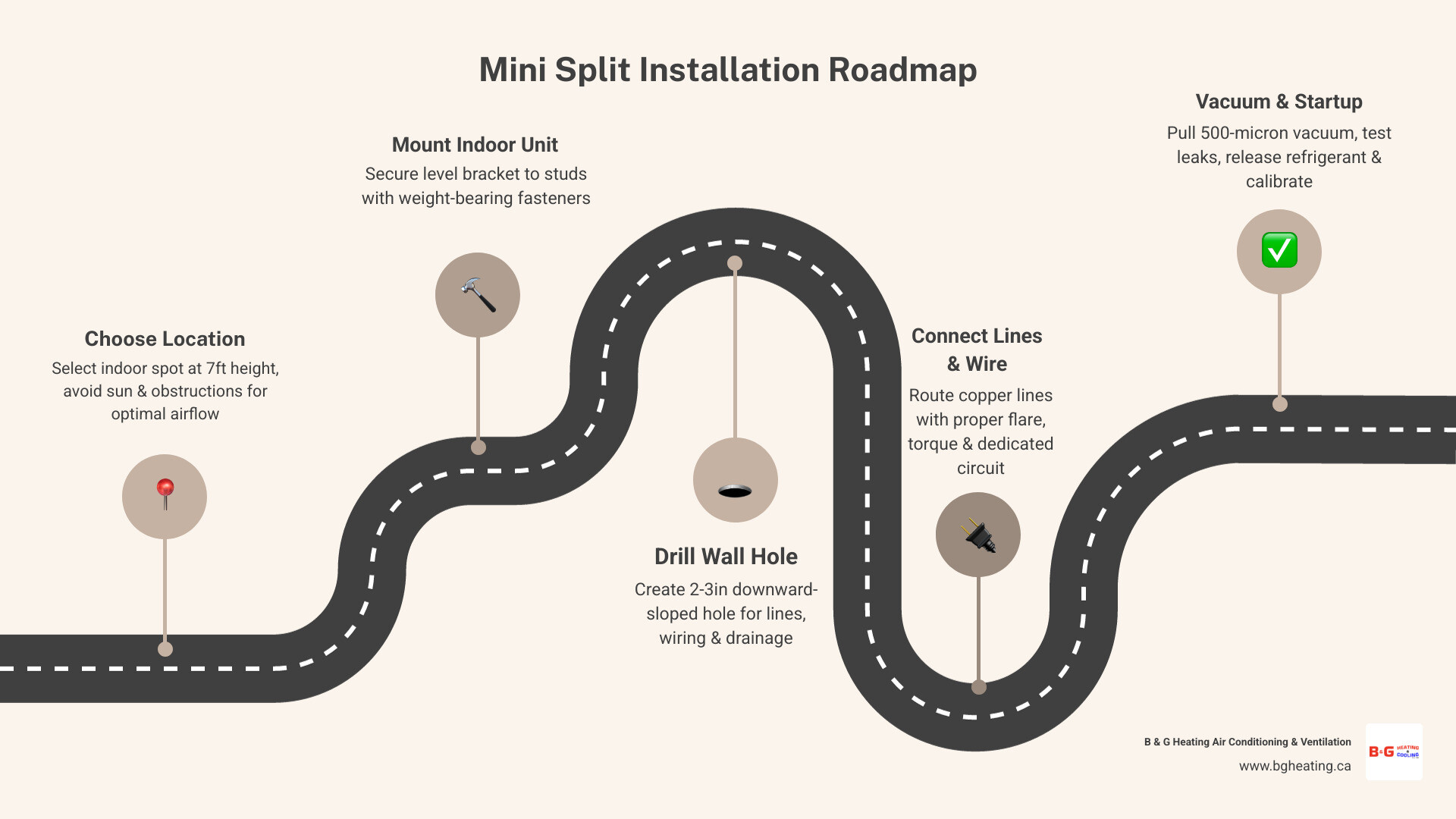
Here’s a quick overview of the eight core steps:
- Choose the right location for your indoor air handler
- Mount the indoor unit on a secure, level wall bracket
- Drill the wall hole for refrigerant lines, wiring, and drainage
- Position the outdoor condenser on a level, stable surface
- Route and connect the refrigerant lines using proper flaring and torque specs
- Wire the electrical connections on a dedicated circuit with a disconnect box
- Vacuum and pressure-test the lines to remove moisture and check for leaks
- Start up the system and verify cooling, heating, and drainage performance
Done right, a mini split delivers efficient, zoned comfort without the energy losses of traditional ductwork. Done wrong, it can lose up to 30% of its efficiency before you even flip it on for the first time. Most installation failures aren’t equipment problems — they’re the result of shortcuts taken during setup.
This guide walks through each step clearly, so you know exactly what’s involved and what to watch out for.
Essential Tools and Preparation for Your Installation
Before we dive into the question of how is a mini split installed step by step, we need to talk about the toolbox. You can’t build a skyscraper with a plastic hammer, and you certainly can’t install a high-efficiency HVAC system with just a screwdriver and some duct tape (though we appreciate the optimism!).
Preparation is the silent hero of a successful installation. In May 2026, modern systems are more sensitive than ever to precision. To ensure your system operates at peak performance, the importance of proper AC installation cannot be overstated. Using the wrong tools is the fastest way to void a warranty or cause a refrigerant leak that will have you sweating through the Hamilton summer.
| Standard Household Tools | Specialized HVAC Equipment |
|---|---|
| Tape Measure | Vacuum Pump (capable of 500 microns) |
| Level | Manifold Gauge Set |
| Stud Finder | Eccentric Flaring Tool |
| Drill and Bits | Torque Wrench (with crowfoot adapters) |
| Screwdrivers | Micron Gauge |
| Adjustable Wrench | Hole Saw (2.5 to 3-inch diameter) |
| Wire Strippers | Nitrogen Tank and Regulator |
Beyond the physical tools, preparation involves checking your home’s electrical capacity. Most mini splits require a dedicated circuit. If you’re in Burlington or Oakville and planning an installation, ensure you have the space in your panel before you start drilling holes in your siding!
How is a mini split installed step by step: The Indoor Setup
The indoor unit, or air handler, is the face of your comfort. It’s what you’ll be looking at every day, so its placement and mounting need to be perfect. When we maximize comfort ductless mini split systems, we focus on two things: airflow and aesthetics.

Step 1: Choosing the Right Location for Indoor Units
Location isn’t just about where the unit looks best; it’s about physics. You want the air handler high on a wall—typically 7 to 8 feet above the floor—to allow the cool air to sink naturally and circulate.
Avoid placing the unit in direct sunlight or near other heat sources, as this can trick the thermostat into running the system longer than necessary. You also need at least 6 inches of open space above and on the sides of the unit for proper intake airflow. If you’re looking for ductless mini split HVAC services in Hannon, ON, our team always looks for an exterior wall first to make the line set routing as short and efficient as possible.
Step 2: Mounting the Indoor Air Handler
Once the location is set, it’s time to secure the mounting plate. This is a critical part of how is a mini split installed step by step. If the plate isn’t level, the condensate water (the moisture the AC pulls from the air) won’t drain properly. Instead of going outside, it will end up running down your wallpaper.
Use a stud finder to locate the wall framing. You want the mounting screws to bite into solid wood, not just drywall. Even a small single-zone unit has some weight to it, and vibration over time can loosen poorly secured fasteners. Double-check with your level—even a 1/8-inch tilt can cause a “waterfall” in your living room.
Step 3: Drilling the Wall Hole for Line Sets
Now for the part that makes most homeowners nervous: drilling a 3-inch hole straight through the side of the house. This hole will house the refrigerant lines, the communication cable, and the drain tube.
The key here is the angle. You must drill at a slight downward slope (about a 1/4 inch per foot) toward the outside. This ensures that gravity does the work of pulling the condensate water away from the indoor unit. We typically use a hole saw and start from the inside, switching to the outside for the final breakthrough to prevent the siding from splintering or cracking.
Connecting the Outdoor Condenser and Refrigerant Lines
With the indoor unit hanging and the hole drilled, we move outside. The outdoor condenser is the “engine” of the system, and it needs a stable home.
Step 4: Positioning the Outdoor Unit
The outdoor unit needs to breathe. We recommend placing it on a level concrete pad or a high-quality composite riser. If you live in an area prone to snow, like Grimsby or Binbrook, we often use wall brackets to mount the unit a few feet off the ground to keep it clear of snow drifts.
Check out our Grimsby, Binbrook, and Burlington AC installation tips for more on local weather considerations. Ensure there is at least 12 inches of clearance behind the unit and 20 inches in front for proper heat exchange.
Step 5: Routing and Connecting Refrigerant Lines
This is the most technical part of the process. The refrigerant lines are copper tubes that carry the “cool” between the units.
- Bending: Use your hands carefully or a tubing bender to avoid kinking the copper. A kinked line acts like a clogged artery, forcing the compressor to work harder and eventually fail.
- Flaring: Most mini splits use flare fittings. You’ll use a flaring tool to create a funnel shape at the end of the copper tube. It must be smooth and free of “burrs” (tiny metal shards).
- Torquing: You cannot just “tighten it until it feels right.” You must use a torque wrench to meet the manufacturer’s exact specifications (often measured in foot-pounds). Over-tightening can crack the flare nut, while under-tightening leads to slow leaks. This is one of the key steps in AC system installation that separates the pros from the amateurs.
Step 6: Managing Electrical Wiring and Safety
Mini splits are powerful machines. They require a dedicated electrical circuit—meaning they shouldn’t share a breaker with your toaster or your TV.
You will need to install an outdoor disconnect box near the condenser. This is a safety switch that allows a technician to cut power locally while working on the unit. From the disconnect, power goes to the outdoor unit, and a four-strand communication cable runs back through that wall hole to power and control the indoor air handler. To ensure a smooth AC installation process, always follow local Ontario electrical codes to the letter.
Finalizing the System with Testing and Calibration
The units are mounted, the lines are connected, and the wires are tight. But don’t turn it on yet! If you release the refrigerant now, any air or moisture trapped in the lines will mix with the oil and create acid, which will eat your compressor from the inside out.
Step 7: Vacuuming and Leak Detection
First, we perform a nitrogen pressure test. We pump dry nitrogen into the lines to about 300-500 PSI and let it sit. If the pressure drops, we have a leak.
Once we know the system is airtight, we use a vacuum pump. The goal is to reach a “deep vacuum” of 500 microns or lower. This process boils off any microscopic moisture inside the lines. We then perform a “standing vacuum test”—if the micron level stays low after turning the pump off, the system is perfectly sealed and dry. This level of precision is similar to what we use in a smooth furnace installation process to ensure long-term reliability.
Step 8: Startup and Performance Calibration
Now for the big reveal. We slowly open the service valves on the outdoor unit to release the pre-charged refrigerant into the lines.
After powering the system on, we don’t just walk away. We use digital thermometers to check the “Delta T”—the temperature difference between the air going into the unit and the air coming out. We also run a condensate test by pouring a little water into the indoor unit’s drain pan to make sure it flows freely outside. For those in the Hamilton area, our AC installation services in Hannon, ON include a full calibration to ensure the inverter is ramping up and down correctly for maximum efficiency.
DIY vs. Professional Installation: What Homeowners Should Know
It’s the age-old question: “Can I do this myself?” While there are “DIY kits” on the market with pre-charged lines, there are several things to consider before you pick up the drill.
- EPA 608 Certification: By law, anyone handling refrigerant must be EPA-certified. While DIY kits try to bypass this with special valves, traditional systems require a pro to handle the gas safely.
- Warranty Protection: Most major manufacturers will only honor the parts warranty if the system was installed by a licensed HVAC professional. If your DIY board fries six months from now, you might be on the hook for the full cost.
- Efficiency Loss: Statistics show that improper installation can lead to a 30% loss in efficiency. That beautiful 25 SEER2 rating you paid for? It could drop to the level of a window unit if the lines aren’t vacuumed or the charge is slightly off.
- Safety: We’re dealing with high-voltage electricity and high-pressure refrigerants. One wrong wire can result in a fried control board (or worse, a fire), and a refrigerant spray can cause instant frostbite on the skin.
For most homeowners in the Hamilton and Burlington areas, the peace of mind that comes with professional ductless mini split HVAC services is worth the investment. It ensures the system lasts its full 15-20 year lifespan.
Frequently Asked Questions about Mini Split Installation
How long does a typical mini split installation take?
For a standard single-zone system, a professional team can usually have you up and running in 4 to 8 hours. If you’re doing a multi-zone system (one outdoor unit with three or four indoor heads), expect it to take 1 to 2 days. The complexity of the line set routing—like running lines through an attic or crawlspace—is the biggest factor in the timeline.
Does DIY installation void the manufacturer warranty?
In many cases, yes. Most brands require a signature and license number from a certified technician to register the warranty. Without that, you may only receive a very limited warranty or none at all. Professional installation is essentially an insurance policy for your equipment.
What maintenance is needed after the installation is complete?
Mini splits are low-maintenance, but they aren’t “no-maintenance.”
- Monthly: Pop the front cover and rinse the plastic air filters. This is the #1 thing you can do to keep the system efficient.
- Seasonally: Check the outdoor unit to make sure leaves, grass clippings, or snow aren’t blocking the coils.
- Annually: Schedule a professional tune-up. A technician will deep-clean the indoor “evaporator” coil and check the refrigerant levels to ensure there are no tiny leaks.
Conclusion
Installing a mini split is one of the best ways to upgrade your home’s comfort and value. By following the steps of how is a mini split installed step by step, you ensure that your system runs quietly, efficiently, and for a very long time. From the initial mounting of the bracket to the final micron test, every detail matters.
At B & G Heating Air Conditioning & Ventilation, we’ve been the trusted choice for families across Hamilton, Stoney Creek, and the surrounding areas for years. As a family-owned business, we treat your home like our own, ensuring every flare nut is torqued and every drain is sloped to perfection.
If you’re ready to ditch the window units and experience true zoned comfort, we’re here to help. Reach out to us for professional ductless mini split HVAC services and let’s get your home ready for whatever the Ontario weather throws our way!