


How Mineral Buildup Destroys a Water Heater Faster in Hard Water Areas
Understanding how mineral buildup destroys a water heater faster in hard water areas starts with a simple fact: when hard water is heated, the dissolved calcium and magnesium it carries don’t stay dissolved. They crystallize and settle — coating heating elements, lining tank walls, and slowly strangling your water heater’s ability to do its job.
Quick Answer: How Mineral Buildup Destroys Your Water Heater
- Scale insulates heat: A layer of mineral scale as thin as 1/4 inch on a heating element can reduce efficiency by up to 40%, forcing the heater to run longer and hotter
- Overheating damages metal: When scale traps heat, the metal components underneath overheat and weaken over time
- Sediment fills the tank: Mineral deposits settle at the tank bottom, reducing hot water capacity and creating damaging steam pockets
- Anode rods deplete faster: Hard water accelerates the corrosion of the sacrificial anode rod, leaving the tank itself vulnerable
- Tankless units clog: In tankless systems, scale narrows the heat exchanger passageways, triggering shutdowns and flow failures
- Lifespan drops significantly: Water heaters in hard water areas can fail in as few as 6 years, versus the expected 8–12 year lifespan
Over 85% of homes across North America deal with hard water to some degree. If you live in Hamilton or the surrounding areas of Southern Ontario, your water supply picks up calcium and magnesium as it moves through the region’s geology — and your water heater bears the brunt of it. Most homeowners don’t notice anything is wrong until performance has already dropped or the unit fails entirely. By that point, the damage has been building for years.
This guide breaks down exactly what’s happening inside your tank, which components are most at risk, and what you can do to protect your investment before it’s too late.
Understanding Hard Water and the Science of Scale
To understand why our water heaters struggle, we first have to look at what is coming out of our taps. “Hard water” isn’t a medical term or a marketing buzzword; it is a technical measurement of dissolved minerals—specifically calcium and magnesium—found in your water supply.
In areas like Hamilton, Ancaster, and Burlington, water often travels through limestone and chalk deposits. As it does, it dissolves these minerals, carrying them right into your home’s plumbing. We measure this “hardness” in two primary ways: Grains per Gallon (GPG) or Milligrams per Litre (mg/L), also known as Parts per Million (PPM).
| Water Hardness Category | Grains per Gallon (GPG) | mg/L or PPM |
|---|---|---|
| Soft | 0 – 3.5 | 0 – 60 |
| Moderately Hard | 3.5 – 7.0 | 60 – 120 |
| Hard | 7.0 – 10.5 | 120 – 180 |
| Very Hard | 10.5+ | 180+ |
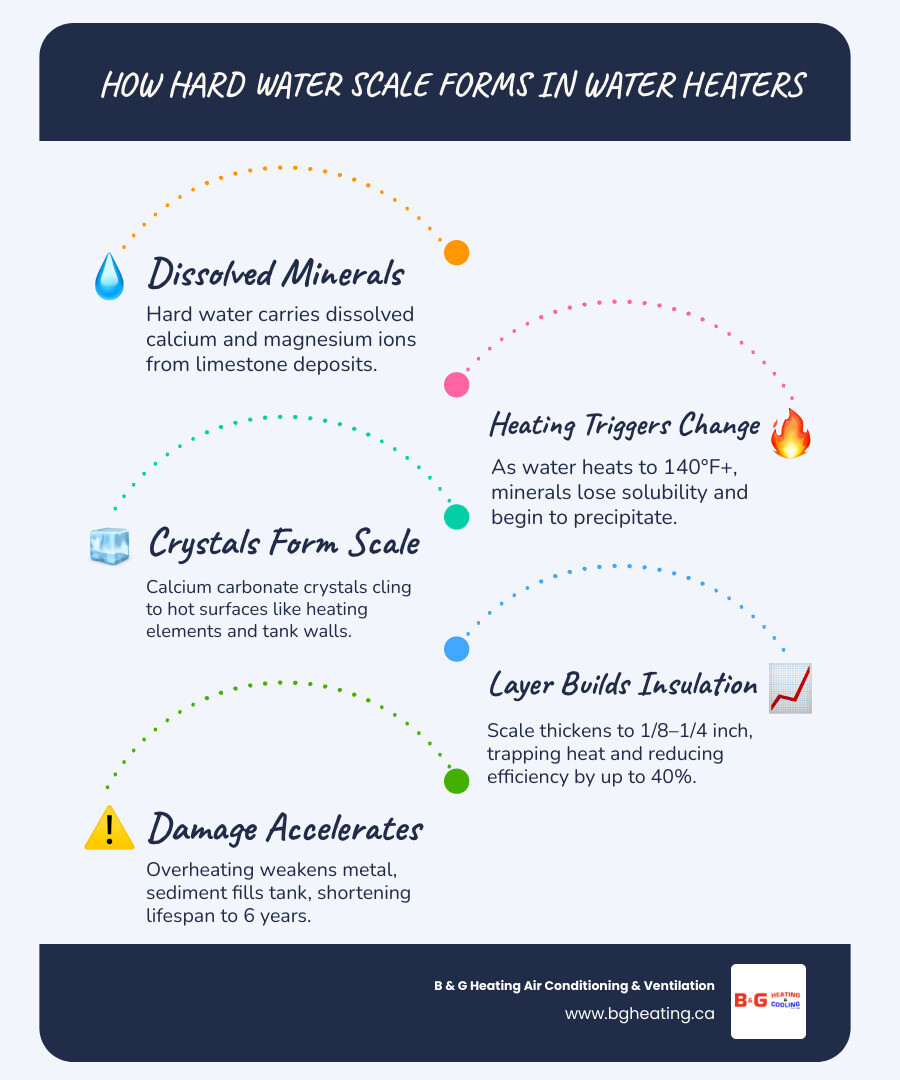
The science behind the destruction is a phenomenon called inverse solubility. Most substances (like sugar or salt) dissolve better as water gets hotter. Calcium carbonate does the exact opposite. When water is heated to typical water heater temperatures (120°F to 140°F), the minerals “precipitate” or fall out of the liquid state and turn into solid crystals. These crystals then latch onto the hottest surfaces they can find—usually your heating elements or the bottom of the tank.
When you are Choosing The Right Water Heater, understanding your local water hardness is the first step in ensuring your new unit doesn’t become a “mineral magnet” within its first year of service.
How mineral buildup destroys a water heater faster in hard water areas
The primary way how mineral buildup destroys a water heater faster in hard water areas is through a process of “thermal insulation.” Think of scale as a thick, stony blanket wrapped around the very components meant to heat your water.
The Efficiency Drain
When scale coats a heating element (in electric models) or the bottom of the tank (in gas models), the heat has to fight through that rock-hard layer before it can reach the water. Research shows that just 1/4 inch of scale buildup can reduce your heater’s efficiency by up to 40%. This means for every dollar you spend on water heating, 40 cents is being wasted just trying to penetrate the mineral crust.
The Overheating Cycle
Because the heat is trapped behind the scale, the metal underneath—whether it’s the copper element or the steel tank floor—reaches much higher temperatures than it was designed to handle. This excessive heat causes the metal to expand and contract violently, leading to fatigue, cracks, and eventually, total tank failure. This is why we often see Water Heater Repair Issues Solved by simply addressing the sediment before the tank itself ruptures.
Displacement and Noise
As minerals settle, they occupy physical space. In a 50-gallon tank, several inches of sediment can actually reduce your hot water capacity by several gallons. You might notice your showers getting shorter over time. Furthermore, as water gets trapped beneath this layer of “rock,” it boils and turns into steam, creating the “kettling” or popping sounds that are classic Signs You Need Water Heater Repair.
The Impact of Scale on Different Water Heater Systems
Not every water heater reacts to hard water in the same way. While the underlying chemistry remains the same, the point of failure changes depending on the technology you use.
For those considering a Professional Water Heater Replacement, it’s vital to know that modern high-efficiency units, including heat pump water heaters, are just as susceptible—if not more so—to mineral damage. Heat pump models use a different heating method but still rely on internal coils that can become encased in scale, leading to a massive drop in their energy-saving potential. Understanding What To Expect Water Heater Replacement in a hard water area means planning for protection from day one.
How mineral buildup destroys a water heater faster in hard water areas: Tank vs. Tankless
Tankless water heaters are often marketed as “low maintenance,” but in Southern Ontario’s hard water areas, the opposite can be true. Because tankless units use high-intensity heat exchangers with very narrow passageways, they are extremely sensitive to scale.
- Narrow Passageways: Even 1/8 inch of scale can significantly restrict water flow.
- Flow Sensors: Minerals can “gum up” the sensors that tell the unit to turn on, leading to inconsistent temperatures.
- Heat Exchanger Failure: If the heat exchanger becomes clogged, the unit can overheat and shut down entirely to prevent a fire, leaving you with no hot water at all.
This often leads to Troubleshooting Low Hot Water Pressure issues where the culprit isn’t the pipes, but the “choked” heat exchanger inside the unit.
Why mineral buildup destroys a water heater faster in hard water areas: The Role of the Anode Rod
Every tank-style water heater has a “sacrificial” anode rod. Its job is to be more “attractive” to corrosion than the steel tank itself. It literally sacrifices itself so the tank doesn’t rust.
In hard water areas, the chemical reactions between the minerals and the rod are accelerated. The rod dissolves much faster—sometimes in as little as two years. Once that rod is gone, the minerals and the water’s natural corrosivity turn their attention to the steel tank. This leads to pinhole leaks and the inevitable need for Water Heater Tune Up Maintenance Hannon On to check and replace these rods before the tank is compromised.
Proven Strategies to Protect Your Investment
Knowing how mineral buildup destroys a water heater faster in hard water areas is only half the battle. The other half is prevention. We recommend a multi-tiered approach for our neighbors in Hamilton and Stoney Creek.
- Water Softeners (Ion Exchange): These are the gold standard. They replace calcium and magnesium ions with sodium ions. Soft water prevents scale from ever forming, which can double the life of your heater.
- Salt-Free Conditioners (TAC): Template Assisted Crystallization (TAC) doesn’t remove the minerals but changes their structure so they stay suspended in the water rather than sticking to your tank. This is a great low-maintenance option for many homes.
- Annual Flushing: Even with a softener, we recommend a “flush and fill” at least once a year. This involves draining the tank to wash out any loose sediment before it has a chance to harden into a permanent crust.
- Lowering the Temperature: Setting your thermostat to 120°F (rather than 140°F) significantly slows down the rate of mineral precipitation.
When Professionals Handle Water Heater Installation, we can assess your local water quality and recommend the right filtration or softening system to pair with your unit. Utilizing comprehensive Water Heater Services Hannon On ensures that your system is monitored by experts who know exactly what “hard water havoc” looks like.
Frequently Asked Questions about Hard Water Damage
How much shorter is the lifespan of a water heater in hard water areas?
In a “soft water” environment, a standard tank water heater can easily last 10 to 12 years. However, in “very hard” water areas, that lifespan can be slashed by nearly 50%. It is not uncommon to see units fail in as few as 6 years if they haven’t been maintained. If your unit is approaching the 6-to-8-year mark in a hard water zone, it may be Time For Water Heater Replacement before an emergency leak occurs.
Does regular flushing prevent all mineral damage?
Flushing is incredibly effective at removing “loose” sediment—the sandy stuff at the bottom. However, it cannot easily remove “scale,” which is the hard, rock-like substance that has already fused to the heating elements or tank walls. Think of flushing like brushing your teeth; it removes the daily plaque, but it won’t remove the hardened tartar that has already set in. This is why Water Heater Repair Hannon On sometimes requires professional descaling chemicals to restore a neglected unit.
Will hard water buildup void my manufacturer warranty?
This is a detail many homeowners miss. Many manufacturers of high-end water heaters—especially tankless models—explicitly state in their warranty that the unit must be protected from hard water. If a technician finds that a heat exchanger failed due to scale buildup and you don’t have a softener or a record of regular descaling, the manufacturer may deny your claim. Proper Water Heater Installation Hannon On always includes a discussion about these warranty requirements to keep your investment protected.
Conclusion
The reality of living in Southern Ontario means we have to be proactive about our water quality. Whether you are in Hamilton, Binbrook, or Grimsby, the “silent nemesis” of mineral buildup is likely at work inside your water heater right now. By understanding how mineral buildup destroys a water heater faster in hard water areas, you can take the steps necessary to extend the life of your appliance, save money on your monthly energy bills, and ensure your family always has a reliable supply of hot water.
At B & G Heating Air Conditioning & Ventilation, we’ve seen the damage that untreated hard water can do. We are a family-owned company dedicated to providing the Hamilton area with honest, high-quality workmanship. From Water Heater Replacement Hannon On to a simple maintenance check, we are here to help you Upgrade Your Aging Water Heater System and keep it running efficiently for years to come.
Don’t wait for the popping noises or the cold showers to start. Contact our experts for professional water heater services and let us help you protect your home from the effects of hard water.