


The Real Difference Between Tankless and Tank Water Heaters for Ontario Homeowners
Making a tankless vs tank water heater comparison for Ontario homeowners comes down to a few key factors: upfront cost, long-term savings, hot water demand, and how your home handles Hamilton’s cold winters. Here’s a quick breakdown to help you decide:
| Factor | Tank Water Heater | Tankless Water Heater |
|---|---|---|
| Upfront cost | Lower | Higher |
| Energy efficiency | 0.64–0.70 UEF | 0.87–0.96 UEF |
| Hot water supply | Limited by tank size | Continuous on demand |
| Lifespan in Ontario | 8–12 years | 20+ years |
| Hard water maintenance | Annual flushing | Annual descaling required |
| Best for | Tight budgets, high simultaneous demand | Long-term owners, moderate daily use |
| Winter performance | Reliable, slower recovery | Excellent if properly sized |
| Installation complexity | Simpler | Gas line and venting upgrades often needed |
Your water heater quietly accounts for roughly 20% of your home’s total energy use. Most Ontario homeowners don’t think about it until they’re standing in a cold shower — but making the right choice now saves money and stress for years ahead.
In Hamilton and the broader GTA, cold winter groundwater temperatures (as low as 3–5°C), moderately hard water, and older housing stock all shape which system actually performs best in your home. There’s no single right answer. The best choice depends on your household size, how long you plan to stay in the home, your existing gas line, and how much upfront cost you’re comfortable with.
This guide walks you through every factor that matters for Ontario homeowners in 2026 — from energy efficiency and installation requirements to maintenance, rebates, and real break-even numbers.
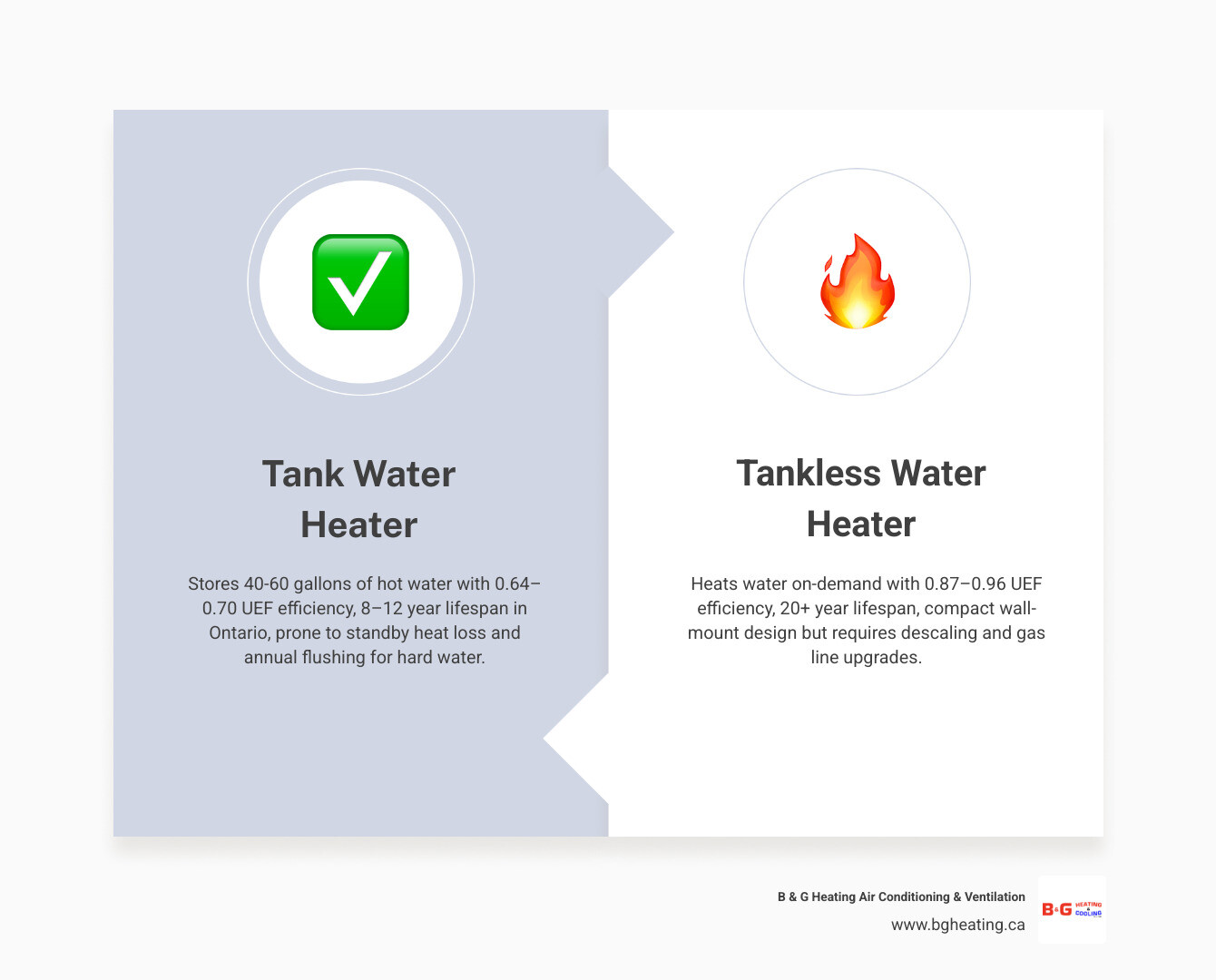
Key Differences in a Tankless vs Tank Water Heater Comparison for Ontario Homeowners

When we look at a tankless vs tank water heater comparison for Ontario homeowners, the most obvious difference is the physical footprint. A traditional tank is a large, cylindrical beast that holds between 40 and 60 gallons of water, taking up significant floor space in your basement or utility room. In contrast, a tankless unit is roughly the size of a carry-on suitcase and mounts directly to the wall.
The mechanical difference is even more significant. Traditional tanks operate on the principle of “standby heating.” They keep a large volume of water hot 24/7, regardless of whether you are using it. This leads to standby heat loss—energy that escapes through the tank walls even when you’re asleep or at work. Tankless systems, however, provide on-demand heating. When you turn on a tap, a high-powered burner (usually gas) flashes the water to the desired temperature instantly.
Choosing The Right Water Heater requires looking at the Uniform Energy Factor (UEF). In 2026, modern power-vent tanks typically reach a UEF of 0.64 to 0.70. Condensing tankless models are significantly more efficient, achieving 0.87 to 0.96 UEF. This means nearly 96% of the energy consumed goes directly into heating your water, compared to roughly 65-70% for a tank.
Is a tankless vs tank water heater comparison for Ontario homeowners different for large families?
For a large family in a city like Burlington or Oakville, the decision often hinges on simultaneous demand. A tank water heater has a finite supply. If three people shower back-to-back, the fourth person is likely facing a “chilly surprise.” However, tanks can often handle multiple fixtures at the exact same moment (like a shower and a dishwasher) more easily because the hot water is already sitting there, ready to go.
Tankless units provide an endless supply of hot water, meaning you can shower for hours without it running cold. The limitation is the flow rate, measured in Gallons Per Minute (GPM). In Ontario, where winter groundwater is very cold, a tankless unit has to work harder to heat that water. If your family tries to run two showers, the dishwasher, and the laundry all at once, you might notice a drop in pressure or temperature. Troubleshooting Low Hot Water Pressure often reveals that the unit was simply undersized for the household’s peak demand.
Which option is better for a tankless vs tank water heater comparison for Ontario homeowners planning to sell?
If you are planning to sell your home in the Hamilton area within the next two to three years, the ROI on a tankless system might not fully realize. While tankless units are highly attractive to modern buyers who value energy efficiency and space-saving designs, the higher upfront installation cost may not be fully recouped in a quick sale.
However, if you plan to stay in your home for 10 years or more, tankless is often the superior financial move. It lasts twice as long as a tank and saves on monthly gas bills. For those with an old, leaking unit, choosing to Upgrade Your Aging Water Heater System to a high-efficiency tankless model can significantly boost your home’s “mechanical profile” for future buyers, showing that the home has been meticulously maintained with modern technology.
Performance and Reliability During Extreme Ontario Winters
Ontario winters present a unique challenge for water heaters. During the peak of January, groundwater temperatures in Hamilton and the GTA can drop to between 3°C and 5°C. To reach a comfortable shower temperature of 55°C, a tankless unit must provide a massive “temperature rise” of over 50 degrees.
This is where professional sizing becomes critical. A unit that works perfectly in the summer might struggle when the lake water entering your home is near freezing. We ensure that the units we install are rated for these specific Ontario conditions. Gas tankless models are generally preferred over electric in our climate because they can generate the necessary heat much faster.
Reliability is also a concern. Many homeowners ask about freezing. Modern tankless units come equipped with internal freeze protection heaters to prevent the heat exchanger from cracking during a cold snap. Furthermore, our Water Heater Services Hannon On include ensuring that venting is installed correctly to prevent ice buildup, which can lead to system shutdowns. If a system does fail during a blizzard, timely Water Heater Repair Hannon On is essential to prevent frozen pipes elsewhere in the home.
Maintenance Requirements for Hard Water in Hamilton and the GTA
Water hardness is a major factor in our region. Toronto’s water hardness typically sits around 120–140 mg/L, while parts of Hamilton and Guelph can be even higher. This “hard” water contains minerals like calcium and magnesium that solidify when heated, creating scale.
In a traditional tank, this scale settles at the bottom, acting as an insulator between the burner and the water, which forces the heater to work harder and eventually causes the tank to fail. This is why we recommend Water Heater Tune Up Maintenance Hannon On to flush out sediment annually.
For tankless units, maintenance is even more vital. Because the water passages in the heat exchanger are so small, scale can quickly restrict flow and reduce efficiency. Most manufacturers require annual descaling—flushing the unit with a vinegar solution—to maintain the warranty. If you notice a “service” code on your unit or a drop in water temperature, these are clear Signs You Need Water Heater Repair. Neglecting this can shorten a 20-year lifespan down to less than 10.
Professional Installation Standards and TSSA Regulations
In Ontario, water heater installation is strictly regulated by the Technical Standards and Safety Authority (TSSA). Under the TSSA B149.1 Natural Gas and Propane Installation Code, it is illegal for an unlicensed homeowner to install a gas water heater.
Professional Water Heater Installation is particularly complex for tankless systems. Because they flash-heat water, they require a much higher BTU input than a tank—often 199,000 BTUs compared to a tank’s 40,000 BTUs. This frequently means your existing 1/2-inch gas line must be upgraded to a 3/4-inch line to ensure the unit gets enough fuel.
Venting is another hurdle. Older tanks often used a chimney vent (atmospheric), but modern condensing tankless units and power-vent tanks use PVC or specialized plastic venting that must exit through a sidewall. Ensuring these vents are placed safely away from windows and air intakes is a job for experts. When Professionals Handle Water Heater Installation, you get the peace of mind that comes with a gas-safe inspection and a properly filed permit, protecting your home insurance and your family’s safety from carbon monoxide risks.
Frequently Asked Questions About Ontario Water Heaters
Do tankless water heaters work during Hamilton power outages?
This is a common concern. While tankless units use gas to heat the water, they require electricity for the control board, sensors, and electronic ignition. Unless you have a battery backup or a small generator, a tankless unit will not provide hot water during a power outage. Traditional tanks with a “standing pilot light” (which are becoming rarer due to efficiency standards) can sometimes provide hot water without power, but most modern power-vent tanks also require electricity to run the exhaust fan. If you have Water Heater Pilot Light Problems, it’s often a sign of a failing thermocouple or electronic igniter.
What are the current 2026 rebates for Ontario homeowners?
As of May 2026, the rebate landscape has shifted. While some older programs have closed, many local utility providers and federal initiatives still offer incentives for switching to high-efficiency equipment. Energy Star-certified tankless units often qualify for rebates because they significantly reduce a home’s carbon footprint. When considering a Water Heater Replacement Hannon On, we can help you identify the most current provincial and federal grants available to offset your investment.
How long do these systems last in Ontario’s climate?
One of the strongest arguments for tankless technology is longevity. A well-maintained tankless unit can easily last 20 to 25 years. This is because parts are replaceable; if a sensor or a burner fails, we can fix it. Traditional tanks, however, are designed to be replaced entirely once the inner lining corrodes and the tank leaks—usually after 8 to 12 years in our hard water areas. If your tank is over a decade old, it may be Time For Water Heater Replacement before an emergency leak occurs.
Conclusion
Choosing between a tank and a tankless system is a significant decision for any Ontario homeowner. Whether you prioritize the lower initial cost and simplicity of a tank or the endless hot water and 20-year lifespan of a tankless unit, the key is professional sizing and expert installation.
At B & G Heating Air Conditioning & Ventilation, we’ve spent years helping families in Hamilton, Ancaster, Stoney Creek, and across the GTA find the perfect balance of comfort and efficiency. We don’t believe in a one-size-fits-all approach. Our team provides honest, diagnostic assessments to determine which system fits your family’s habits and your home’s infrastructure.
Don’t wait for a cold shower to tell you your water heater is failing. Schedule your professional water heater consultation today and let us help you secure reliable, efficient hot water for years to come.