


What to Expect From Your Water Heater’s Lifespan in Southern Ontario
How long a water heater lasts in Southern Ontario depends on the type of unit you have, your local water quality, and how well it’s been maintained. In short, most homeowners in the Hamilton area can expect the following:
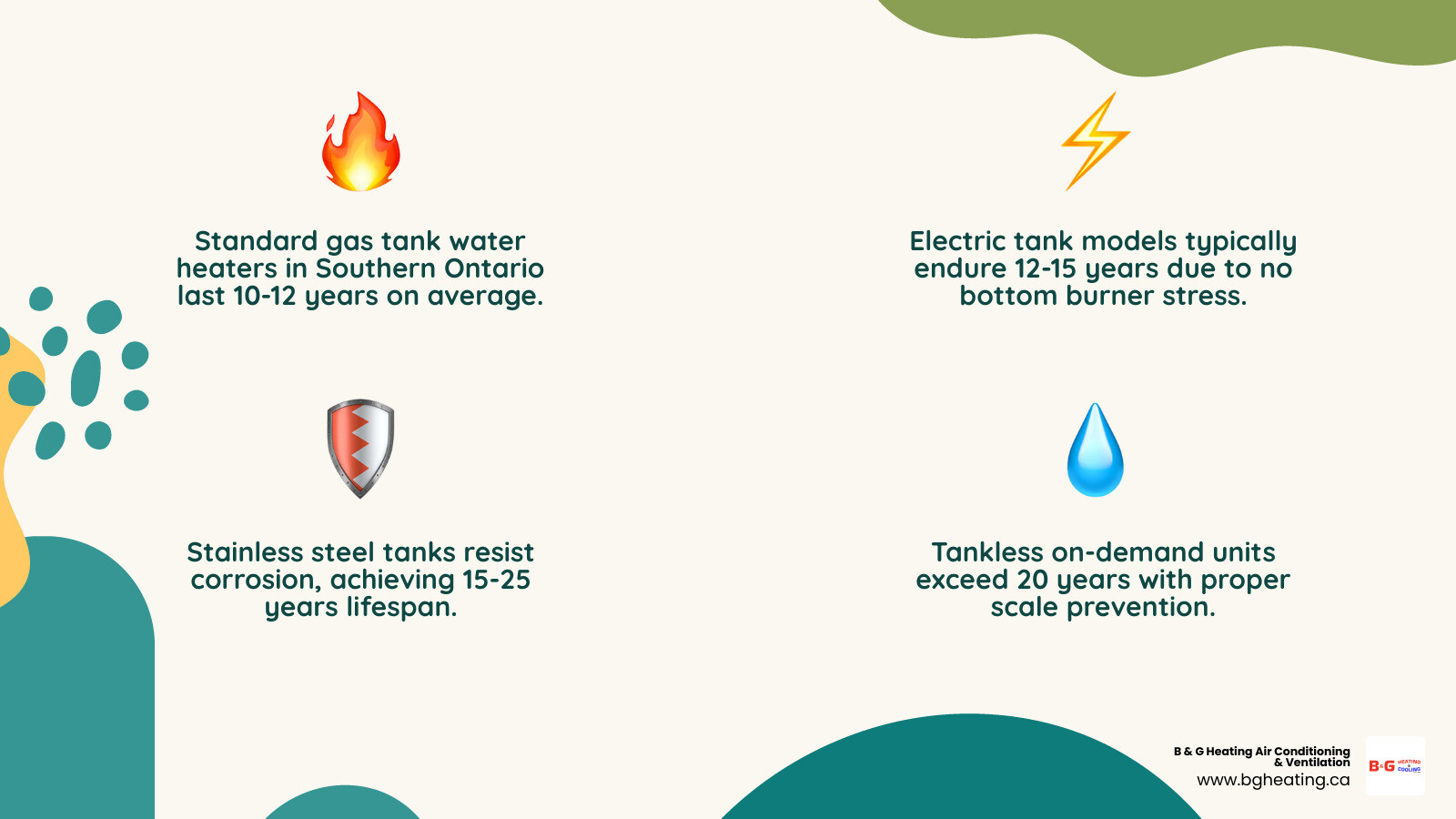
| Water Heater Type | Average Lifespan in Southern Ontario |
|---|---|
| Standard gas tank (atmospheric) | 10-12 years |
| Power-vented gas tank | 8-10 years |
| Electric tank | 12-15 years |
| Stainless steel tank | 15-25 years |
| Tankless (on-demand) | 20+ years |
If your unit is approaching or past these ranges, it’s worth paying close attention. Southern Ontario’s hard water accelerates wear in ways that many homeowners don’t expect. Calcium and mineral deposits build up inside tanks, force the system to work harder, and quietly shorten the unit’s life — often by years.
The good news? Knowing what to watch for puts you in control. The sections below walk through everything you need to make a smart, informed decision about your water heater.
How Long Does a Water Heater Last in Southern Ontario?
When we talk to our neighbors in places like Ancaster, Binbrook, and Stoney Creek, the first question is almost always about the “expiration date” of their equipment. We’d all love for our appliances to last forever, but in plumbing and HVAC, every component has a finite life. In Southern Ontario, that life is heavily influenced by our unique regional environment.
The lifespan of your system is primarily dictated by its construction and the fuel it uses. For example, electric tanks often outlast gas tanks simply because they don’t have a burner at the bottom constantly stressing the metal. However, newer technology like stainless steel tanks and tankless systems are changing the game entirely.
Choosing the right system for your home isn’t just about the upfront purchase; it’s about understanding how many years of hot showers you’re actually buying. If you’re currently weighing your options, Choosing The Right Water Heater/ can help you navigate the pros and cons of each type.
How long does a water heater last in Southern Ontario if it’s a tankless model?
Tankless water heaters, often called “on-demand” systems, are the marathon runners of the hot water world. While a traditional tank might start showing its age after a decade, a well-maintained tankless unit can easily provide reliable service for 20 years or more.
Why do they last so much longer? It comes down to physics. Traditional tanks store 40 to 60 gallons of water, constantly reheating it to stay at the set temperature. This creates a “standby loss” and allows minerals to settle at the bottom of the tank 24/7. A tankless unit only heats water when you turn on a tap. Because there is no storage tank, there is no risk of the tank floor rusting out or a massive flood occurring due to a structural failure of the vessel.
However, tankless units aren’t invincible. They rely on a high-efficiency heat exchanger. In hard water areas like Hamilton and Burlington, calcium can “scale” onto these exchangers, reducing efficiency and potentially causing early failure. This is why we emphasize Water Heater Services Hannon On/ that include specialized descaling. With modern scale prevention technology and annual maintenance, these units are a fantastic long-term investment for Southern Ontario families.
How long does a water heater last in Southern Ontario when using a traditional gas tank?
Gas-powered tanks are the most common sight in basements from Oakville to Brantford. However, their lifespan varies depending on how they vent exhaust.
- Atmospheric Gas Tanks (10–12 years): These are the traditional models with a draft hood on top that vents naturally up a chimney. They are simple and reliable, but the constant heating of the tank bottom eventually leads to metal fatigue and sediment “baking” onto the floor.
- Power-Vented Gas Tanks (8–10 years): These units use a blower motor to push exhaust out a side wall. While they are more efficient and flexible for installation, the added mechanical components and higher heat intensity often mean a slightly shorter lifespan than their atmospheric cousins.
Most of these tanks are “glass-lined” steel. This means the inside of the steel tank is coated with a thin layer of porcelain to protect it from rust. Over time, heat cycles cause that glass to develop microscopic cracks, allowing water to reach the steel. Once the steel starts to rust, the clock is ticking. This is why Professional Water Heater Installation/ is so important; a unit that isn’t leveled or vented correctly will experience internal stress that leads to early leaks.
Local Factors: Why Water Heaters Fail Faster in Hamilton and the GTA

If you live in Southwestern Ontario or the GTA, your water heater is working harder than a unit in a “soft water” region. Hamilton, in particular, is known for its hard water. But what does that actually mean for your tank?
Hard water contains high levels of dissolved minerals, primarily calcium and magnesium. When this water is heated, these minerals solidify into “scale” or sediment. This sediment settles at the bottom of the tank, creating a thick, insulating layer between the gas burner and the water.
The “Popcorn” Effect Have you ever heard your water heater making a banging or popping sound? That’s the sound of water trapped beneath a layer of sediment turning into steam and “popping” through the crust. Not only is this annoying, but it also means your burner has to run much longer to heat the water through that layer of “rock.” Research shows that just one inch of sediment can force a heater to use 10% more energy, costing homeowners significantly more every year.
Insurance and Regulations In Southern Ontario, it’s not just the hardware that dictates when you should replace your unit—it’s the insurance companies. Many Canadian insurers have strict policies regarding water heaters. Because a failed tank is one of the leading causes of basement flooding and water damage claims, many companies now require or strongly prefer that tanks be replaced every 10 years.
Furthermore, the Technical Standards and Safety Authority (TSSA) has strict safety codes for gas installations in Ontario. If your unit is old and the venting or gas lines no longer meet current safety standards, a technician may be required to “red tag” the unit, meaning it must be repaired or replaced to ensure your family’s safety. When the time comes for a swap, Water Heater Replacement Hannon On/ ensures you stay compliant with all local codes and insurance requirements.
Warning Signs: Is It Time for a Water Heater Replacement?
We always tell our customers: your water heater will usually try to tell you it’s dying before it actually gives up the ghost. Learning to listen (and look) can save you from a 2 AM emergency.
1. Rusty Water If you turn on the hot water and see a brownish or yellowish tint, but the cold water runs clear, your tank is likely rusting from the inside out. This is a sign that the protective anode rod has been depleted and the steel tank itself is now corroded.
2. Rumbling and Banging Noises As mentioned earlier, sediment buildup causes these sounds. If the noise is loud and persistent, it means the sediment layer is thick. This causes the bottom of the tank to overheat, which can weaken the steel and lead to a catastrophic leak.
3. Lukewarm Temperatures If your showers are getting shorter or the water just isn’t as hot as it used to be, your heating elements (in electric tanks) or the burner assembly (in gas tanks) may be failing. In some cases, the “dip tube” (which directs cold water to the bottom of the tank) may have broken, causing cold water to mix with the hot water at the top of the tank.
4. The 50% Repair Rule Deciding whether to fix or toss an old unit can be tough. We generally recommend the “50% Rule”: if the cost of Water Heater Repair Hannon On/ is more than half the cost of a new unit, and the tank is over 8 years old, replacement is the smarter financial move.
Determining the Age via Serial Number Don’t know how old your tank is? Look at the manufacturer’s label for the serial number. Most manufacturers use a code where the first letter represents the month (A=January, B=February, etc.) and the next two digits represent the year. For example, a serial number starting with “E21” likely means the unit was manufactured in May 2021. If you’re unsure, Signs You Need Water Heater Repair/ and Time For Water Heater Replacement/ offer more detailed checklists to help you decide.
Proactive Care: How to Extend Your Water Heater’s Lifespan
While how long a water heater lasts in Southern Ontario is partly up to fate and water chemistry, you can definitely tip the scales in your favor with proactive maintenance. Think of it like changing the oil in your car; you wouldn’t expect an engine to last 300,000 kilometers without a few oil changes, right?
The Magic of the Anode Rod Inside every steel tank is a “sacrificial” anode rod. Its only job is to be more attractive to corrosion than the tank itself. The water attacks the rod instead of the steel. However, these rods eventually dissolve. We recommend having your anode rod inspected every 3 years. Replacing a depleted rod is a simple task that can effectively double the life of your tank.
Annual Flushing Because of the hard water in regions like Haldimand County and Niagara, we suggest flushing your tank at least once a year. This involves draining a few gallons of water from the valve at the bottom of the tank to remove accumulated sediment. This keeps the heat transfer efficient and prevents the “popcorn” noise and tank floor damage.
Temperature and Pressure Relief (T&P) Valve This is the most important safety feature on your heater. It prevents the tank from exploding if the pressure or temperature gets too high. You should test this valve once a year by lifting the lever briefly to ensure water flows out and then stops completely. If it’s crusty or leaking, it needs immediate attention.
Regular Water Heater Tune Up Maintenance Hannon On/ is the best way to catch these small issues before they turn into basement-flooding disasters.
Frequently Asked Questions about Water Heater Longevity
How do I tell the age of my water heater?
As mentioned, the serial number is your best friend here. Most tanks in Ontario homes (like John Wood or GSW models) follow a standard format. Look for the “Rating Plate” on the side of the tank. If the serial number is something like “L15123456,” the “L” is the 12th letter of the alphabet (December) and “15” stands for 2015. If the label is missing or unreadable, a professional can usually identify the age based on the model’s design and safety features.
Is it better to rent or buy a water heater in Ontario?
This is a classic Ontario debate!
- Renting: You pay a monthly fee, and the rental provider covers repairs and replacements. This is “stress-free” but significantly more expensive over 10–15 years.
- Buying: You own the equipment. While you’re responsible for maintenance, the unit usually pays for itself in less than 7 years compared to rental costs.
In Southern Ontario, where tanks last 10+ years, buying is almost always the better long-term financial choice. If you are currently tied to a contract, we can help you explore Water Heater Rental Hannon On/ options or buyout strategies.
Why is my water heater making a popping sound?
This is almost always “kettling.” It happens when minerals (calcium) from our hard Southern Ontario water settle at the bottom. Water gets trapped under this scale, boils, and “pops” through the layer. It’s a sign that your heater is struggling to transfer heat and is likely losing efficiency. If you’re also noticing a drop in pressure, check out our guide on Troubleshooting Low Hot Water Pressure/.
Conclusion
Understanding how long a water heater lasts in Southern Ontario is about more than just reading a manufacturer’s sticker. It’s about recognizing the impact of our local hard water, staying ahead of insurance requirements, and performing the simple maintenance that keeps a system running efficiently.
At B & G Heating Air Conditioning & Ventilation, we’ve spent years serving families across Hamilton, Burlington, Grimsby, and the surrounding areas. As a family-owned business, we know that a broken water heater isn’t just a mechanical failure—it’s a disruption to your family’s routine. Whether you’re looking to extend the life of your current tank or you’re ready to upgrade to a high-efficiency tankless system, we’re here to provide the expert, honest advice you deserve.
Don’t wait for a cold shower to tell you it’s time for a change. Be proactive, keep an eye on those warning signs, and remember that a little maintenance goes a long way.
Explore our full range of water heater solutions and products