


Why Your Mini Split Is Not Heating Well in Cold Ontario Weather
If your mini split not heating well in cold Ontario weather is leaving you shivering at home, you’re not alone — this is one of the most common complaints we hear from homeowners across Hamilton and the surrounding region every winter.
Here are the most common reasons your mini split may be struggling to heat your home:
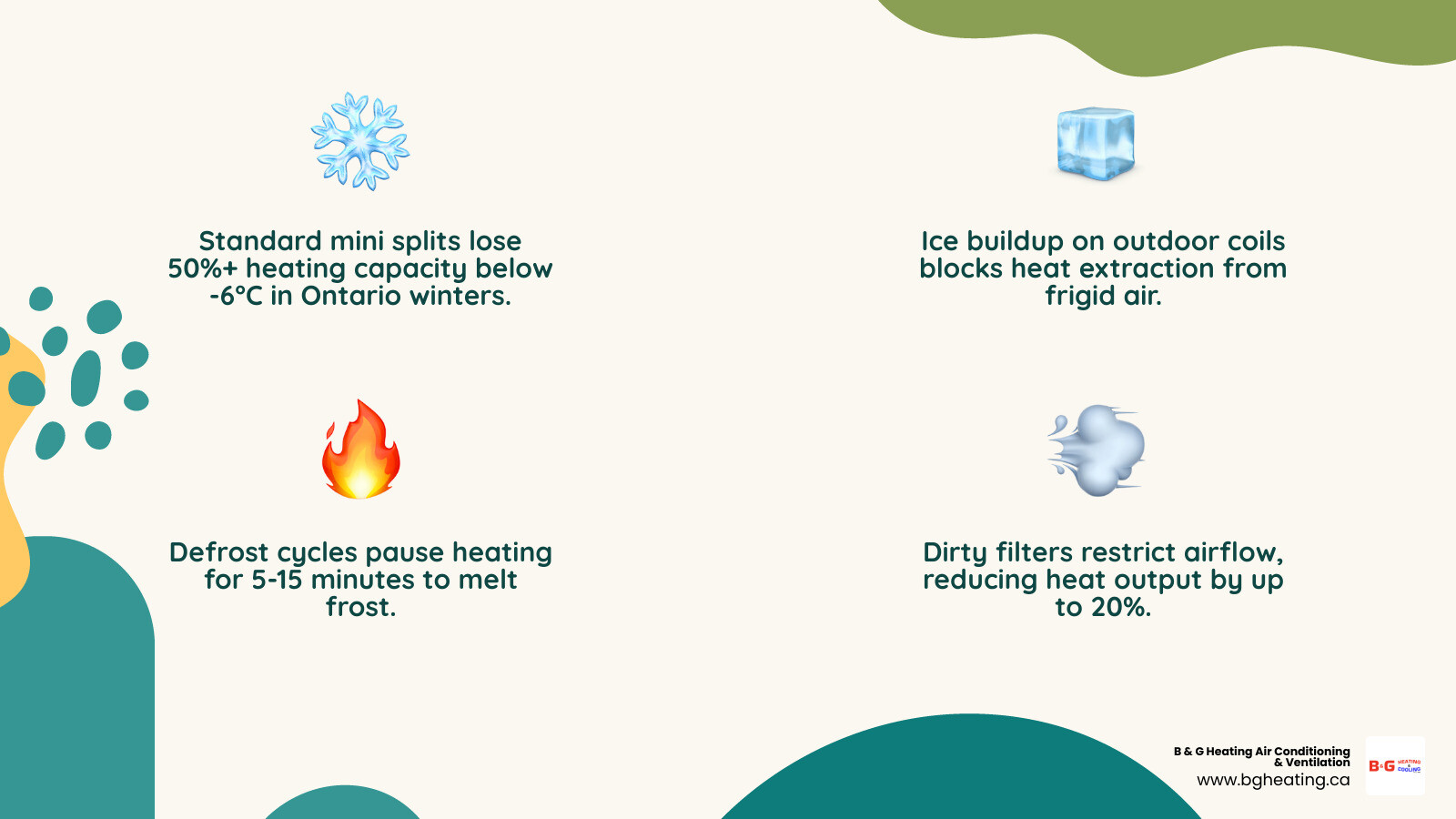
- Temperature limits reached – Standard mini splits lose significant heating capacity below -6°C, and Ontario winters regularly hit -10°C to -15°C or colder
- Dirty air filters – Restricted airflow forces the system to work harder and deliver less heat
- Ice buildup on the outdoor unit – Frost or heavy ice blocks heat absorption from the outdoor air
- Defrost cycle running – The system temporarily stops heating (for 5–15 minutes) to melt frost off the outdoor coil — this is normal
- Low refrigerant – A leak reduces the system’s ability to transfer heat efficiently
- Short-cycling – The unit turns on and off too quickly, never fully heating the space
- Wrong thermostat settings – Unit left in “Auto” or “Cool” mode instead of “Heat”
- Undersized or mismatched equipment – A unit not rated for Ontario’s cold climate will struggle below certain temperatures
Most of these issues have straightforward fixes. Some require a licensed HVAC technician, especially anything involving refrigerant or electrical components.
Ontario winters are unforgiving. When temperatures drop into the low teens below zero, even a well-maintained mini split can reach the edge of its design limits. Understanding what’s normal — and what’s a warning sign — is the first step to staying warm all season long.
Why is my mini split not heating well in cold Ontario weather?
To understand why your system is struggling, we first have to look at how it works. Unlike a furnace that burns fuel to create heat, a mini split is a heat pump; it moves heat from one place to another. Even at -15°C, there is still thermal energy in the outdoor air. However, as the mercury drops, the “available” heat becomes harder to extract.
In southeastern Ontario, where January lows average -10°C (14°F), standard mini split models often hit a wall. Many basic units start losing efficiency rapidly once it drops below freezing (0°C) and may stop heating effectively entirely around -6°C. When a system reaches its ambient temperature limit, the inverter technology—which usually helps the compressor run at variable speeds for efficiency—has to work at maximum capacity just to maintain a lukewarm breeze.
Furthermore, the humidity levels in places like Hamilton and Burlington play a huge role. Our “damp cold” leads to faster frost accumulation on the outdoor coils compared to drier climates. If your home has a weak thermal envelope (poor insulation or drafty windows), the heat your mini split does manage to produce escapes faster than the unit can replace it. To get a better handle on how these systems are graded for our climate, you can understand heat pump efficiency SEER rating explained to see how HSPF (Heating Seasonal Performance Factor) impacts winter comfort.
Common Causes for Poor Heating Performance in Sub-Zero Temperatures

When we visit homes in Ancaster or Stoney Creek for a mini split not heating well in cold Ontario weather, we often find a combination of mechanical and environmental factors at play.
Airflow Restrictions
The number one culprit is often the simplest: dirty filters. If the indoor head cannot pull in enough air, it cannot transfer heat into the room. This leads to weak airflow and a system that runs constantly without reaching the set temperature. To keep your system running at peak performance, it is vital to maximize comfort ductless mini split systems by keeping those filters pristine.
Refrigerant and Sensors
Refrigerant is the “blood” of your HVAC system. It doesn’t get used up like gas; if it’s low, you have a leak. Signs of a leak include oil stains at the connector points or the system entering a “failsafe” mode. Additionally, sensor accuracy can be an issue. If the thermostat is placed in a “warm spot” or near a lamp, it may think the room is 22°C when you’re actually shivering at 18°C.
Short-Cycling and Multi-Zone Issues
Short-cycling is when the unit turns on for 3–5 minutes and then shuts off. In Ontario, many 2023–2025 heat pump retrofits were oversized, which is the leading cause of this problem. If you have a multi-zone system (one outdoor unit with several indoor heads), the system has to balance the load. If only one small head is calling for heat in a bedroom, the outdoor unit might struggle to modulate low enough, causing it to cycle frequently and provide inconsistent warmth. You can learn more about these “red flags” by checking out signs you need heat pump repair.
Troubleshooting a mini split not heating well in cold Ontario weather
Before calling in the pros, try these DIY steps:
- Check the Mode: Ensure your remote says “Heat” (usually a sun icon). Avoid “Auto” mode in Ontario winters, as the system may get confused and switch to cooling if the sun warms up the room through a window.
- Clean the Filters: Pop the front panel and wash the mesh filters.
- Fan Settings: Switch the fan from “Auto” to a fixed medium or high speed to help circulate the warm air better.
- Power Cycle: Sometimes the “computer” inside needs a reset. Turn the circuit breaker off for 5 minutes and then back on.
- Clear the Outdoor Unit: Ensure no snow or ice is blocking the sides or back of the outdoor unit.
If these don’t work, it may be time for professional ductless mini split HVAC services to dig deeper into the electronics.
Professional diagnostics for a mini split not heating well in cold Ontario weather
When our technicians arrive at your home in Grimsby or Niagara-on-the-Lake, we perform a series of technical tests. We check the “temperature split”—measuring the air going into the unit versus the air coming out. A healthy system should show a “Delta T” of about 15°C to 30°C.
We also look at the refrigerant type. While older systems use R-410A, many newer models use R-32, which performs better in extreme cold. If we suspect a leak, TSSA regulations require us to find and repair the leak rather than just “topping it up.” We also test the reversing valve, the component that allows the unit to switch from cooling to heating, to ensure it isn’t sticking. For residents in the city, our heat pump repair Hamilton team uses specialized gauges to ensure your system is charged to the exact manufacturer specifications.
Understanding the Defrost Cycle and Ice Management
One of the most misunderstood parts of owning a mini split is the defrost cycle. Because the outdoor unit is extracting heat from the air, the outdoor coils become much colder than the ambient temperature. In Ontario’s humid winters, moisture freezes onto these coils instantly.
To fix this, the system periodically enters “Defrost Mode.” It essentially turns into an air conditioner for 5–15 minutes, sending heat back to the outdoor unit to melt the ice. You might see steam rising from the unit or hear a “whooshing” sound—this is completely normal! However, if the unit is encased in a block of solid ice that doesn’t melt, you have a problem.
| Normal Frost | Problematic Ice Buildup |
|---|---|
| Thin, white “fuzz” on the coils | Solid “glacier” covering the entire unit |
| Melts away every 30–90 minutes | Ice persists for days or grows thicker |
| Steam visible during defrost | Bottom of the unit (base pan) is full of ice |
| System returns to heating quickly | System blows cold air indefinitely |
If you are in the Hannon area and notice your unit is struggling to manage ice, our Hannon ON heating and air conditioning services can help inspect your base pan heaters or drainage path.
Managing a mini split not heating well in cold Ontario weather due to ice
To prevent ice-related failures:
- Clear the Snow: Keep at least 2 feet of clearance around the outdoor unit.
- Elevate the Unit: Ensure your unit is on a stand or wall bracket above the typical snow line.
- Wind Protection: In windy areas like Haldimand or Dunnville, a wind baffle can prevent the defrost cycle from being interrupted by freezing gusts.
- Never Chip Ice: Do not use a screwdriver or hammer to chip ice off the coils; you will likely puncture a refrigerant line.
If your system is constantly icing up, it’s a sign that you need ductless mini split HVAC services Hannon ON to check the defrost sensors.
Upgrading to Cold-Climate Technology for Ontario Winters
If your current unit simply cannot keep up when it hits -15°C, it might be a “standard” model not designed for our climate. Modern “Cold-Climate” or “Hyper-Heat” models are engineered specifically for places like Ontario. These units feature variable-speed compressors that can maintain 100% heating capacity down to -15°C and continue operating as low as -25°C or -30°C.
When upgrading, we use Manual J heat loss calculations to ensure the unit is sized perfectly for your home’s specific insulation and window quality. Many homeowners in Mississauga and Oakville are also taking advantage of Ontario energy rebates to offset the cost of these high-efficiency upgrades. Integrating a mini split with a backup heating source (like baseboard heaters or a furnace) is also a smart “hybrid” strategy for those rare nights when the temperature reaches record lows.
Frequently Asked Questions about Mini Split Heating
Why does my unit blow cold air during the winter?
Most often, this is the defrost mode. The indoor fan may continue to spin at a very low speed to sense room temperature, but the air will feel cool because the heat is being diverted to melt ice outside. If it blows cold air for more than 20 minutes, it may be a sign you need heat pump repair.
How often should I clean my filters in the heating season?
In Ontario’s winter, we recommend checking them every 4–6 weeks. Because the air is drier, more dust and pet dander circulate through the house. Clean filters are the easiest way to maximize comfort ductless mini split systems.
When should I call a professional for a heating failure?
You should call us if you see error codes (blinking lights) on the indoor head, if the outdoor unit is making loud grinding noises, or if the system is completely iced over and failing to heat. For fast response times, our heat pump repair Hamilton team is ready to help.
Conclusion
A mini split not heating well in cold Ontario weather is a challenge, but it doesn’t have to mean a miserable winter. Whether it’s a simple filter cleaning or a more complex refrigerant repair, B & G Heating Air Conditioning & Ventilation is here to ensure your home stays a sanctuary against the cold.
As a family-owned business, we take pride in serving our neighbors across Hamilton, Burlington, St. Catharines, and the surrounding areas. From seasonal maintenance to emergency repairs, our focus is always on quality workmanship and your total comfort. If your system is acting up, don’t wait for the next cold snap. Contact us today for Hamilton ON heating and air conditioning services or to learn more about our professional ductless mini split HVAC services. We’ll help you find the right solution to keep the heat on, no matter what the Ontario weather throws your way.