


Is Your AC Keeps Turning On and Off? What Is Wrong and How to Fix It Fast
If your ac keeps turning on and off repeatedly, you are dealing with a problem called short cycling — and it is one of the most common HVAC complaints Dallas homeowners face, especially during peak summer heat. Short cycling means your AC is not completing a full cooling cycle. Instead, it runs for just a few minutes, shuts off, then starts again — over and over.
Quick answer: Why does my AC keep turning on and off?
The most common causes are:
- Dirty air filter — restricts airflow and causes the system to overheat and shut down
- Thermostat problems — low batteries, wrong placement, or a faulty sensor sends bad signals
- Low refrigerant — pressure drops trigger safety switches that cut the system off
- Oversized AC unit — cools the space too fast, shuts off before removing humidity
- Dirty condenser or evaporator coils — cause overheating and early shutoffs
- Failing run capacitor or electrical issues — disrupts power to the compressor or fan
- Clogged condensate drain line — float switch shuts the unit off to prevent water damage
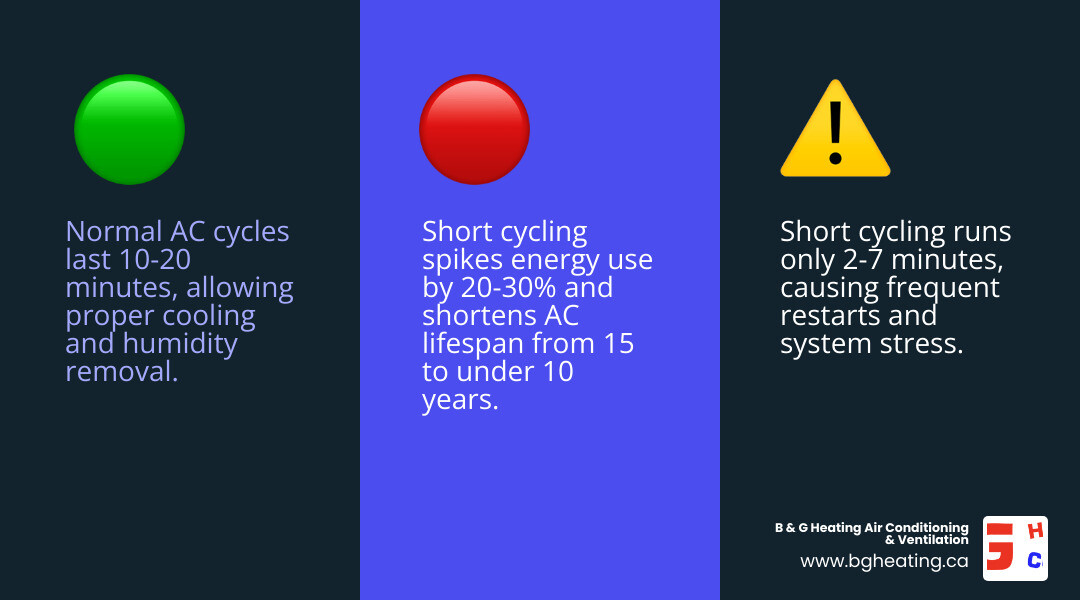
A normal AC cycle should last 10 to 20 minutes. If yours is shutting off after 2 to 7 minutes, something is wrong — and ignoring it puts real strain on your compressor, drives up your energy bills, and shortens your system’s lifespan from its expected 12 to 15 years.
At B & G Heating Air Conditioning & Ventilation, we help Hamilton homeowners diagnose and fix short cycling before it turns into a costly repair or full system replacement. Keep reading to find out exactly what is causing your AC to cycle and what you can do about it.
Understanding Short Cycling: Why Your AC Keeps Turning On and Off and What Is Wrong
When we talk about an ac keeps turning on and off what is wrong, the technical term is “short cycling.” Think of your air conditioner like a marathon runner. It needs a steady pace to reach the finish line (your desired indoor temperature). Short cycling is like that runner sprinting for ten seconds, stopping to gasp for air, and then trying to sprint again. It is incredibly inefficient and wears out the “body” of your HVAC system much faster than normal operation.
In May 2026, with energy standards becoming more rigorous, understanding this behavior is vital for protecting your home investment. Short cycling isn’t just a nuisance; it’s a cry for help from your equipment. Identifying Common Ac Issues early can save you from a total system breakdown during a heatwave in Hamilton or Burlington.
Normal Cycle Lengths in 2026
In a perfectly balanced home, your AC should run for about 10 to 20 minutes at a time. During these minutes, the system isn’t just lowering the temperature; it is also pulling humidity out of the air. If the cycle is too short—say, under 7 minutes—the air might feel cool, but it will likely feel “clammy” because the system didn’t run long enough to dehumidify.
Ambient temperature plays a huge role here. On a mild day in Ancaster, your cycles might be shorter. But if it’s a sweltering afternoon and your unit is clicking off every three minutes, you need to Resolve Frequent Ac Cycling Problems immediately.
The Impact of Frequent Restarts
Every time your AC starts up, it uses a massive “surge” of electricity—up to seven times more than it uses while running steadily. If your system restarts 10 times an hour instead of 2 or 3, your electricity bill will skyrocket.
Beyond the bill, the mechanical toll is heavy. Frequent restarts cause component fatigue, specifically in the motor windings and the compressor. The compressor is the most expensive part of your system. Constant stopping and starting can lead to Signs Your Ac Needs Immediate Repair, such as burnt-out wires or a seized motor.
Top 5 Reasons Your AC Keeps Turning On and Off and What Is Wrong
When our team at B & G Heating visits homes in Stoney Creek or Oakville, we usually find that the culprit behind a cycling AC falls into one of these five categories.
Dirty Air Filters and Airflow Blockages
Believe it or not, a simple air filter is the #1 cause of short cycling. When a filter is clogged with dust, pet hair, and debris, it creates “static pressure.” The blower fan has to work twice as hard to pull air through, and the lack of airflow causes the evaporator coils to get too cold.
When the coils get too cold, they can actually freeze over. Your system has safety sensors that detect this drop in temperature or the lack of airflow and shut the system down to prevent the compressor from pumping liquid refrigerant (which can destroy it). This is a classic example of Common Ac Problems In Summer. If your Ac Not Cooling Effectively, the filter is the first place you should look.
Thermostat Placement and Malfunctions
Your thermostat is the “brain” of the operation. If it’s giving the wrong orders, the AC will behave erratically. We often see homeowners in Mississauga or Brantford who have their thermostat placed in a bad spot—like directly under a supply vent, near a sunny window, or close to a hot kitchen appliance.
If a blast of cold air from the vent hits the thermostat, it thinks the whole house is cool and shuts the AC off. Two minutes later, it realizes the room is actually hot and turns it back on. This “ghost” temperature reading is a common Hvac Troubleshooter item. Also, don’t forget the batteries! Low batteries can cause the thermostat to lose its connection to the AC, leading to random shutdowns.
Refrigerant Leaks and Pressure Switches
Your AC uses refrigerant to move heat from inside to outside. It’s a closed loop, meaning it shouldn’t “run out” like gas in a car. If it’s low, you have a leak. Low refrigerant levels cause the pressure in the lines to drop.
Modern AC units are equipped with low-pressure safety switches. When the pressure falls below a certain point, the switch trips and kills the power to the compressor to prevent it from overheating. Once the pressure stabilizes slightly, it might kick back on, only to trip again. If you hear hissing noises or see ice on the copper lines, this is likely Why Is Your Ac Not Shutting Off or cycling correctly.
Mechanical and Electrical Culprits Behind Short Cycling
Sometimes the issue isn’t a maintenance task like a filter change, but a more complex mechanical or electrical failure.
Oversized AC Units
In the HVAC world, bigger is definitely not always better. If an AC unit is too powerful for the square footage of your home, it will blast the house with cold air and reach the thermostat’s set point in just a few minutes.
While this sounds like a good thing, it’s actually a disaster for your comfort and your equipment. The unit never stays on long enough to remove moisture, leaving your home in places like Grimsby or Caledonia feeling like a swamp. To avoid this, we always perform a Manual J calculation to ensure the system is sized perfectly for your specific home.
| Feature | Oversized System | Correctly Sized System |
|---|---|---|
| Cycle Length | 2-5 minutes (Short) | 10-20 minutes (Standard) |
| Humidity Control | Poor (Clammy air) | Excellent (Dry, crisp air) |
| Energy Usage | High (Frequent surges) | Optimized (Steady run) |
| Component Wear | Accelerated | Minimal |
Compressor and Capacitor Issues
The “run capacitor” is like a battery that gives your AC the extra “oomph” it needs to start and stay running. If the capacitor is weakening, it might struggle to keep the motor spinning, causing the system to drop out and restart.
Similarly, an aging compressor might experience “hard starting.” This happens when the internal parts of the compressor are worn down, requiring more voltage than your home can easily provide. This leads to voltage drops and triggers the overload protection, which shuts the unit down to prevent a fire. If you’re wondering How Do You Troubleshoot An Ac Problem involving electrical components, it’s usually best to leave the multimeter to the pros.
Step-by-Step Troubleshooting for an AC That Keeps Turning On and Off and What Is Wrong
Before you call for backup, there are several things you can check yourself. Follow this list to see if you can resolve the issue:
- Check the Air Filter: Slide it out. If it looks gray or you can’t see light through it, replace it immediately. This fixes short cycling about 40% to 60% of the time!
- Inspect Your Vents: Make sure all supply and return vents are open. Closing too many vents in unused rooms can actually cause the system to overheat and cycle.
- Clear the Outdoor Unit: Ensure there is at least two feet of clearance around your outdoor condenser. Remove leaves, tall grass, or any “shacks” built around the unit that might be trapping heat.
- Check Thermostat Settings: Ensure it is set to “Cool” and “Auto” (not “On”). If the screen is blank or fading, pop in some fresh alkaline batteries.
- Look for Ice: If you see ice on the indoor evaporator coil or the outdoor brass valves, turn the AC off and set the fan to “On.” This will melt the ice while you wait for a technician.
Checking the Condensate Drain Line
Your AC produces a lot of water (condensation). This water flows down a drain line. If that line gets clogged with algae or “sludge,” the water backs up. Most modern systems have a “float switch”—a little device that detects rising water and shuts the AC off before your floor gets flooded.
If your AC turns off and won’t come back on for a long time, check the drain pan. If there’s standing water, you’ve found your problem. A quick flush with vinegar every few months can prevent these clogs from forming.
Resetting the Circuit Breaker
Sometimes a power surge or a particularly hot day in Kitchener or Guelph can cause the AC to draw too much power and trip the breaker.
- Go to your electrical panel.
- Look for the switch labeled “AC” or “HVAC.”
- If it’s in the middle position, flip it all the way to “Off” and then back to “On.”
- Warning: If the breaker trips again immediately, do not keep resetting it. This indicates a serious electrical short or a failing compressor that could cause a fire.
Frequently Asked Questions
How often should I change my air filter in 2026 to prevent cycling?
In the Hamilton and Niagara regions, we recommend checking your filter every 30 days during the peak cooling season. If you have pets or live in a high-dust area like a new construction zone in Binbrook, you may need to replace a standard 1-inch filter every month. High-efficiency pleated filters can sometimes last 60-90 days, but always check them monthly to be safe.
Can a faulty thermostat cause my AC to restart every few minutes?
Yes, absolutely. If the internal sensor is failing or if the wiring has become loose/corroded, the thermostat may lose its “call for cool” signal intermittently. This causes the AC to shut down prematurely. Upgrading to a modern smart thermostat can often solve these communication issues and provide more stable cycling.
What are the signs that my AC compressor is overheating?
If your compressor is overheating, you might notice the outdoor unit feels exceptionally hot to the touch. You may also hear a loud “click” followed by a humming sound (this is the motor trying to start but failing). In many cases, an overheating compressor will run for 2-3 minutes, shut off for 15 minutes to cool down, and then try again. This is a major red flag that requires professional attention.
Conclusion
An ac keeps turning on and off what is wrong is not a problem that fixes itself. Whether it’s a simple dirty filter or a more complex refrigerant leak, ignoring the signs of short cycling will eventually lead to a much larger bill and a very uncomfortable home.
At B & G Heating Air Conditioning & Ventilation, we’ve been the trusted family-owned HVAC experts for Hamilton, Burlington, Oakville, and the surrounding areas for years. We pride ourselves on quality workmanship and ensuring our neighbors stay cool regardless of how high the Ontario humidity climbs. If your AC is acting up, don’t wait for it to quit entirely. Contact us today for Professional HVAC Services and Products and let us get your system back on a healthy, efficient cycle.