


How Long Does a Central Air Conditioner Last in Ontario?
The average lifespan of a central air conditioner in Ontario is typically 12 to 15 years with reasonable maintenance. Some well-maintained units can push past that mark, but most homeowners should start planning for replacement somewhere in that window.
Quick answer at a glance:
| Condition | Expected Lifespan |
|---|---|
| Minimal or no maintenance | 8 to 12 years |
| Regular maintenance | 12 to 15 years |
| Excellent care and ideal conditions | Up to 20 years |
Natural Resources Canada puts the life expectancy of a central air conditioner at 15 years or longer — and that lines up with what HVAC professionals across the province see every day. That said, Ontario’s climate adds real stress to your system. Hot, humid summers, harsh winters, freeze-thaw cycles, and road salt all take a toll on outdoor components over time.
The good news is that lifespan is not fixed. How long your system lasts depends heavily on how it was installed, how often it’s serviced, and how hard it has to work each cooling season. A unit that gets annual tune-ups and prompt repairs will consistently outlast one that only gets attention when something breaks. According to the Heating, Refrigeration and Air Conditioning Institute of Canada (HRAI), units that receive annual professional maintenance run an average of 3 to 5 years longer than comparable units that are only serviced when a problem arises.
Whether you’re trying to get more life out of your current system or figuring out whether it’s time to replace it, understanding what drives AC longevity in Ontario is the right place to start.
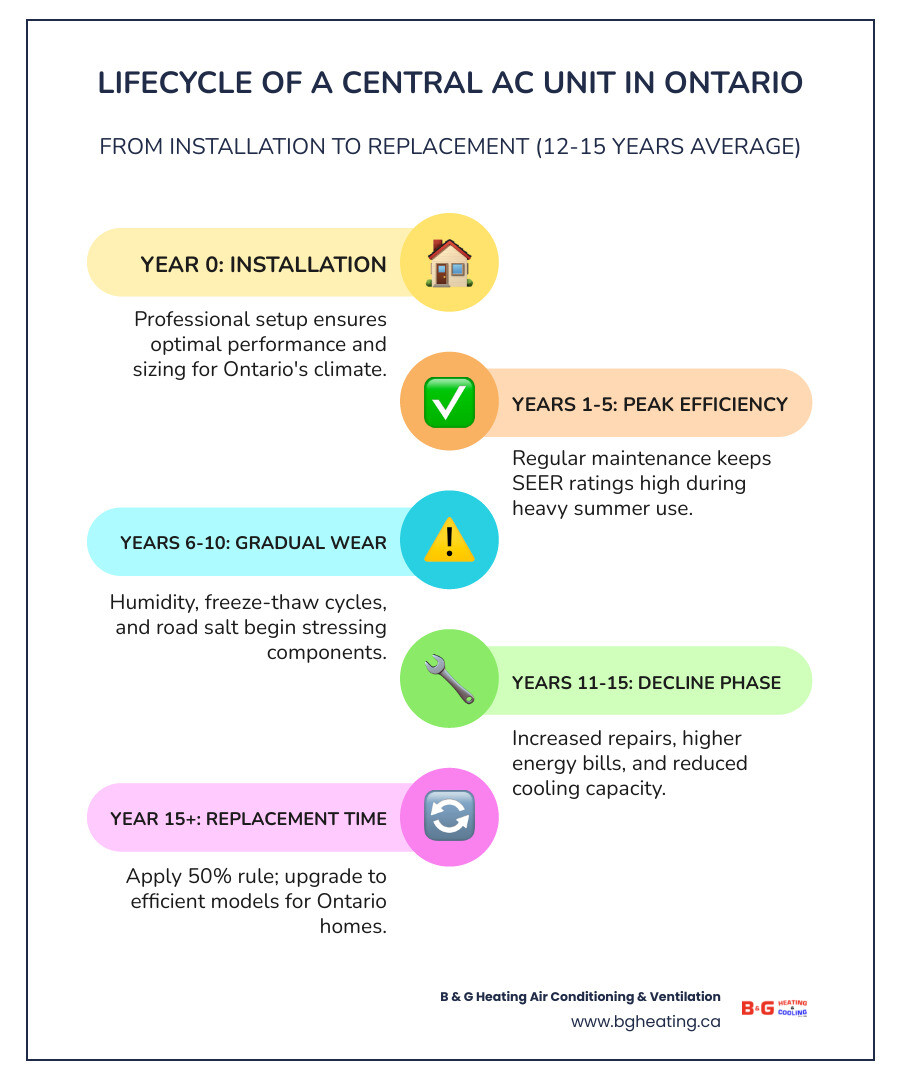
Understanding the Average Lifespan of a Central Air Conditioner in Ontario
For most homes we serve in Hamilton and surrounding Ontario communities, the practical planning benchmark is still 12 to 15 years. Some systems make it to 16, 18, or even 20 years, but that is usually the exception, not the rule.
Why the range? Because two air conditioners of the same age can be in completely different condition. One may still cool well, control humidity, and run quietly. Another may already be struggling because of skipped maintenance, poor airflow, incorrect sizing, or years of heavy summer use.
Southern Ontario also gives AC equipment a mixed bag of stress:
- Hot stretches that force long cooling cycles
- Humid weather that makes the system work harder to remove moisture
- Spring and fall dirt, pollen, and cottonwood buildup around the outdoor unit
- Long winters that leave the condenser sitting outside through snow, ice, and temperature swings
If you want a better sense of how these systems work as a whole, our detailed information on central air conditioners explains the basics in plain language.
A helpful way to think about lifespan is like mileage on a vehicle. Age matters, but operating conditions matter too. A 10-year-old unit that has been oversized, short-cycling, and neglected may be closer to the end than a 14-year-old unit that was installed correctly and serviced every year.
How Ontario’s Climate Impacts the Average Lifespan of a Central Air Conditioner in Ontario
Ontario weather is not gentle on outdoor HVAC equipment. It is not just the heat in July that matters. The shoulder seasons and winters matter too.
Here are the biggest local stressors:
- Freeze-thaw cycles: Repeated freezing and thawing can wear down cabinet finishes, fasteners, and exposed components over time.
- Humidity: High humidity means your AC is not just cooling air, it is also pulling moisture out of it. That extra dehumidification load increases runtime and strain.
- Road salt and airborne corrosion: In Hamilton, Burlington, Stoney Creek, Hannon, and nearby areas, salt exposure can contribute to corrosion on condenser coils and metal surfaces.
- Winter exposure: Snow, ice, and wind can leave the outdoor unit dirty, damp, and vulnerable to rust if it is already aging.
- Debris accumulation: Leaves, grass clippings, pollen, and dust can block airflow through the condenser coil.
This is one reason location-specific care matters. Homes near roads, driveways, and high-traffic areas often see more buildup and corrosion than homeowners expect. If you are in the area and want local support, our central HVAC services in Hannon, ON are part of the broader solutions we provide across the region.
Key Factors That Determine How Long Your Cooling System Lasts
A central air conditioner does not live or die by age alone. In our experience, these are the biggest factors that shape longevity.
Installation quality
Good equipment can still have a short life if it was installed poorly. Proper line set practices, electrical connections, refrigerant charge, airflow setup, and system commissioning all matter. A unit that starts life with the wrong refrigerant charge or poor airflow is already behind.
Correct sizing
Bigger is not always better. An oversized AC cools the house too quickly, then shuts off before removing enough humidity. That is called short cycling, and it creates extra wear. An undersized system has the opposite problem: it runs too long and struggles to keep up.
Proper sizing should be based on a load calculation, not a guess and not simply matching the old unit.
Airflow and ductwork condition
Your AC depends on the indoor side of the system too. Dirty filters, blocked vents, restrictive ductwork, leaking ducts, and weak blower performance all increase strain. Poor airflow can lead to frozen coils, reduced comfort, and compressor stress.
Our articles on the 5 most important components of an effective AC system and what are the 4 main parts of an AC? are useful if you want to understand how all these pieces work together.
Thermostat habits and runtime
If the thermostat is set very low all summer, the system racks up more operating hours. That does not mean you cannot be comfortable. It just means more runtime equals more wear. Smart thermostat scheduling and realistic setpoints can reduce unnecessary strain.
Electrical and refrigerant health
Capacitors, contactors, fan motors, and wiring connections all affect reliability. So does refrigerant charge. Low refrigerant is not just a comfort issue; it can damage major components if ignored.
Related equipment age
On many Ontario homes, the AC shares airflow components with the furnace, especially the blower and filter. If the furnace is older, the blower is weak, or the ductwork is in poor shape, the AC may appear to be failing sooner than expected when the real issue is the broader system.
Maximizing the Average Lifespan of a Central Air Conditioner in Ontario Through Maintenance
If homeowners ask us for the single best way to get more years out of their system, the answer is boring but effective: maintenance. Not glamorous. Very useful.
HRAI data cited in the research shows professionally maintained units can last 3 to 5 years longer on average. That is a major difference.
Key maintenance habits include:
- Replacing or cleaning filters on schedule
- Keeping the outdoor unit clear of leaves, weeds, and debris
- Cleaning condenser and evaporator coils when needed
- Checking refrigerant charge
- Inspecting electrical parts for wear
- Clearing the condensate drain line
- Catching small issues before they become major failures
Annual tune-ups are especially important in spring, before the first heat wave finds the one weak capacitor in the house.
You can learn more in our guides on the benefits of regular AC maintenance, what is included in central HVAC maintenance?, and prolonging AC system lifespan.
Homeowners can also help between service visits by:
- Changing the filter every 1 to 3 months depending on usage, pets, dust, and allergies
- Keeping supply vents and return grilles unblocked
- Trimming vegetation around the outdoor condenser
- Gently rinsing surface debris from the condenser coil when appropriate
- Watching for water leaks, unusual noises, or weak airflow
- Using the thermostat fan setting on Auto instead of running the fan constantly unless there is a reason to do so
Recognizing the Warning Signs Your AC is Nearing End-of-Life
Most air conditioners do not dramatically announce retirement like a hockey player with a farewell tour. Usually, they decline in small ways first.
Common end-of-life signs include:
- More frequent repairs
- Longer cooling cycles
- Uneven temperatures between rooms
- Weak airflow
- Higher hydro bills without a clear explanation
- Strange noises such as grinding, buzzing, rattling, or hard starts
- Humidity problems indoors
- Water leaks or drain problems
- Freezing on the coil or refrigerant lines
- Warm air or inconsistent cooling
If a system is around 10 to 12 years old and its efficiency has clearly dropped, that is often when homeowners start to notice comfort changes first. The house may still get cool eventually, but it takes longer, feels clammy, or has hot spots that were not there before.
Another major red flag is older refrigerant. If your system uses R-22, replacement becomes more practical in many cases. R-22 was phased out, so older units that leak refrigerant can be much harder to justify keeping alive. In general, systems installed before 2010 are the ones most likely to use it, though the nameplate should always be checked to confirm.
For a deeper look at failure symptoms, see our articles on warning signs AC needs replacement and enhancing lifespan of AC.
Deciding Between Repair and Replacement for Your Ontario Home
This is where age, reliability, comfort, and efficiency all meet in the same conversation.
A useful guideline is the 50% rule. If a major repair starts approaching about half the value of replacement, especially on an older unit, replacement usually deserves serious consideration. It is not a law, but it is a practical rule of thumb.
Other replacement triggers include:
- The unit is already in or beyond the 12 to 15 year window
- Repairs are becoming frequent
- The system uses R-22
- Humidity control is poor
- Cooling is uneven or unreliable
- The outdoor unit is badly corroded
- Related components such as the furnace blower or ductwork are also due for attention
Repair vs. replacement checklist
| Situation | Repair may make sense | Replacement may make sense |
|---|---|---|
| System age | Under 10 years | 12 to 15+ years |
| Repair history | First meaningful repair | Repeated breakdowns |
| Refrigerant | Current refrigerant | R-22 system |
| Comfort | Still cools evenly | Hot spots, humidity, long runtimes |
| Efficiency | Bills stable | Hydro bills rising |
| Component issue | Minor electrical or control part | Major compressor or coil issue |
| Planning | Short-term fix needed | Long-term reliability desired |
A replacement is not just about avoiding repairs. It can also improve day-to-day comfort. Newer systems are typically much more efficient than older low-SEER equipment, and SEER2 ratings now give a more realistic measure of performance. Compared with much older units, an efficient modern system can noticeably reduce electricity use during Ontario summers.
That means potential hydro savings, but also:
- Better humidity control
- Quieter operation
- More consistent temperatures
- Improved reliability during peak heat
- Lower environmental impact from reduced electricity consumption
Preventive service still matters either way. If you are trying to delay replacement responsibly, our article on the benefits of preventive AC maintenance explains how routine care protects both performance and lifespan.
If you are weighing the next step, our guide on when to consider AC replacement can help frame the decision.
Frequently Asked Questions about Ontario AC Longevity
Can an AC unit last 30 years in Canada?
It can, but it is rare.
A central AC that reaches 30 years is usually more of a durability story than a value story. Even if it still runs, it is typically much less efficient, harder to repair, and more likely to use outdated parts or refrigerant. Most homeowners are better served by planning around the normal 12 to 15 year benchmark rather than hoping for a 30-year miracle machine in the backyard.
In practical terms, once a unit gets into the high teens, the better question is usually not “Can it keep running?” but “Is it still worth running?”
When is the best time of year to replace an AC in Hamilton?
Spring and fall are usually the best times.
Those shoulder seasons tend to allow for calmer planning, better scheduling flexibility, and less chance of making a rushed decision during a heat wave. Replacing before peak summer can also help you avoid the classic emergency scenario where the AC quits on the hottest weekend of the year, which somehow always feels personal.
That said, if your system is clearly failing, the best time may simply be before it fails completely.
Does a heat pump last longer than a central air conditioner?
Usually not in Ontario if the heat pump handles both heating and cooling year-round.
A central AC only works during the cooling season. A heat pump may run in both summer and winter, which adds wear. Research commonly places residential heat pumps around the 10 to 15 year range, while central AC systems often land around 12 to 15 years in Ontario conditions. Ductless systems can sometimes last longer, often around 20 years or more, partly because of zoned operation and different usage patterns.
The right comparison depends on how the system is used, the installation quality, and whether it is part of a hybrid setup with a furnace.
Conclusion
The average lifespan of a central air conditioner in Ontario is best understood as a range, not a fixed deadline. For most homeowners, that means planning around 12 to 15 years, watching performance closely after the 10-year mark, and remembering that maintenance, installation quality, airflow, and Ontario weather all influence the outcome.
At B & G Heating, we help homeowners across Hamilton and surrounding areas make practical decisions about repair, maintenance, and replacement. As a trusted family-owned HVAC company, we focus on quality workmanship, honest guidance, and reliable indoor comfort solutions that fit the home as a whole, not just one piece of equipment.
If you are researching replacement timing, you can also review what should you expect to pay to replace your air conditioner?. And if you want a professional opinion on how much life your current system may have left, request a professional AC assessment today.