


Hard Water and Home Appliances: What Every Hamilton Homeowner Should Know
What is hard water and why does it affect home appliances? Hard water is water that contains high levels of dissolved minerals — mainly calcium and magnesium — picked up as groundwater moves through rock and soil. These minerals leave behind scale deposits inside pipes, fixtures, and appliances. Over time, that buildup forces appliances to work harder, use more energy, and wear out faster.
Here’s a quick summary:
- What it is: Water with elevated calcium and magnesium mineral content
- Where it comes from: Groundwater passing through limestone and chalk deposits
- How you notice it: White residue on faucets, cloudy dishes, stiff laundry, reduced water pressure
- Why it matters: Scale coats heating elements and clogs components, cutting efficiency by up to 30%
- Most affected appliances: Water heaters, dishwashers, washing machines, coffee makers, and ice makers
More than 85% of American homes deal with hard water — and Hamilton and the surrounding Southern Ontario region are no exception. The local geology, rich in limestone deposits, means the water flowing into your home is likely carrying a significant mineral load. You may have already spotted the signs: a chalky crust around your faucet, spots on your glassware, or a showerhead that just doesn’t spray the way it used to. What’s harder to see is what’s happening inside your appliances.
This guide breaks down exactly how hard water forms, what it does to your home’s major systems, and what you can do to protect your investment.
What is hard water and why does it affect home appliances in Hamilton?

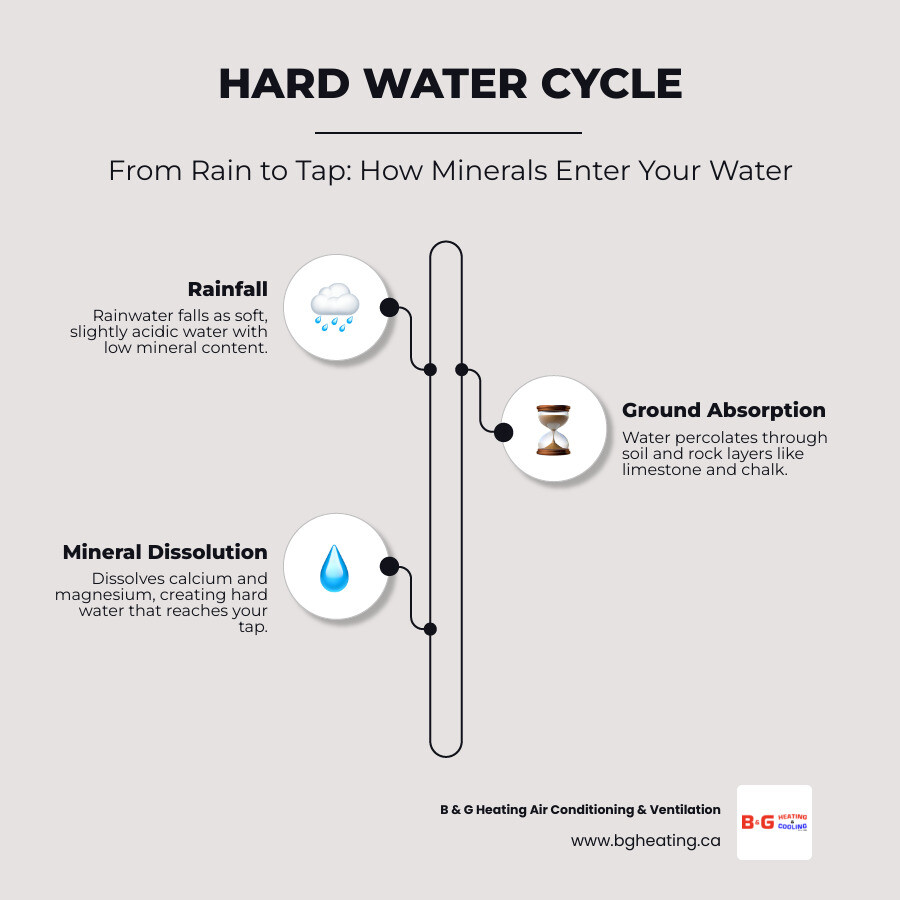
To understand the science behind what is hard water and why does it affect home appliances, we have to look at the ground beneath our feet. In areas like Ancaster, Dundas, and Stoney Creek, our water travels through ancient layers of limestone and chalk. As rainwater—which is naturally soft and slightly acidic—percolates through these geological formations, it dissolves minerals, primarily calcium carbonate and magnesium.
By the time this water reaches your home’s intake, it is saturated with these “hardness” ions. The real trouble begins when this water is heated or evaporated. This triggers a thermal reaction known as mineral precipitation. When hard water hits the heating element of your water heater or the spray jets of your dishwasher, the minerals “fall out” of the liquid and solidify into a rock-like crust called limescale.
This limescale is incredibly stubborn. It doesn’t just sit there; it acts as a powerful insulator. In a water heater, for example, the scale forms a barrier between the burner and the water, meaning the unit has to run longer and hotter to achieve the same temperature. This leads to internal stress that often results in Water Heater Repair Issues Solved only by professional intervention. If you notice your hot water isn’t as consistent as it used to be, these are often the first Signs You Need Water Heater Repair caused by Southern Ontario’s unique geology.
How Water Hardness is Measured and Identified
Knowing if you have hard water isn’t just about guessing; it’s about the numbers. Water hardness is typically measured in two ways: Grains per Gallon (GPG) or Parts per Million (PPM) (sometimes expressed as mg/L).
The U.S. Geological Survey (USGS) and Canadian water standards generally classify water based on the concentration of calcium carbonate. For reference, if your water tests above 7 GPG (or roughly 120 PPM), it is officially classified as “hard.” Many homes in the Hamilton and Niagara regions see levels much higher than this, often exceeding 10.5 GPG, which is considered “very hard.”
| Hardness Classification | Grains per Gallon (GPG) | mg/L or PPM |
|---|---|---|
| Soft | 0 – 3.5 | 0 – 60 |
| Moderately Hard | 3.5 – 7.0 | 61 – 120 |
| Hard | 7.0 – 10.5 | 121 – 180 |
| Very Hard | 10.5+ | 181+ |
If you don’t have a laboratory test handy, your home will tell you the truth through several visible symptoms. You might notice “soap scum”—a film left on your skin or bathtub because the minerals prevent soap from lathering and instead turn it into a sticky curd. You may find yourself Troubleshooting Low Hot Water Pressure because mineral “stalactites” are literally narrowing the diameter of your pipes. Other signs include cloudy glassware that stays foggy even after washing and laundry that feels stiff or looks dingy.
The Impact on Your Major Household Systems
Why what is hard water and why does it affect home appliances like water heaters?
Your water heater is the “ground zero” for hard water damage because heat accelerates scale formation. As the water sits in the tank, minerals settle at the bottom, creating a thick layer of sediment. This sediment acts like a thermal blanket, insulating the water from the heating source.
If you hear strange popping, rumbling, or banging noises coming from your basement, that’s the sound of steam bubbles struggling to escape from beneath that heavy layer of mineral crust. This doesn’t just sound scary; it wastes a massive amount of energy—up to 30% more, according to some studies. Eventually, the bottom of the tank can overheat, leading to metal fatigue and leaks.
To prevent a premature “geology exhibit” from forming in your tank, we highly recommend regular Water Heater Tune Up Maintenance Hannon On. Professional Water Heater Services Hannon On can help flush out this sediment before it hardens into a permanent problem.
Understanding what is hard water and why does it affect home appliances like dishwashers and washers?
Dishwashers and washing machines are equally vulnerable. In a dishwasher, the tiny holes in the spray arms are easily clogged by mineral deposits. When these jets are blocked, your dishes don’t get the pressure they need to get clean, leading to spots and “etching” (permanent scratches caused by mineral friction).
In washing machines, hard water is a double-threat. First, it interferes with your detergent. You’ll find yourself using twice as much soap just to get a decent lather, yet your clothes still come out feeling like sandpaper. Second, the scale builds up on the internal pumps and filters. This can lead to drainage issues and, eventually, total pump failure. We often see homeowners needing Water Heater Repair Hannon On and similar appliance fixes much sooner than expected because the “hidden” parts of their machines are choked with calcium.
Prevention and Maintenance Strategies for Homeowners
The good news is that you don’t have to just live with the effects of hard water. There are several levels of defense you can employ to protect your home:
- Water Softeners (The Gold Standard): These systems use a process called “ion exchange.” Inside the tank are millions of tiny resin beads charged with sodium ions. As hard water passes through, the beads grab the calcium and magnesium and trade them for a tiny bit of sodium. This removes the minerals entirely before they ever reach your appliances.
- Salt-Free Descalers: These don’t remove the minerals, but they change their chemical structure so they can’t “stick” to surfaces. This is a great eco-friendly option for those who want to avoid salt.
- Manual Maintenance: For smaller appliances like coffee makers or kettles, a simple monthly soak in white vinegar or citric acid can dissolve existing scale.
- Tank Flushing: For your water heater, flushing the tank once a year is vital. This involves draining the water to remove the loose sediment at the bottom.
If your current system is already showing signs of significant age or failure due to years of mineral abuse, it might be time for a Professional Water Heater Installation. Modern units are often designed with better scale resistance, and we can help you Upgrade Your Aging Water Heater System to a model that will handle Hamilton’s water quality much more efficiently.
Frequently Asked Questions about Hard Water
Is hard water safe to drink and what are the health considerations?
Yes, hard water is generally safe to drink. In fact, many people prefer the taste because of the mineral content. Calcium and magnesium are essential dietary minerals that contribute to bone health and cardiovascular function. The main “health” concerns are actually cosmetic—hard water can strip the natural oils from your skin and hair, leading to dryness, itchiness, and “frizz.” For those on extremely low-sodium diets, it’s worth noting that salt-based softeners add a small amount of sodium to the water, though you can use potassium chloride as an alternative.
Can existing hard water buildup be removed from appliances?
In many cases, yes! For fixtures and small appliances, white vinegar is your best friend. Its acidity breaks down the alkaline calcium deposits. For water heaters, however, once the scale has “baked” onto the elements or the bottom of the tank, it becomes much harder to remove manually. If your heater is struggling to stay lit or maintain temperature, you might be dealing with Water Heater Pilot Light Problems caused by sediment interference, which usually requires a professional flush or part replacement.
How much longer do appliances last with a water softener?
The difference is staggering. Studies have shown that water heaters can last nearly twice as long—up to 11 years with soft water compared to just 5 or 6 years with very hard water. Washing machines and dishwashers also see their lifespans extended by several years because the pumps and seals aren’t being ground down by abrasive minerals. When Choosing The Right Water Heater, considering a companion water softener is one of the smartest financial moves a homeowner can make.
Conclusion
At B & G Heating Air Conditioning & Ventilation, we’ve spent years seeing how Southern Ontario’s water can take a toll on even the best household systems. From Hamilton to Burlington and out to St. Catharines, the mineral content in our groundwater is a constant challenge for appliance longevity and energy efficiency.
Understanding what is hard water and why does it affect home appliances is the first step toward a more comfortable, cost-effective home. By investing in preventive maintenance, regular flushing, and water softening solutions, you can protect your dishwasher, save your laundry, and ensure your water heater doesn’t quit on you in the middle of a cold January morning.
If you’re worried about the scale in your pipes or the noises coming from your basement, don’t wait for a total breakdown. Whether you need a simple tune-up or a full Water Heater Replacement Hannon On, our family-owned team is here to ensure your home stays running smoothly. Give us a call today to discuss how we can help you beat the “hard water blues” and improve your home’s indoor comfort.
Ready to protect your home from the effects of hard water? Visit our services page to explore our water heater and maintenance solutions!