


Why Your Heat Pump Won’t Switch Between Heating and Cooling Mode
If your heat pump is not switching between heating and cooling mode, the most likely causes are:
- Thermostat issues – wrong settings, dead batteries, or a faulty signal
- Stuck reversing valve – the component that directs refrigerant flow gets jammed or fails
- Solenoid coil failure – the electrical part that controls the reversing valve burns out
- Low refrigerant – leaks reduce pressure and prevent proper mode changes
- Electrical problems – damaged wiring, blown fuses, or a failed control board
- Airflow restrictions – dirty filters or blocked coils cause the system to behave erratically
Most homeowners notice the problem when they adjust the thermostat for the season and the air coming from the vents is the wrong temperature — warm air when you need cooling, or cool air when you need heat.
Picture this: it’s a mild spring morning in Hamilton, ON, and by mid-afternoon the temperature has climbed enough that you reach for the thermostat to switch over to cooling — but nothing changes. The air stays warm. That frustrating scenario is one of the most common heat pump complaints, and it happens for a handful of well-understood reasons.
A heat pump not switching between heating and cooling mode is almost always tied to one of a few core components: the reversing valve, the thermostat, the electrical controls, or the refrigerant system. Understanding which part is causing the problem is the first step to fixing it. Some checks are simple enough for any homeowner to do safely at home. Others require a certified HVAC technician with the right tools and training.
This guide walks you through both — so you know exactly what to look for, what you can do yourself, and when it’s time to call in a professional.
How a Heat Pump Not Switching Between Heating and Cooling Mode Works
To understand why your system is stuck, we first need to look at the “magic” that makes a heat pump unique. Unlike a furnace that creates heat or a standard air conditioner that only removes it, a heat pump is a two-way street. It uses a specialized component to flip the script on how refrigerant moves through your home.

The Role of the Reversing Valve and Solenoid
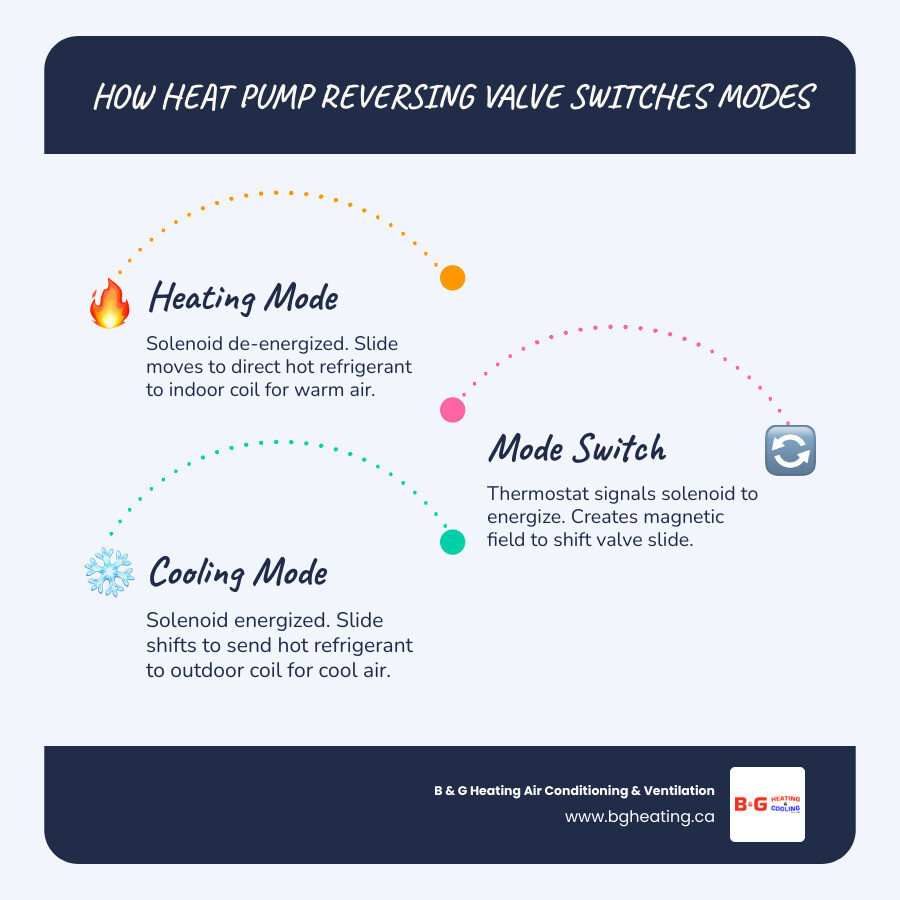
The heart of the operation is the reversing valve, often called a four-way valve. Inside this valve is a slide mechanism that physically moves to redirect the flow of refrigerant.
Think of it like a train track switch. When the slide is in one position, the refrigerant moves in a path that absorbs heat from the outside air and brings it indoors (Heating Mode). When the slide moves to the other side, the refrigerant flow is reversed, absorbing heat from your indoor air and dumping it outside (Cooling Mode).
How does it move? That’s where the solenoid comes in. The solenoid is an electrical coil that sits on top of the valve. When your thermostat calls for a mode change, it sends an electrical current to the solenoid, creating a magnetic field. This magnetic field pulls the internal slide into the “energized” state. When the power is cut, the valve returns to its “relaxed” state. If the solenoid burns out or the slide gets stuck, you end up with a heat pump not switching between heating and cooling mode.
To get the most out of this process, it helps to understand heat pump efficiency SEER ratings explained, as a healthy reversing valve is key to maintaining those high-efficiency numbers we love in Ontario.
Normal Operation Expectations in May 2026
As of May 2026, modern heat pump systems are more responsive than ever, but they aren’t instantaneous. If you’ve just toggled your thermostat, here is what is considered “normal”:
- Switching Time: It usually takes 1 to 3 minutes for the system to physically shift gears. Most systems have a built-in delay to protect the compressor from pressure spikes.
- The “Whoosh”: You might hear a brief hissing or whooshing sound from the outdoor unit. This is just the refrigerant equalizing as the valve shifts.
- Temperature Stabilization: Once the mode switches, it can take 10 to 15 minutes for the air coming out of your vents to reach its full heating or cooling potential.
Common Reasons Your Heat Pump Is Stuck in One Mode
When things go wrong, it’s usually a battle between mechanical failure and electrical confusion. In our experience serving the Hamilton and Stoney Creek areas, we see a few repeat offenders.
Thermostat and Communication Failures
Sometimes the “brain” of the house isn’t talking to the “muscles” outside. If your thermostat is miscalibrated or has a loose wire, the signal to switch modes never reaches the heat pump. Smart thermostats are great, but they can occasionally suffer from software glitches or “Auto” mode confusion where they get stuck in a loop. Checking for dead batteries or solving thermostat communication issues is often the easiest first step.
Mechanical and Electrical Component Issues
If the thermostat is working fine, the problem is likely at the unit itself.
- Solenoid Burnout: If the solenoid coil fails, it can’t create the magnetic pull needed to move the reversing valve slide.
- Stuck Slide: Over time, debris or physical wear can cause the internal slide of the reversing valve to jam. If it’s stuck in the middle, you might get lukewarm air; if it’s stuck at one end, you’re trapped in that mode forever.
- Control Board Failure: The defrost control board acts as the traffic controller. If a relay on this board fries, it won’t send power to the solenoid. This is a common part of the HVAC troubleshooter process we perform during service calls.
Airflow and Refrigerant Obstructions
It might seem unrelated, but dirty filters and low refrigerant can cause mode-switching headaches. If your refrigerant levels are low due to a leak, there might not be enough pressure to physically push the reversing valve slide into position. Similarly, if your filters are clogged, the system can overheat, causing the control board to “lock out” certain functions as a safety measure. If you notice these symptoms, it’s one of the clear signs you need heat pump repair.
Troubleshooting a Heat Pump Not Switching Between Heating and Cooling Mode
Before you panic and assume you need a whole new system, there are several “soft” fixes you can try. We always recommend starting with the basics.
Safe Homeowner Inspection Steps
- The 5-Minute Power Cycle: Go to your electrical panel and find the breaker for your heat pump. Flip it off, wait five full minutes (this allows the electronics to fully discharge and the refrigerant pressures to equalize), and flip it back on. Sometimes a hard reset is all the control board needs.
- Thermostat Check: Ensure you aren’t just in “Fan Only” mode. Set the temperature at least 3-4 degrees away from the current room temperature to force the system to engage.
- Filter Inspection: A clogged filter is the root of much HVAC evil. Replace it if it looks grey or dusty.
- Clear the Perimeter: Head outside to your unit. Ensure there is at least a 2-foot clearance around the sides and that no leaves, snow, or debris are clogging the coils. This is especially vital for heat pumps services in Hannon, ON where seasonal debris can pile up quickly.
Identifying Signs of a Faulty Reversing Valve
How do you know if the valve is truly the culprit? Listen and feel:
- The “Click” Test: Have someone switch the mode at the thermostat while you stand by the outdoor unit. You should hear a distinct “click” followed by a “whoosh.” If you hear nothing, the solenoid or thermostat signal is likely dead.
- Wrong Air Temperature: If you set the system to “Cool” and the large copper pipe at the outdoor unit is scorching hot, the valve is stuck in heating mode.
- Constant Defrost: If your unit keeps shifting into defrost mode even when it isn’t icy, the reversing valve or its sensors are likely malfunctioning. This is a common issue we address with ductless mini split HVAC services in Hannon, ON.
Professional Solutions for a Heat Pump Not Switching Between Heating and Cooling Mode
If the DIY steps didn’t do the trick, it’s time to bring in the pros. Dealing with refrigerant and high-voltage electricity isn’t just difficult; it can be dangerous without the right gear.
When to Call a Certified Technician
At B & G Heating, our technicians use specialized tools to pinpoint the failure. We can test the solenoid for a magnetic charge using a “solenoid magnet” tool—if the magnet sticks, we know the coil is getting power. If the coil is powered but the valve doesn’t move, we know the valve itself is mechanically stuck.
We also handle:
- Reversing Valve Replacement: This involves recovering the refrigerant, cutting out the old valve, and brazing in a new one. It’s a complex job that requires precision.
- Refrigerant Leak Repair: If low pressure is the cause, we find the leak, seal it, and recharge the system to factory specs.
- Control Board Swaps: If the “brain” is fried, we can replace the board and recalibrate your sensors. This is part of our professional ductless mini split HVAC services.
Preventive Maintenance for Reliable Mode Switching
The best way to avoid a heat pump not switching between heating and cooling mode is to catch small issues before they become “stuck” issues.
- Bi-Annual Tune-ups: We recommend a check-up in the spring (before cooling season) and the fall (before heating season).
- Coil Cleaning: Keeping the outdoor coils clean reduces the strain on the compressor and the reversing valve.
- Electrical Tightening: Vibrations can loosen wires over time. We check every terminal to ensure a solid connection.
Frequently Asked Questions about Heat Pump Mode Switching
How long should it take for my heat pump to switch modes?
Typically, you should notice the transition starting within 1 to 3 minutes. However, it may take up to 15 minutes for the house to actually feel the temperature change. If nothing has happened after 20 minutes, there is likely an issue.
Why is my heat pump blowing cold air when set to heat?
This could be a stuck reversing valve, but it could also be the “Defrost Cycle.” In the winter, your heat pump occasionally reverses itself to melt ice off the outdoor coils. During this 10-15 minute window, it might blow cooler air. If it lasts longer than that, you likely have a component failure.
Is it normal for my heat pump to make a whooshing noise when changing modes?
Yes! That “whoosh” is the sound of refrigerant changing direction and pressures equalizing. It’s actually a sign that your reversing valve is doing its job. However, loud banging or grinding noises are not normal and should be inspected immediately.
Conclusion
A heat pump not switching between heating and cooling mode can turn your comfortable home into an oven or an icebox in a matter of hours. Whether it’s a simple thermostat glitch or a mechanical jam in the reversing valve, getting it fixed quickly is essential for your comfort and the longevity of your system.
At B & G Heating Air Conditioning & Ventilation, we’ve been the trusted choice for families across Hamilton, Burlington, and Oakville for years. We understand the local climate and the specific demands it puts on your HVAC system. From simple maintenance to complex heat pump repair in Hamilton, our family-owned team is dedicated to quality workmanship and your total satisfaction.
Don’t spend another day in the wrong temperature. If your heat pump is acting up, give us a call and let us restore the reliable comfort you deserve. Reach out to us today to maximize comfort with ductless mini split systems or any of our traditional heat pump services!