


How a Central Air Conditioner Works — A Quick, Clear Answer
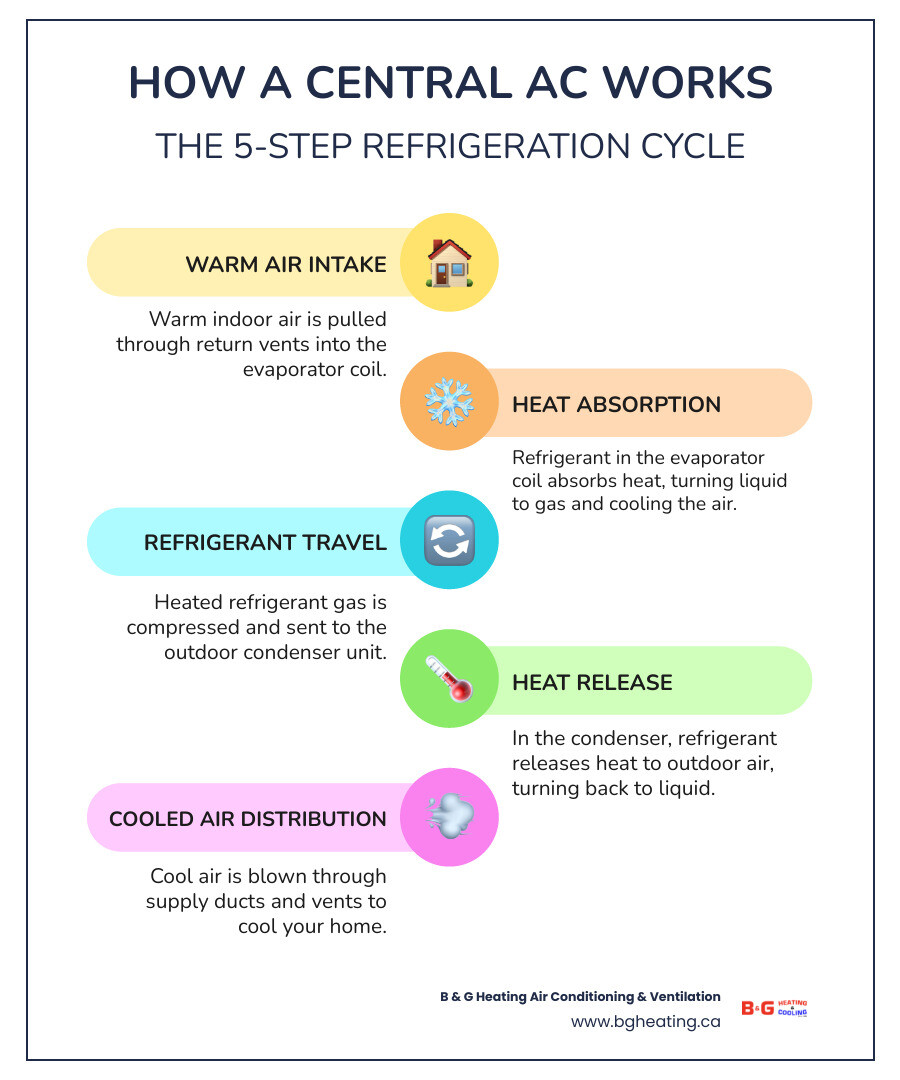
How does a central air conditioner work? Simply put, it removes heat from the air inside your home and releases it outside, leaving your living spaces cool and comfortable. Here’s the basic process at a glance:
- Warm air is pulled in through return vents inside your home.
- Refrigerant absorbs the heat as air passes over the indoor evaporator coil, cooling the air down.
- The heated refrigerant travels outside to the condenser unit, where the heat is released into the outdoor air.
- Cooled air is pushed back through supply ducts and out through vents in each room.
- The cycle repeats until your thermostat’s target temperature is reached.
This continuous loop of heat transfer — not “creating cold” — is what keeps your home comfortable all summer long.
On July 17, 1902, Willis Carrier invented the first modern air conditioning system. What started as a solution to a humidity problem in a printing plant became one of the most important home comfort technologies ever developed. By the 1960s, central air conditioning had become the standard for whole-home cooling in the United States and Canada, and it remains the most common HVAC system in use today.
For homeowners in Hamilton and the surrounding area, understanding how this system works isn’t just interesting — it helps you make smarter decisions about maintenance, repairs, and upgrades. Whether your system is running fine or giving you trouble, knowing the basics puts you in control.
Understanding the Basics: How Does a Central Air Conditioner Work?
To understand how does a central air conditioner work, we first have to clear up a common myth: air conditioners do not “create” coldness. Instead, they act like a giant heat sponge. They soak up the heat inside your home and squeeze it out into the backyard.
This magic is made possible by the refrigeration cycle and a scientific principle called “phase conversion.” This is the process of changing a substance from a liquid to a gas and back again. When a liquid turns into a gas (evaporation), it absorbs a massive amount of heat. When that gas turns back into a liquid (condensation), it releases that heat.
In your central AC system, a chemical called refrigerant travels through a closed loop of copper coils. Indoors, it evaporates to become a cold gas, sucking the heat right out of your indoor air. Outdoors, it is compressed and condensed back into a liquid, dumping that heat into the outside air. For a deeper dive into these mechanics, check out this Detailed Information On Central Air Conditioners.
The Core Components of Your Cooling System
A central air conditioner is a team effort. If one player is off their game, the whole house stays warm. Most systems we see in Hamilton and Burlington are “split systems,” meaning they have components both inside and outside the house.

There are four primary parts that make the refrigeration cycle possible:
- The Evaporator Coil (Indoor): Located inside your air handler or attached to your furnace, this is where the cooling happens. Cold refrigerant flows through these coils, and as warm air blows over them, the refrigerant “grabs” the heat.
- The Compressor (Outdoor): Often called the “heart” of the system, the compressor is the large pump in your outdoor unit. It squeezes the refrigerant gas, raising its temperature and pressure so it’s ready to release the heat it just gathered.
- The Condenser Coil (Outdoor): This is the large outdoor radiator. As the hot gas flows through these coils, a large fan blows outdoor air over them, carrying the heat away from your home.
- The Expansion Valve: This acts like a nozzle on a spray bottle. It depressurizes the refrigerant, cooling it down significantly before it heads back inside to start the process over.
You can learn more about these essential pieces in our guides on What Are The 4 Main Parts Of An Ac and the 5 Most Important Components Of An Effective Ac System.
The Role of Refrigerant in How a Central Air Conditioner Work
Think of refrigerant as the “courier” of your HVAC system. It is a specialized fluid that moves in a continuous, closed-loop system between the indoor and outdoor units. For decades, R-410A was the industry standard, but as of 2024 and 2026, newer models are transitioning to low Global Warming Potential (GWP) refrigerants to be more environmentally friendly.
The refrigerant’s job is to change pressure. When the pressure is lowered by the expansion valve, the refrigerant becomes incredibly cold. When it’s squeezed by the compressor, it becomes incredibly hot. This temperature difference is what allows it to “sponge up” heat from a 23°C living room and “dump” it into a 30°C afternoon in Stoney Creek. Understanding these terms is easier when you know the Hvac Terminology.
Thermostat Control and Air Distribution
The thermostat is the “brain” of the operation. When the temperature in your hallway rises above your setpoint—say, 22°C—the thermostat sends an electrical signal to the AC system to start the cycle.
Once the signal is received, the indoor blower motor (part of your Air Handling Unit or AHU) begins to pull warm air from your rooms through “return registers.” This air passes through a filter, over the cold evaporator coils, and is then pushed back into your home through “supply ducts.” This distribution network ensures that every room, from the basement to the attic, receives even cooling.
Comparing System Types and Efficiency Ratings
Not every central AC is built the same. In our region, from Ancaster to Niagara-on-the-Lake, we typically see two main configurations:
- Split-Systems: The most common residential setup. You have an outdoor cabinet (condenser/compressor) and an indoor coil (evaporator) usually sitting on top of your furnace.
- Packaged Units: All components are housed in one single outdoor cabinet, usually placed on a roof or a concrete slab. These are great for homes with limited indoor space.
When it comes to performance, you’ll encounter single-stage vs. two-stage systems. A single-stage unit is either 100% “on” or completely “off.” A two-stage unit is more sophisticated; it can run at 100% on the hottest days, but on milder days, it can run at about 70% capacity. This prevents the system from constantly “cycling” on and off, which saves energy and keeps the temperature more consistent.
To measure how much “bang for your buck” you’re getting, look at the SEER (Seasonal Energy Efficiency Ratio) or the newer SEER2 ratings. Newer systems can have SEER ratings as high as 26. An ENERGY STAR certified unit is typically 15% more efficient than standard models. If you’re wondering which is right for you, read more about What Is The Most Efficient Form Of Air Conditioning.
Why Proper Installation Matters for How a Central Air Conditioner Work
You could buy the most expensive, high-efficiency air conditioner on the market, but if it isn’t installed correctly, it will perform like a budget model. Proper installation is the difference between a system that lasts 20 years and one that breaks down in five.
At B & G Heating, we use professional standards like the ACCA Manual J to perform a “load calculation.” This ensures the unit is perfectly sized for your home’s square footage, insulation levels, and window exposure. An oversized unit will cool the house too fast without removing humidity, leaving you feeling clammy. An undersized unit will run forever and never get the house cool. We also focus on duct sealing to ensure the air you pay to cool actually reaches your rooms.
Learn more about the Key Steps In Ac System Installation and the Importance Of Proper Ac Installation to ensure your investment is protected.
Benefits and Maintenance for Long-Term Performance
Central air conditioning offers benefits that window or portable units simply can’t match. Beyond just cooling, it is a powerful dehumidifier. In the humid summers of Hamilton and Burlington, removing moisture from the air is often more important for comfort than lowering the temperature. Central systems also improve indoor air quality by pulling air through high-quality filters, removing dust and allergens.
However, this performance comes with a responsibility. In an average-sized home, an AC can consume more than 2,000 kilowatt-hours of electricity per year. To keep those bills low and the system healthy, maintenance is key:
- Filter Changes: Change your air filter every one to three months. A clogged filter restricts airflow, forcing the system to work harder and potentially causing the coils to freeze.
- Coil Cleaning: Outdoor coils can get covered in grass clippings, dirt, and “cottonwood” fluff. Gently hosing them off helps the system breathe.
- Annual Tune-ups: A professional inspection can catch small issues—like a failing capacitor or a slight refrigerant leak—before they turn into a mid-July breakdown.
Frequently Asked Questions About Central Cooling
Does a central AC bring in fresh air from outside?
Actually, no! This is one of the most common misconceptions. Your central AC recirculates the air already inside your home. The outdoor unit is only there to release heat. If you want fresh air, you would need a separate ventilation system like an HRV (Heat Recovery Ventilator).
What is the difference between a central AC and a heat pump?
They look almost identical and use the same refrigeration cycle to cool your home. However, a heat pump has a “reversing valve.” This allows it to flip the cycle in the winter, absorbing heat from the outdoor air and moving it inside to heat your home. It’s an incredibly efficient year-round solution.
How often should I change my air filters?
For most homes in our service area—from Brantford to Oakville—we recommend checking your filter once a month. If you have pets or allergies, you’ll likely need to replace it every 30 to 60 days. If the house is quiet and you live alone, you might get away with 90 days. A clean filter is the easiest way to prevent system strain.
Conclusion
Understanding how does a central air conditioner work helps you appreciate the complex science keeping your family comfortable. From the 1902 invention by Willis Carrier to the high-efficiency, two-stage systems of 2026, air conditioning has come a long way.
At B & G Heating Air Conditioning & Ventilation, we are proud to be your local Hamilton HVAC experts. As a family-owned company, we’ve spent years serving our neighbors in Dundas, Waterdown, Stoney Creek, and beyond. We specialize in quality workmanship and reliable solutions that keep your home’s air perfectly chilled all summer long.
Whether you are looking for a new installation, a quick repair, or a seasonal tune-up to keep your system running efficiently, we are here to help. Schedule your cooling service today and experience the comfort you deserve.