


Your Heat Pump Needs Servicing More Often Than You Think
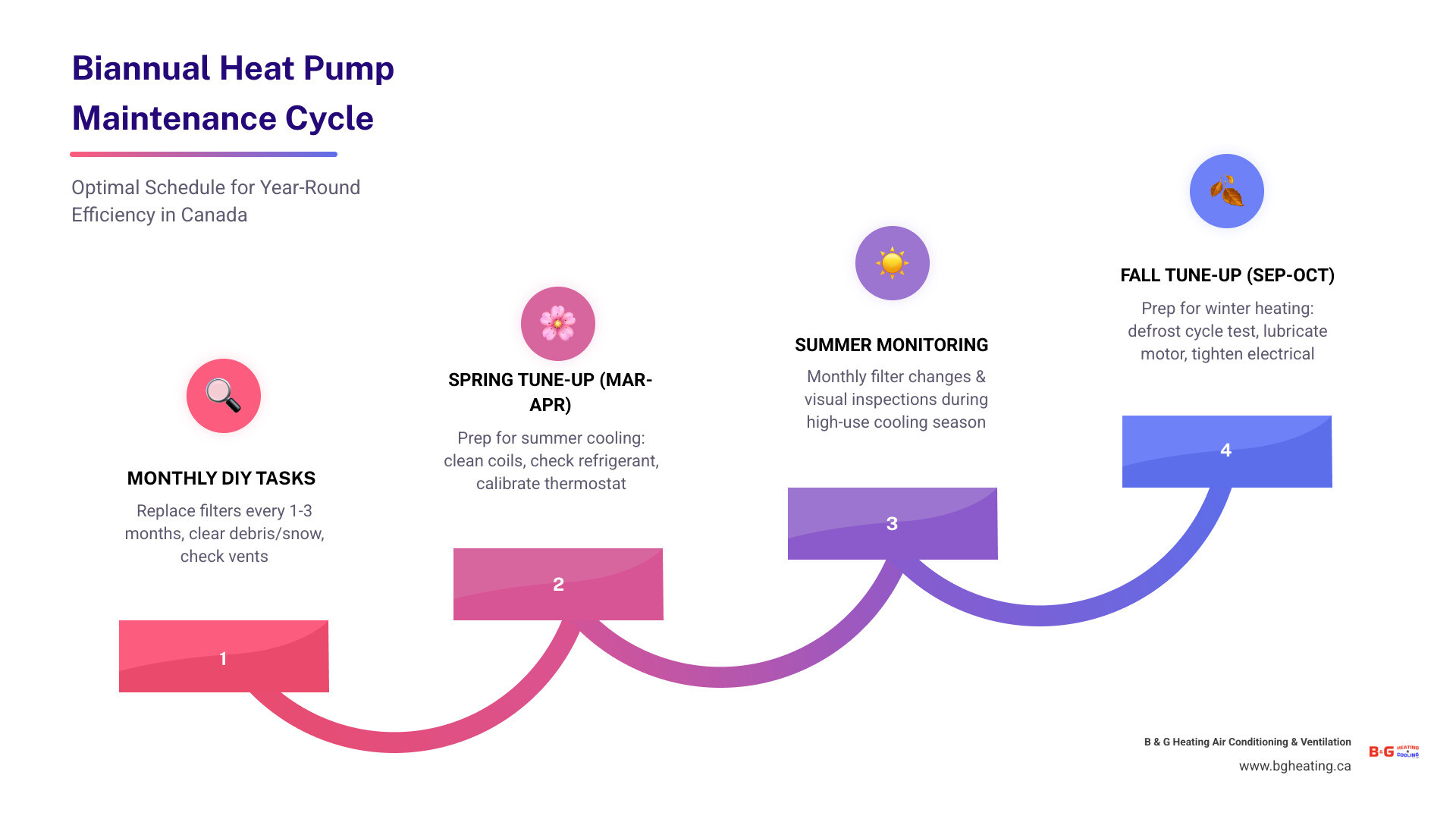
How often should a heat pump be serviced in Canada is one of the most common questions homeowners ask — and the short answer is twice a year: once in spring and once in fall.
Here’s a quick breakdown:
| Service Type | Frequency | Best Timing |
|---|---|---|
| Professional tune-up | Twice per year | Spring (March–April) and Fall (September–October) |
| Filter replacement | Every 1–3 months | Year-round (monthly if you have pets) |
| Debris and snow clearance | Monthly or as needed | Year-round |
| Full DIY visual inspection | Monthly | Year-round |
Unlike a furnace that only runs in winter, or an air conditioner that only runs in summer, your heat pump runs all year long. It heats your home in winter and cools it in summer — with no off-season to recover. That means it accumulates twice the wear of a traditional HVAC system, and it needs twice the maintenance to match.
In Hamilton’s four-season climate, where winters can push well below -15°C and summers bring high humidity, that wear adds up fast. Research from the U.S. Department of Energy shows that a well-maintained heat pump can operate up to 25% more efficiently than a neglected one. An NREL analysis of over 550,000 households found that properly maintained heat pumps cut home energy use by 31% to 47% — translating to real savings for Canadian homeowners every single year.
Skipping even one service visit can quietly cost you — through higher energy bills, shorter equipment life, and the risk of a breakdown on the coldest night of the year.
Determining How Often Should a Heat Pump Be Serviced in Canada

When we talk about the Canadian climate, especially in Southern Ontario regions like Hamilton, Burlington, and Stoney Creek, we aren’t just dealing with “cold.” We are dealing with dramatic seasonal transitions. One week we’re scraping frost off the windshield, and the next, we’re dealing with the heavy humidity of the Great Lakes.
Because your heat pump is the workhorse behind both your heating and cooling, it doesn’t get a “summer vacation” or a “winter nap.” This continuous operation is the primary reason why the answer to how often should a heat pump be serviced in Canada is strictly biannual.
Biannual Schedule: Spring and Fall
We recommend scheduling your professional tune-ups during the “shoulder seasons.”
- Spring (March–April): This prepares the reversing valve and cooling components for the upcoming summer humidity.
- Fall (September–October): This ensures the defrost cycle and auxiliary heating elements are ready to handle the sub-zero temperatures of an Ontario winter.
A professional visit during these times ensures that the system is optimized for the specific demands of the upcoming season. To better understand how these service visits keep your system running at peak performance, it helps to Understand Heat Pump Efficiency Seer Rating Explained. A high SEER or HSPF rating only stays high if the components are clean and calibrated.
Why Biannual Service Outperforms Annual Checks
You might be tempted to think, “My furnace only needed one visit a year, why is this different?” It comes down to component wear. A heat pump’s compressor and fan motor work roughly 4,000 to 5,000 hours per year in a four-season climate. A traditional furnace might only run for 2,000 hours.
By choosing a biannual schedule, you are effectively doubling the lifespan of your equipment. Well-maintained heat pumps in Ontario can last 15 to 20 years. If you neglect them, that lifespan can plummet to just 8 to 10 years. Regular Tag/Hvac Maintenance is the single most effective way to prevent the “January panic” when the heat goes out during a cold snap.
How Often Should a Heat Pump Be Serviced in Canada for Maximum Efficiency?
Efficiency isn’t just a buzzword; it’s a reflection of your monthly budget. In Canada, a neglected heat pump can consume 10% to 25% more energy than a clean one. When we perform Heat Pumps Services Hannon On, we focus on optimizing the Coefficient of Performance (COP).
In extreme cold, your heat pump has to work harder to extract heat from the outdoor air. If the coils are dirty or the refrigerant is slightly low, the system will rely more heavily on its “backup” or auxiliary electric heat strips. These strips are much more expensive to run. Proper maintenance ensures your heat pump stays in its “efficient zone” longer, saving homeowners in places like Ancaster or Waterdown between $400 and $800 CAD annually on energy bills.
Why Heat Pumps Require More Care Than Traditional Furnaces
A heat pump is a more sophisticated piece of machinery than a standard furnace or AC unit. While a furnace simply burns fuel to create heat, a heat pump uses a complex refrigeration cycle to move heat from one place to another.
| Feature | Traditional Furnace | Traditional AC | Heat Pump |
|---|---|---|---|
| Operation | Heating only | Cooling only | Heating & Cooling |
| Active Months | 5–6 months | 3–4 months | 12 months |
| Complexity | Moderate | Moderate | High (Reversing valves, defrost boards) |
| Service Frequency | Annual | Annual | Biannual |
The Complexity of Dual-Purpose Mechanics
The most critical difference is the reversing valve. This is the component that allows the heat pump to switch from “AC mode” to “Heat mode.” If this valve sticks due to lack of lubrication or debris, you could find yourself with a giant air conditioner in the middle of December.
Furthermore, heat pumps have a defrost cycle. In the Ontario winter, frost naturally builds up on the outdoor coils. The system must periodically switch modes to melt that ice. If the sensors are dirty or the defrost board is malfunctioning, the unit will turn into a solid block of ice, leading to a total system failure. This is why a Guide To Professional Furnace Service isn’t enough for heat pump owners—you need specialized heat pump expertise.
Impact of Extreme Canadian Temperatures on Service Needs
Our local weather in the Golden Horseshoe is “dramatic,” to put it mildly. We see everything from -25°C wind chills to 35°C humidex readings.
- Sub-zero Operation: In deep winter, the compressor operates at higher pressures.
- Summer Humidity: High humidity levels mean the condensate drain line works overtime to remove moisture from your indoor air. If this line clogs with algae or dust, it can back up and cause water damage to your home.
If your system is struggling with these extremes, you may notice Heat Pump Repair Hamilton becomes necessary sooner than expected. Regular servicing catches these “strain points” before they turn into broken parts.
Warranty Compliance and Professional Documentation
Did you know that skipping your maintenance could actually void your warranty? Most major manufacturers (like Mitsubishi, Daikin, or Lennox) explicitly state in their fine print that regular professional maintenance is required to keep the parts warranty valid.
If a compressor fails in year seven, the manufacturer may ask for “proof of service.” If you can’t provide records of professional Furnace Maintenance And Tune Up Services (or the heat pump equivalent), they may deny your claim. We provide detailed, written documentation after every visit to ensure your investment stays protected.
Professional Maintenance Checklist vs. Homeowner DIY Tasks
While we handle the technical “heavy lifting,” there are things you can do to help. Think of us as the doctor giving the check-up, while you are the one responsible for the daily “diet and exercise” of your HVAC system.
What We Do During a Professional Visit
A professional tune-up is much more than just a quick look. It is a 21-point (or more) inspection that includes:
- Refrigerant Charge: Checking for leaks and ensuring the levels are exact. Too much or too little refrigerant can destroy a compressor.
- Electrical Tightening: Canadian temperature swings cause wires to expand and contract, which can loosen connections over time.
- Coil Cleaning: We clean both the indoor evaporator coil and the outdoor condenser coil. Even a thin layer of dust acts like an insulator, forcing the system to work 20% harder.
- Component Lubrication: Moving parts like the blower motor need oil to reduce friction and heat.
- Thermostat Calibration: Ensuring your “brain” is talking correctly to the “muscles.”
For a deeper look at what these visits entail, you can check our guide on What Is Covered In A Furnace Or Boiler Tune Up, which shares many similarities with the heat pump process.
Essential Monthly DIY Maintenance for Homeowners
The most important thing you can do is change your air filter.
- Frequency: Every 1 to 3 months. If you have a Golden Retriever or a Persian cat, make it once a month.
- Airflow: A dirty filter is like trying to run a marathon while breathing through a pillow. It strains the motor and can even cause the indoor coil to freeze.
Other DIY tasks include:
- Clear Debris: Keep leaves, twigs, and grass clippings at least 18 inches away from the outdoor unit.
- Snow Clearance: After a Southern Ontario blizzard, ensure snow isn’t burying the unit. A buried heat pump cannot “breathe” and will shut down.
- Visual Inspection: Look for Signs You Need Heat Pump Repair, such as oil leaks around the base or frayed wiring.
Factors That Increase How Often Should a Heat Pump Be Serviced in Canada
Not every home is the same. Some factors might mean you need to keep a closer eye on your system:
- Pets: Dander and fur clog filters and coils faster.
- Renovations: Drywall dust is the “silent killer” of HVAC systems. If you’ve recently renovated your home in Dundas or Burlington, your system needs a deep clean immediately.
- High Pollen: If you live near heavy foliage or parks, your outdoor coils will likely get “carpeted” in pollen every spring.
- Multi-Zone Systems: Mini-splits with multiple indoor heads have more valves and sensors that require checking.
Risks of Skipping Scheduled Heat Pump Maintenance
What happens if you just… don’t do it? In the short term, you might not notice much. But underneath the cabinet, the damage is cumulative.
- Financial Loss: You will pay 10% to 25% more on your utility bills every single month. Over five years, that’s thousands of dollars literally disappearing into thin air.
- The “Year 8” Wall: Many neglected heat pumps fail completely around year 8. A well-maintained system will sail right past year 15.
- Indoor Air Quality: Your heat pump is also an air purifier. If the coils are damp and dirty, they can become a breeding ground for mold and bacteria, which is then blown into your living room.
- Inconsistent Comfort: You’ll notice “hot spots” or “cold spots” as the system loses its ability to move heat effectively.
Frequently Asked Questions About Heat Pump Servicing
When is the best time to schedule professional service?
The absolute best times are March/April and September/October. By booking during these windows, you beat the “emergency rush.” When the first -10°C night hits Hamilton, our phones ring off the hook with emergency repairs. By servicing in the fall, you ensure you aren’t one of the people waiting in the cold.
What are the signs my heat pump needs immediate attention?
Don’t wait for your scheduled visit if you notice:
- Strange Noises: Grinding, squealing, or loud rattling.
- Ice Accumulation: If the unit stays covered in ice even when it’s not freezing outside.
- Frequent Cycling: If the unit turns on and off every few minutes (short-cycling).
- The “Smell”: A musty or “dirty sock” smell coming from the vents.
How often should a heat pump be serviced in Canada if it is a hybrid system?
Many homes in our service area use a “Dual-Fuel” or hybrid system—a heat pump paired with a gas furnace. In this case, the maintenance is even more vital. You need a biannual check for the heat pump and an annual safety check for the furnace. We often perform these together in the fall to ensure the “hand-off” between the two systems is seamless.
Conclusion
At B & G Heating Air Conditioning & Ventilation, we’ve seen how a little bit of prevention goes a long way. As a family-owned business serving Hamilton and the surrounding communities—from Grimsby to Brantford and Oakville to St. Catharines—we treat your home’s comfort as our own.
Understanding how often should a heat pump be serviced in Canada is the first step toward a more efficient, comfortable, and affordable home. Don’t let your “silent guardian” struggle through another season alone. Whether you’re in a modern townhouse in Stoney Creek or a classic home in Dundas, regular maintenance is the key to longevity.
Ensure your system is ready for the season by booking your professional heat pump service today