


Understanding the Difference Between the Indoor Air Handler and Outdoor Condenser Unit
The difference between the indoor air handler and outdoor condenser unit is straightforward: one manages airflow inside your home, and the other releases heat outside. Together, they form the two halves of a split HVAC system — and understanding what each one does can save you a lot of confusion when something goes wrong or when it’s time for an upgrade.
Here’s a quick side-by-side breakdown:
| Feature | Indoor Air Handler | Outdoor Condenser Unit |
|---|---|---|
| Location | Inside the home (attic, basement, utility closet) | Outside on a concrete slab |
| Main function | Circulates and distributes conditioned air | Releases heat from inside your home to the outdoors |
| Key components | Blower motor, evaporator coil, air filter | Compressor, condenser coil, exhaust fan |
| Refrigerant state | Absorbs heat as refrigerant evaporates | Releases heat as refrigerant condenses |
| Moisture role | Removes humidity from indoor air | No direct role in dehumidification |
Most homeowners in Hamilton and the surrounding area interact with these two components every single day — they just don’t always know what they’re looking at. Whether you’re troubleshooting a comfort issue, planning a replacement, or just trying to understand your system better, knowing how these units differ (and how they work together) is the first step.
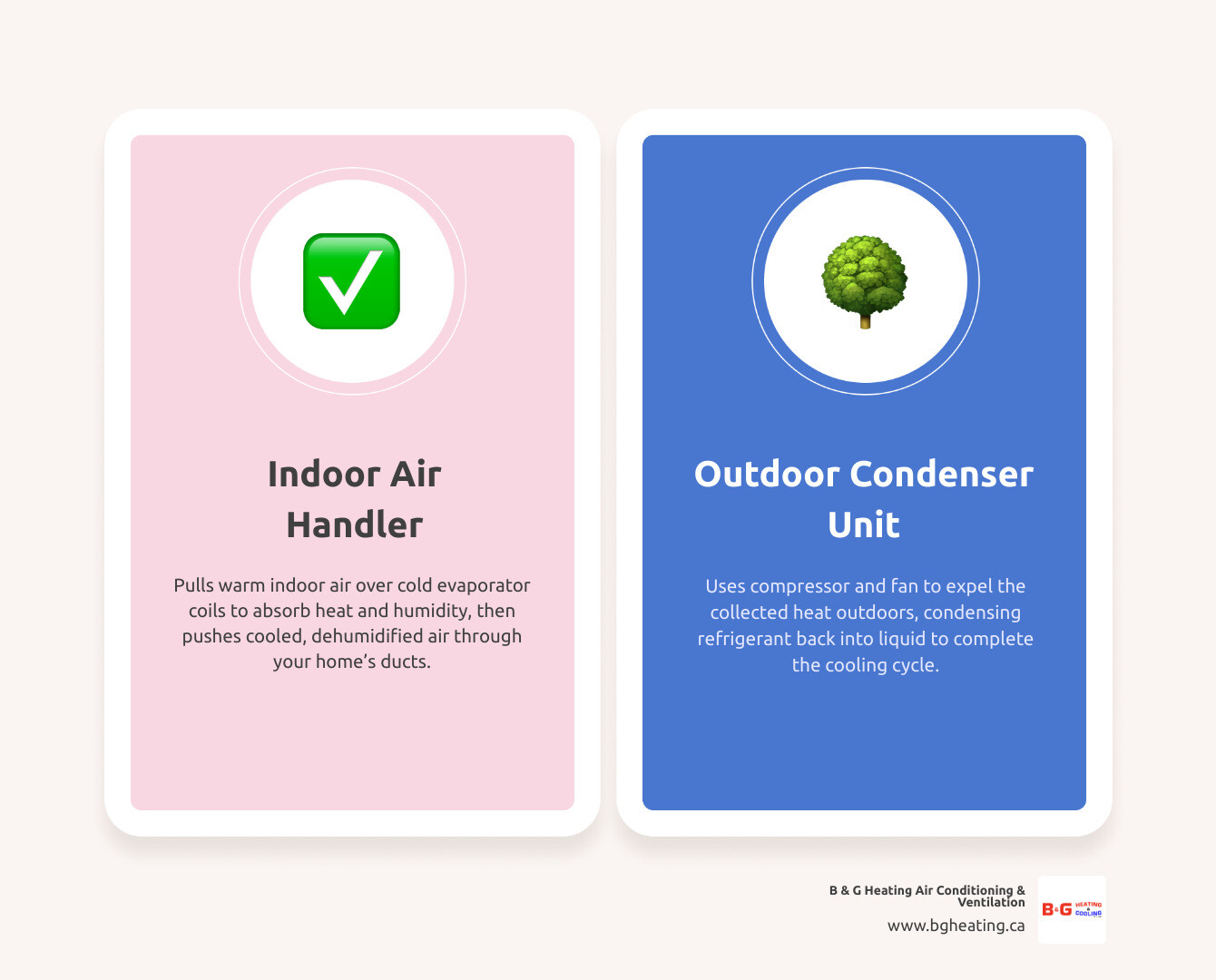
To dive deeper, the air handler is essentially the “lungs” of your home, while the condenser is the “heat dump.” In a cooling cycle, the air handler pulls warm air from your rooms, passes it over a cold evaporator coil to absorb heat, and then pushes that cooled air back through your vents. Meanwhile, the heat absorbed by the refrigerant is pumped outside to the condenser. The condenser then uses a high-powered fan and a compressor to squeeze that heat out into the Hamilton air. For more foundational knowledge, check out this Detailed Information on Central Air Conditioners.
It is important to remember that these units are a team. You can’t have one without the other in a standard split system. If you want to know more about the broader picture, you can read about What Are the 4 Main Parts of an AC? to see how these two units fit into the overall machinery of your home’s comfort.
Key Components and Locations of Your HVAC System

Knowing where your equipment lives is the first step in basic home maintenance. In our region—from the historic homes in Dundas to the newer builds in Binbrook—the indoor air handler is typically tucked away in a utility closet, a basement, or even an attic. Its job is to be the central hub for air distribution.
The air handler is a large metal box that houses several critical parts. First, there is the evaporator coil, which is where the actual cooling happens as refrigerant flows through it. Then there is the blower motor, a powerful fan that moves the air through your ductwork. Finally, it holds your air filters, which catch dust and allergens before they circulate through your living spaces. These are among the 5 Most Important Components of an Effective AC System.
Internal Components of the Outdoor Condenser Unit
While the air handler stays cozy inside, the condenser unit is built to brave the elements. Usually sitting on a sturdy concrete slab in your backyard or at the side of your house, this unit is designed for heat dissipation.
Inside that weatherproof metal housing, you’ll find:
- The Compressor: Often called the “heart” of the system, this part circulates the refrigerant between the indoor and outdoor units. It also consumes the most energy.
- The Condenser Coil: A series of fins and tubes where the heat collected from inside is released to the outside air.
- The Exhaust Fan: This pulls air across the condenser coils to speed up the cooling of the refrigerant.
Where to Find the Difference Between the Indoor Air Handler and Outdoor Condenser Unit in Your Home
If you are walking around your property in Ancaster or Stoney Creek, you can easily spot the difference between the indoor air handler and outdoor condenser unit by their footprints. The indoor unit is connected to your home’s ductwork and occupies a relatively small vertical or horizontal space inside.
The outdoor unit requires “breathing room.” We always recommend at least two feet of clearance around the condenser to ensure it can exhaust heat properly. These two units are physically linked by refrigerant lines (copper pipes) and electrical wiring. If you look near your outdoor unit, you’ll also see an electrical disconnect box—a safety switch used by technicians during repairs.
Why Matching Your Indoor and Outdoor Units is Essential
As we move through May 2026, HVAC technology has become incredibly precise. One of the biggest mistakes a homeowner can make is trying to “mix and match” indoor and outdoor units from different brands or different eras. For a system to run at its peak, the air handler and condenser must be a “matched pair.”
This compatibility is often verified by AHRI certification (Air-Conditioning, Heating, and Refrigeration Institute). When units are matched, they are guaranteed to work together to achieve their advertised SEER2 ratings (Seasonal Energy Efficiency Ratio). Proper matching ensures that the blower motor in the air handler provides the exact amount of airflow needed for the condenser’s capacity. For the best results, you should always prioritize AC Installation for Peak Performance and understand the Importance of Proper AC Installation.
The Risks of a Mismatched Difference Between the Indoor Air Handler and Outdoor Condenser Unit
What happens if you ignore this advice? A mismatched difference between the indoor air handler and outdoor condenser unit can lead to a host of expensive problems.
- Energy Waste: A mismatched system could cost you 20–40% more in electricity because the units are “fighting” each other rather than working in harmony.
- Warranty Void: Most manufacturers will not honor a warranty if the indoor and outdoor units aren’t compatible.
- Refrigerant Issues: Older air handlers might not be compatible with modern refrigerants like R-32, which is the current standard for efficiency and environmental safety in 2026.
- Premature Failure: If the condenser is too powerful for the indoor coil, the system will cycle on and off too frequently, wearing out the compressor years before its time.
Following the Key Steps in AC System Installation is the only way to ensure your investment lasts as long as it should.
Maintenance and Troubleshooting for Long-Term Performance
Maintaining your HVAC system doesn’t have to be a chore, but it is necessary. Because the indoor and outdoor units do different jobs, they have different maintenance needs. Indoors, your focus should be on filter changes every 60 to 90 days and ensuring the condensate drain is clear. In humid climates like we often see in the Golden Horseshoe, algae can grow in these drains, leading to clogs and water damage.
Outdoors, the condenser needs to stay clean. Grass clippings, leaves, and pollen can clog the condenser coils, forcing the unit to work harder. We recommend gently hosing off the unit (with the power off!) and keeping plants trimmed back. If you are in Hannon, you might consider a professional AC Maintenance Tune-Up Hannon ON to handle the deep cleaning. The Benefits of Regular AC Maintenance include lower bills and a much longer system lifespan.
Signs of Failure in Your Air Handler or Condenser
How do you know which unit is acting up? Here are some common red flags:
- Weak Airflow: This usually points to a problem with the indoor air handler’s blower motor or a very dirty filter.
- Strange Noises: Squealing or grinding inside usually means a blower issue; loud banging or buzzing outside often indicates a failing compressor or fan motor in the condenser.
- Uneven Cooling: If some rooms are hot while others are cold, your system might be struggling to distribute air (air handler) or losing its ability to remove heat (condenser).
- Frozen Coils: If you see ice on the indoor unit or the copper pipes, you likely have an airflow restriction or a refrigerant leak.
If you notice any of these, it’s time to call for AC Service Hannon ON before a small problem becomes a total system breakdown.
Frequently Asked Questions about HVAC Units
Can I replace just the outdoor condenser?
While it is technically possible to replace only the outdoor unit, we almost never recommend it. A partial replacement creates a “mismatched” system. Your old indoor air handler likely won’t have the efficiency or the coil design to keep up with a modern, high-SEER2 condenser. This leads to efficiency loss, reduced reliability, and often voids your manufacturer’s warranty. It’s almost always better to replace both units at once to ensure a fresh start and long-term peace of mind.
How long do these units typically last?
In our region, AC systems typically last 10 to 15 years. However, this depends heavily on maintenance. A unit that is never cleaned and has a clogged filter might die in 8 years, while a well-maintained system in a shaded spot in Burlington or Oakville might push toward the 20-year mark. Environmental factors, like salt air if you’re very close to the lake or heavy cottonwood seeds in the spring, can also accelerate wear on the outdoor condenser.
Does an air conditioner always need an air handler?
Not exactly. In many Hamilton homes with gas heating, the “air handler” function is actually performed by your furnace blower. In this setup, an evaporator coil is mounted on top of your furnace, and the furnace’s fan pushes the air through. However, if you have an all-electric home or a heat pump system, you will likely have a dedicated air handler designed specifically for that purpose. Both setups require ductwork to distribute the air throughout your home.
Conclusion
Understanding the difference between the indoor air handler and outdoor condenser unit helps you become a more informed homeowner. When these two units work in perfect harmony, you get lower energy bills, better indoor air quality, and a home that stays perfectly cool even during the most humid Ontario summers.
At B & G Heating Air Conditioning & Ventilation, we’ve spent years helping families in Hamilton, Haldimand, and the surrounding communities find the perfect balance for their home comfort. Whether you need a quick repair or a full system replacement, our team is dedicated to quality workmanship and your total satisfaction. Don’t wait for a heatwave to find out your system is struggling.
Explore our full range of Air Conditioning Services Hannon ON or Schedule your professional HVAC consultation today to ensure your home stays comfortable all year long.