


The Definitive Guide to AC Repair vs Replace
Should You Repair or Replace Your AC? Start With This AC Repair vs Replace Decision Guide
This AC repair vs replace decision guide gives you a clear, math-based way to make the right call — without the stress of deciding under pressure.
Quick Answer: Repair or Replace?
| Situation | Recommendation |
|---|---|
| Unit under 8-10 years old, single issue, stable bills | Repair |
| Age × repair cost under $5,000, warranty active | Repair |
| Unit 12+ years old, 3+ repairs in 3 years | Replace |
| Age × repair cost over $5,000 | Replace |
| Repair cost is 50%+ of a new system’s price | Replace |
| System uses R-22 refrigerant (pre-2010) | Replace |
| Rising energy bills, poor comfort, safety concerns | Replace |
When your AC stops working on the hottest day of a Hamilton summer, the first instinct is to fix it fast and move on. But that split-second decision — repair or replace — can cost you thousands if you get it wrong. A system that’s too old, too inefficient, or too far gone will just break down again. And a brand-new replacement on a unit that had years of life left is money you didn’t need to spend.
The good news? This doesn’t have to be a gut-call. There are straightforward rules and clear warning signs that take the guesswork out of it. Whether your AC just quit or you’re noticing higher bills and weaker cooling, this guide walks you through everything you need to make a confident, informed decision.
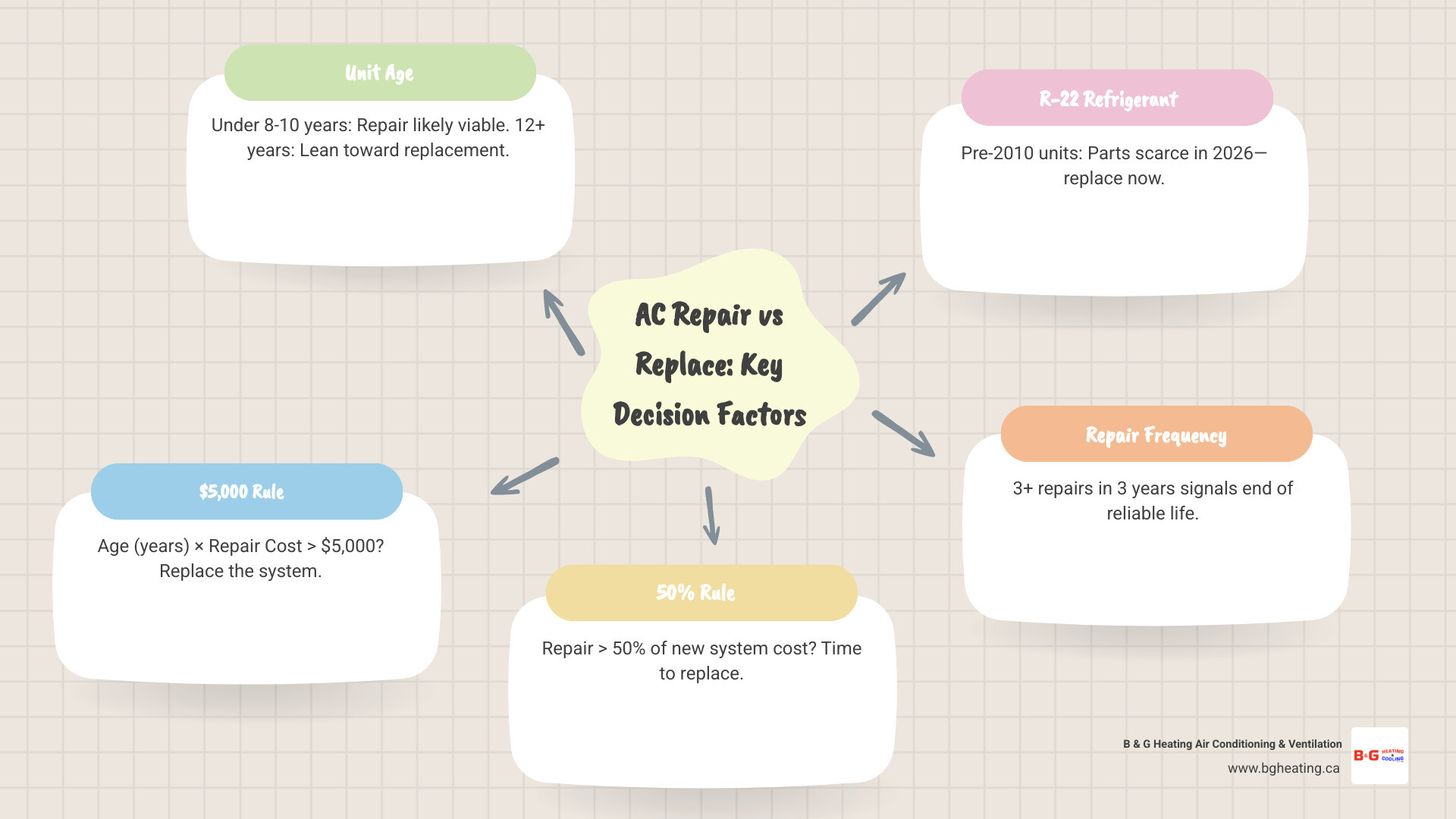
Why this decision feels urgent in summer
Summer AC problems always feel like emergencies because, honestly, they are. When your home is hot, sticky, and getting more uncomfortable by the hour, it is easy to say yes to the first option that gets cool air moving again.
That urgency is exactly why homeowners sometimes make the wrong call. A quick repair can be the smart move, but only if the system is still worth saving. If not, that emergency fix may just buy a little time before the next failure.
We always recommend taking one breath, then looking at the big four factors before deciding.
The four factors that matter most before you decide
The most reliable repair-vs-replace decision usually comes down to these four things:
- Age of the unit
- Repair frequency
- Energy efficiency
- Comfort and performance problems
If your AC is young, has been dependable, and needs one isolated fix, repair often makes sense. If it is older, breaking down regularly, running up utility bills, and leaving some rooms feeling like saunas, replacement usually wins.
How Long AC Systems Last and When Repair Still Makes Sense

Most central air conditioners last about 10 to 15 years. With excellent maintenance, some make it closer to 20. Without regular service, many do not get anywhere near that far.
In Hamilton and surrounding areas, humidity, long cooling seasons, airflow issues, and general wear all affect lifespan. Moisture and corrosion can be especially hard on coils over time. Annual tune-ups, filter changes, and prompt small repairs can stretch system life, but they cannot stop aging forever.
What is the average lifespan of a central AC unit?
In 2026, the average lifespan of a central AC unit is still about 10 to 15 years. That is the benchmark most homeowners should use.
A few important notes:
- Well-maintained systems may last longer
- Heavily used systems often wear out sooner
- Poor installation or duct problems can shorten lifespan
- Neglected maintenance speeds up breakdowns
So if your unit is 14 years old and acting up, that is very different from a 6-year-old unit with its first capacitor issue.
When should you repair your AC instead of replacing it?
Repair is usually the better move when the system is still in the first half of its life and the issue is limited.
Repair often makes sense if:
- Your AC is under 8 to 10 years old
- This is the first major problem
- Cooling performance has otherwise been solid
- Your energy bills have stayed fairly stable
- The issue is clearly isolated
- The system is still under warranty
Examples of repair-friendly problems include a failed capacitor, thermostat issue, clogged drain, contactor problem, or other single-component fault on an otherwise healthy system.
If that sounds like your situation, our air conditioning repair services may be the practical next step.
How age should factor into the repair decision
Age matters, but it should not be the only factor.
A simple way to think about it:
- Under 10 years: Lean toward repair
- 8 to 12 years: Evaluate carefully
- 12+ years: Lean toward replacement
That said, age is not a verdict by itself. A well-maintained 10-year-old system with one repair may still be a keeper. A neglected 9-year-old system with repeated problems may already be on borrowed time.
The real question is not just “How old is it?” but “How much reliable life is left?”
The Math That Simplifies the AC Repair vs Replace Decision Guide
Rules of thumb are helpful because they remove emotion from the choice. They are not perfect, but they are very useful.
Below is a simple comparison:
| Factor | Repair Usually Makes Sense | Replacement Usually Makes Sense |
|---|---|---|
| Age | Under 8-10 years | 12+ years |
| Repair history | Rare service calls | 3+ repairs in 3 years |
| $5,000 Rule | Under threshold | Over threshold |
| 50% Rule | Well below 50% | At or above 50% |
| Efficiency | Bills stable | Bills rising noticeably |
| Refrigerant | Modern refrigerant | R-22 system |
| Comfort | Home cools evenly | Humidity, hot spots, weak airflow |
How the $5,000 Rule works in real life
The $5,000 Rule is simple:
- Multiply the age of the AC by the repair cost
- If the result is over $5,000, replacement is usually the better long-term choice
It is not a law of physics. It is a shortcut that helps homeowners avoid sinking money into aging equipment.
Examples:
- An 8-year-old system with a modest repair: 8 × repair cost may land under the threshold, so repair may make sense
- A 12-year-old system with a more serious repair: 12 × repair cost may exceed the threshold, making replacement the smarter bet
This rule works best when paired with common sense. If the system is old, inefficient, and already has a repair history, the formula becomes even more useful.
What the 50% Rule means for AC replacement
The 50% Rule says this: if the repair is 50% or more of the cost of a new system, replacement usually makes more sense.
Why? Because once one major component fails on an older AC, others often follow. Compressors, evaporator coils, and blower-related failures can be signs the whole system is nearing the end.
This is especially true if:
- The unit is older than 10 to 12 years
- The warranty has expired
- Comfort problems existed before the breakdown
- The same unit has needed several repairs recently
Think of it as a warning light, not just a math problem.
How to calculate total cost of ownership over the next few years
A smart decision is not about one repair bill. It is about what ownership will look like over the next 3 to 5 years.
Consider:
- Expected future repairs
- Annual maintenance needs
- Energy use
- Risk of downtime during peak summer
- Warranty protection on a new system
- Available rebates and incentives
- Home comfort and humidity control
Older systems often cost more to keep because they run longer and less efficiently. Research consistently shows that upgrading from older 10-13 SEER equipment to modern higher-efficiency systems can reduce cooling energy use by roughly 20% to 40%, depending on the home and usage.
Variable-speed systems can also improve humidity control and reduce short cycling, which matters a lot in Southern Ontario summers.
Signs It’s Time to Replace Your AC System Instead of Repairing It
Some systems tell you clearly when they are nearing the end. Others whisper for a while, then quit on the hottest weekend of the year. Very dramatic.
Here are the signs replacement deserves serious consideration.
Why repeated repairs are a warning sign, not bad luck
If you have had 3 or more repairs in the past 3 years, that is usually not bad luck. It is a pattern.
Aging ACs tend to fail in clusters. One part wears out, which puts stress on another. Then another component follows. Homeowners often feel like they are playing mechanical whack-a-mole.
Replacement is often smarter when:
- Breakdowns happen every summer
- You had multiple service calls in one season
- The same symptoms keep coming back
- Reliability matters more than squeezing out one last year
Frequent repairs are the AC equivalent of your car saying, “We need to talk.”
How energy efficiency and rising utility bills change the equation
Efficiency is one of the biggest hidden factors in this decision.
Many older systems operate around 10 to 13 SEER. Modern air conditioners can reach 18 to 25+ SEER2, depending on the system. That gap can translate into significantly lower energy use, often around 20% to 40% less for homeowners replacing an outdated unit.
Watch for these clues:
- Summer hydro bills keep climbing
- The AC runs longer than it used to
- Your home stays warm even with the thermostat set low
- Utility costs rose by 15% or more year over year without another clear cause
A newer high-efficiency system can also provide steadier temperatures, quieter operation, and better moisture removal.
Comfort problems that point to replacement
Sometimes the AC is technically running, but the house still does not feel right. That matters.
Replacement may be the better choice if you notice:
- Hot and cold spots between rooms
- Sticky indoor air or poor humidity control
- Weak airflow at vents
- Constant running without reaching set temperature
- Short cycling
- Increasing noise or vibration
A newer system, especially one with variable-speed technology, can often solve comfort issues that repairs alone cannot fully fix.
If you are seeing the early warnings, our guides on when to consider AC replacement and warning signs your AC needs replacement can help you compare symptoms.
Safety issues that mean you should replace immediately
Some problems are not really repair-vs-replace debates. They are safety decisions.
Replace immediately, or at minimum stop using the system until it is professionally assessed, if you notice:
- Burning smells
- Repeated breaker trips
- Damaged wiring
- Electrical arcing
- Significant water leakage near electrical components
- Indoor air quality concerns linked to system condition
Safety always comes first. No amount of “getting one more season out of it” is worth a fire risk or major home damage.
Refrigerant, Warranties, and Incentives: The Overlooked Decision Factors
Why R-22 systems should usually be replaced in 2026
If your AC uses R-22 refrigerant, replacement is usually the right call in 2026.
Why?
- R-22 has been phased out
- It is increasingly scarce
- Leak repairs and recharging are harder and more expensive
- Systems using it are typically older anyway
In practical terms, an R-22 leak often means you are putting money into outdated technology with limited future support. For most pre-2010 units, replacement is the more sensible long-term decision.
How warranties can tip the decision toward repair
Warranty coverage can change the math significantly.
Repair may make more sense when:
- Major parts are still covered
- The compressor or coil remains under warranty
- The unit was properly registered
- The system is otherwise in good condition
That is one reason we always recommend checking warranty status before making a final decision. A covered component on a younger unit is a strong argument for repair.
How rebates and incentives can improve replacement value
Replacement can become more attractive when incentives are available.
Depending on the system and current program rules, homeowners may qualify for:
- Federal efficiency-related tax credits
- Utility rebates
- Manufacturer promotions
- Seasonal installation incentives
Research for 2026 points to federal tax credits of up to $2,000 for qualifying high-efficiency upgrades. These programs can lower the overall ownership cost of replacement and improve the long-term value of installing a better system.
For more on why replacement can make sense, see the importance of AC replacement.
How to Get an Honest AC Assessment and Avoid Costly Mistakes
A good assessment should look at the entire system, not just the broken part. That means airflow, ductwork, refrigerant type, repair history, sizing, humidity control, and overall equipment condition.
Questions to ask during an AC repair vs replace decision guide assessment
When we assess a system, these are the kinds of questions homeowners should ask:
- How old is the system?
- What refrigerant does it use?
- Is this an isolated repair or a sign of broader wear?
- What is the system’s efficiency level?
- How much useful life is likely left?
- Is the indoor and outdoor equipment properly matched?
- Is the AC correctly sized for the home?
- Are ductwork or airflow issues contributing to the problem?
- Would repair solve the comfort issue, or only the immediate failure?
- Is there any active warranty coverage?
For more questions to bring to your appointment, read these essential inquiries before repairing or replacing your air conditioner.
Common mistakes homeowners make when deciding
We see the same avoidable mistakes over and over:
- Choosing by age alone
- Ignoring repeated repair history
- Overlooking maintenance history
- Replacing only the outdoor unit when the system is mismatched
- Chasing the lowest short-term option
- Waiting until total failure in peak summer
- Assuming poor comfort is “normal”
One of the biggest mistakes is replacing only part of the system without checking compatibility. Mismatched equipment can reduce efficiency and create new problems.
Simple checks homeowners can make before booking service
Before assuming the worst, check a few basics:
- Thermostat settings and batteries
- Air filter condition
- Breaker status
- Open and unblocked supply vents
- Debris around the outdoor unit
- Water around the unit
- Ice on the coil or refrigerant lines
If you find ice, shut the system off and call for service. Running a frozen unit can make things worse.
For more warning signs, visit signs your AC needs immediate repair. You can also learn more about proper service decisions in handle AC repair with care and rely on us for AC repair services.
FAQs About This AC Repair vs Replace Decision Guide
What is the average lifespan of a central AC unit in 2026?
The average central AC lifespan in 2026 is about 10 to 15 years. Systems with regular maintenance may last longer, while heavily used or poorly maintained systems often fail sooner.
Should I replace my AC if it is 10 years old but still working?
Not necessarily.
If your 10-year-old AC is cooling well, keeping bills stable, and has not needed repeated repairs, it may still be worth keeping. But if you are seeing rising utility bills, weaker cooling, humidity issues, or frequent service calls, replacement should move higher on the list.
Ten years old is usually the point where the technology gap starts to matter more too, especially with newer variable-speed and high-SEER2 options.
How much can a newer AC lower monthly energy use?
Many homeowners see cooling energy savings in the range of 20% to 40% when upgrading from an older, inefficient system to a modern high-efficiency model. Actual results depend on insulation, ductwork, thermostat habits, and system sizing, but the efficiency gap between old and new equipment can be substantial.
Conclusion: Make the Smart Call Before Your Next Breakdown
The best repair-or-replace decision is rarely based on one thing. It is usually a combination of age, repair frequency, efficiency, refrigerant type, comfort, safety, and long-term value.
As a trusted family-owned HVAC company serving Hamilton and surrounding areas, we believe homeowners deserve clear answers, not guesswork. If your system is younger, reliable, and dealing with one isolated issue, repair may be the right move. If it is older, inefficient, uncomfortable, and asking for attention every summer, replacement is often the smarter investment.
If you are comparing options now, explore our advice on choosing the right AC replacement or browse our full range of air conditioning services.
A little planning today can help you avoid a much sweatier decision tomorrow.