


Why Your AC Is Leaking Water Inside the House
If you’ve noticed ac leaking water inside the house, you’re not alone — and you’re right to take it seriously. The most common causes are a clogged condensate drain line, a dirty air filter, frozen evaporator coils, low refrigerant, a damaged drain pan, a failed condensate pump, or improper installation.
Quick answer — common causes of an AC leaking water inside:
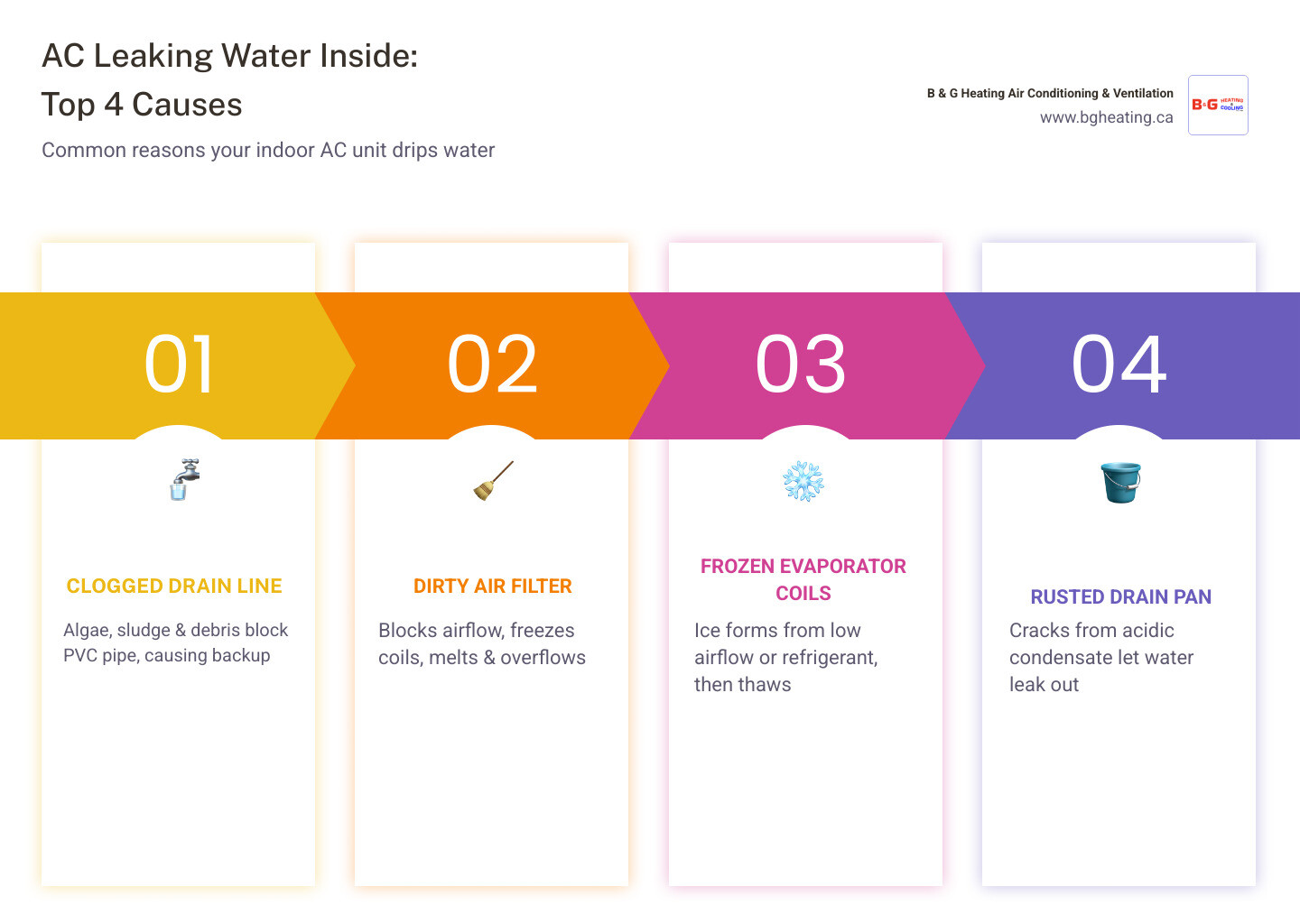
- Clogged condensate drain line — algae, sludge, or debris blocks water from draining out
- Dirty air filter — restricted airflow causes the evaporator coil to freeze, then overflow when it thaws
- Frozen evaporator coils — ice builds up and melts faster than the drain pan can handle
- Low refrigerant levels — causes the coil to drop below freezing and ice over
- Damaged or rusted drain pan — cracks or corrosion let water escape before it reaches the drain
- Failed condensate pump — common in basement installations where gravity drainage isn’t possible
- Improper installation — an unlevel unit causes water to pool and spill from the drain pan
Your AC naturally pulls moisture from the air as part of the cooling process. On a hot, humid day, a healthy system can produce anywhere from 5 to 20 gallons of condensation. All that water is supposed to flow out of your home through a dedicated drain line — quietly and completely out of sight. When something disrupts that process, water ends up somewhere it shouldn’t be.
In Hamilton’s warm, humid summers, air conditioners work hard. That extra strain makes drainage problems more likely, and the consequences of ignoring a leak — water damage, mold growth within 24 to 48 hours, and potential electrical hazards — can escalate quickly.
This guide breaks down every major cause so you know exactly what you’re dealing with and what to do next.
How Your AC System Manages Condensation
To understand why your system is failing, it helps to know how it’s supposed to work. Most homeowners think of their air conditioner purely as a cooling machine, but it is also a powerful dehumidifier. As your AC pulls warm, humid air from your home in Burlington or Oakville, it passes that air over the cold evaporator coils located in your indoor air handler.
Think of a cold can of soda on a humid July afternoon. Droplets of water immediately form on the outside of the can. This is exactly Why Ac Is Dripping Water Indoors. The moisture in the air hits the cold surface of the evaporator coil, turns into liquid water (condensation), and drips down into a primary drain pan.
From there, gravity takes over. The water flows out of the pan and into a PVC condensate line, which carries the water safely outside your house. In a properly functioning system, this process happens thousands of times a day without a single drop hitting your floor. However, because a healthy system can extract up to 20 gallons of water daily during a heatwave, even a small blockage can lead to a massive puddle very quickly.
AC Leaking Water Inside the House: What Causes It?
When we receive calls about an ac leaking water inside the house what causes it, the culprit is usually found within the drainage system itself.

The #1 reason for water leaks in air conditioning systems is a Clogged Condensate Drain Line. Because the drain line is constantly damp, it becomes a breeding ground for various types of gunk. Over time, dust, dirt, and skin cells that bypass your air filter mix with moisture to create a thick sludge.
Common drain line blockages include:
- Algae and Mold: These thrive in the dark, wet environment of the PVC pipe.
- Dust and Debris: Fine particles that settle in the pan and get washed into the pipe.
- Insects and Pests: Small spiders or wasps have been known to build nests at the exit point of the drain line outside.
- Sludge: A combination of bacteria and minerals that creates a “jelly-like” substance.
When the line is blocked, the water has nowhere to go but back up into the drain pan. Most modern systems have a secondary drain pan or a “float switch” safety device. If the water level gets too high, the float switch is supposed to trigger and shut down the AC to prevent an overflow. However, if your system is older or the switch fails, that water will spill over the edges of the pan, leading to ceiling stains or wet carpets.
Troubleshooting Airflow and Coil Issues
Sometimes the leak isn’t caused by a clog, but by the water changing physical states. If you are looking for How To Fix Air Conditioner Leaking Water From The Unit, you first need to check if your system is actually “iced up.”
When airflow is restricted or the system pressure is off, the evaporator coil can drop below freezing. Instead of moisture dripping off the coil, it freezes onto it, turning the unit into a giant block of ice. When the system eventually shuts off, all that ice melts at once, overwhelming the drain pan and causing a leak. You might also notice Why Is My Air Conditioner Leaking Water On The Outside if the melting ice is escaping through the exterior housing.
Why a dirty air filter leads to ac leaking water inside the house what causes it
A dirty air filter is the most common reason for a frozen coil. When the filter is packed with dust, it blocks the warm air from reaching the evaporator coil. Without that warm air to balance the temperature, the refrigerant inside the coil gets too cold, causing the condensation to turn into ice. We recommend changing your filters every 30 to 90 days—or every 30 days if you have pets or allergies—to prevent this blower motor strain and subsequent leaking.
Low refrigerant levels and ac leaking water inside the house what causes it
Low refrigerant is another major factor. It sounds counterintuitive, but less refrigerant actually causes the coil to get colder. Lower pressure in the system allows the refrigerant to expand more than it should, dropping the temperature of the coil below the freezing point. This leads to excessive ice buildup. If you suspect a refrigerant leak, it requires professional repair, as handling refrigerant is a regulated task that requires specialized tools and licensing.
Mechanical Failures and Installation Errors
If your filters are clean and your lines are clear, the problem might be the hardware itself.
Rusted or Damaged Drain Pans
If your air conditioner is between 12 and 15 years old, the drain pan itself might be the issue. Older pans were often made of metal. Over a decade of contact with water—which can be slightly acidic due to the particles it picks up from the air—causes the metal to corrode and rust through. Small pinholes develop, allowing water to drip directly through the bottom of the pan before it ever reaches the drain line.
Condensate Pump Failure
In many homes across Hamilton and Stoney Creek, the furnace and AC are located in the basement. Since the drain line cannot always run “downhill” to the outside, a condensate pump is used to push the water up and out of the house. These pumps have a small reservoir and a motor. If the motor burns out or the internal float gets stuck, the reservoir overflows, leaving a puddle on your basement floor.
| Feature | Clogged Drain Line | Condensate Pump Failure |
|---|---|---|
| Common Location | Attic or Closet Units | Basement Units |
| Primary Symptom | Water backing up in PVC | Water overflowing from pump tank |
| Sound | Often silent or gurgling | Pump may hum but not move water |
| Fix | Clear line with vacuum/vinegar | Repair or replace pump unit |
Installation and Leveling
Water follows the path of least resistance. If your indoor unit was not installed perfectly level, or if the house has settled over time, the water may pool in one corner of the drain pan away from the drain hole. This eventually leads to a spill. Similarly, unsealed air registers or uninsulated ductwork in a crawlspace can cause “sweating,” where condensation forms on the outside of the ducts and drips onto your ceiling.
Immediate Steps and Prevention Strategies
If you find a puddle today, don’t panic, but do act fast.
- Emergency Shutdown: Turn the AC off at the thermostat immediately. This stops the production of more moisture and protects the electrical components.
- Clear Standing Water: Use towels or a wet-dry vacuum to soak up the water. Mold can begin to grow in as little as 24 to 48 hours, so drying the area is your top priority.
- The Wet-Dry Vacuum Trick: If you suspect a clogged line, you can often clear it yourself. Go outside to where the PVC pipe exits your house. Attach your wet-dry vacuum to the end of the pipe (use a wet rag to create a seal) and run it for a minute or two. This can often suck out the “slug” of algae causing the blockage.
- Vinegar Flush: To prevent future clogs, pour a cup of distilled white vinegar down the condensate drain at the indoor unit once every few months. This kills algae before it can form a blockage.
The best defense is a professional annual HVAC tune-up. During a maintenance visit, we check refrigerant levels, inspect the drain pan for rust, test the condensate pump, and flush the drain lines to ensure your home stays dry all summer long.
Frequently Asked Questions about AC Water Leaks
Is it normal for my AC to leak any water inside the home?
No. While it is perfectly normal for your AC to produce water, that water should always stay contained within the drainage system. Any water found pooling on the floor, dripping from the ceiling, or running down the side of the furnace is a sign of a problem that needs to be addressed.
How can I tell the difference between a water leak and a refrigerant leak?
A water leak will look like clear water and usually forms a puddle. A refrigerant leak is often invisible (it’s a gas), but if the liquid refrigerant escapes, it may look like an oily residue. Furthermore, if you hear a “hissing” sound or notice that the air coming from the vents isn’t cold, it’s likely a refrigerant issue.
Why is my AC leaking water even though it is still cooling the house?
This is very common. A clogged drain line doesn’t stop the cooling process; it just stops the water from leaving. Similarly, a frozen coil might still provide some cool air initially, but as the ice thickens, the airflow will eventually stop entirely. Don’t wait for the cooling to fail before fixing the leak, as the water damage could cost far more than the AC repair.
Conclusion
Finding an ac leaking water inside the house can be stressful, but most causes are easily preventable with regular care. Whether it’s a simple drain clog or a more complex refrigerant issue, addressing it early is the key to protecting your home from mold and structural damage.
At B & G Heating Air Conditioning & Ventilation, we’ve spent decades helping families in Hamilton, Ancaster, Burlington, and surrounding areas keep their homes comfortable and dry. As a family-owned business, we pride ourselves on quality workmanship and reliable service. If your AC is acting up, don’t let a small drip turn into a big disaster.
Schedule professional AC service and repairs with our expert team today and get back to enjoying a cool, dry home.