


When Your Heat Pump Won’t Heat or Cool: Recognizing Reversing Valve Failure
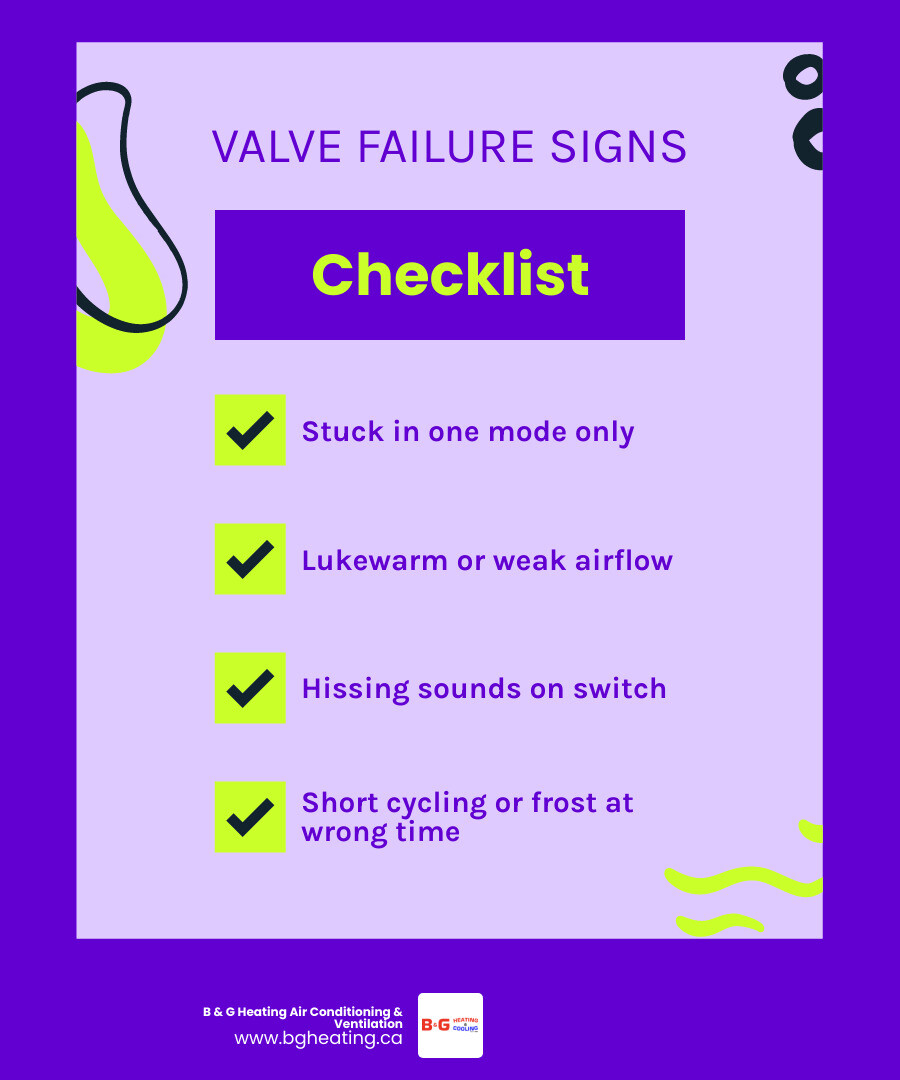
The most common reversing valve failure symptoms in a heat pump are easy to spot once you know what to look for:
- Stuck in one mode – the system only heats or only cools, regardless of what the thermostat says
- Lukewarm or weak airflow – the system runs but can’t reach the set temperature
- Hissing or swooshing sounds from the outdoor unit, especially during mode changes
- Short cycling – the system turns on and off more frequently than normal
- Unusual frost or ice patterns on the outdoor coil at the wrong time of year
- Higher energy bills without a clear reason – a leaking valve forces the system to work harder
If your heat pump is stuck blowing cold air in winter or warm air in summer, the reversing valve is one of the first components worth investigating.
Think of the reversing valve as the traffic cop inside your heat pump. It’s the single component that lets one system do two completely opposite jobs — heating your home in winter and cooling it in summer. Without it, a heat pump is just an air conditioner.
Reversing valves don’t fail often, but when they do, the symptoms can look a lot like other problems. A stuck valve, a burned-out solenoid coil, or an internal refrigerant leak can each produce similar complaints — weak performance, wrong-mode operation, or strange noises — making diagnosis genuinely tricky. Even experienced technicians can confuse a failing valve with a compressor problem if they skip the right diagnostic steps.
This guide walks through everything you need to know: how the valve works, what failure actually looks like, how technicians tell a bad valve apart from a bad compressor, and what you can do to prevent problems before they start.
What is a Reversing Valve and How Does it Work?
At its core, a reversing valve is a four-way valve located in the outdoor unit of your heat pump. While a standard air conditioner only moves heat in one direction (from inside your home to the outside), a heat pump uses this valve to change the direction of the refrigerant flow.
To understand its role, it helps to review How Does a Heat Pump Work for Heating and Cooling? In cooling mode, the valve directs hot, high-pressure gas from the compressor to the outdoor coil, where it releases heat. When you switch to heating, the valve shifts, sending that hot gas to the indoor coil instead.
The Mechanics: Solenoids and Pilots
The reversing valve is a “pilot-operated” valve. This means it doesn’t just move on its own; it uses a small electrical component called a solenoid coil and the system’s own pressure differential to do the heavy lifting.
- The Solenoid: When your thermostat calls for a mode change, it sends an electrical signal (usually through the O or B wire) to the solenoid coil. This creates a magnetic field.
- The Pilot Valve: The magnetic field moves a tiny plunger inside a pilot valve. This opens a small tube that allows high-pressure refrigerant to push against a large sliding “canoe” or “slider” inside the main valve body.
- The Shift: The pressure difference between the high and low sides of the system physically slides the internal mechanism into the new position, rerouting the refrigerant.
Because it relies on pressure to move, a reversing valve often won’t shift if the system is low on refrigerant or if the compressor isn’t pumping strongly enough.
Identifying Reversing Valve Failure Symptoms in a Heat Pump
When this “traffic cop” falls asleep on the job or directs traffic into a head-on collision, your home comfort suffers immediately. Recognizing the reversing valve failure symptoms in a heat pump early can save you from a complete system breakdown during a Hamilton cold snap in May 2026.
Stuck in One Mode
This is the most “classic” symptom. You switch your thermostat from AC to Heat, but the air coming out of the vents remains ice cold. This usually happens because the internal slider is physically jammed due to debris or because the solenoid coil has failed and can no longer initiate the shift.
The Tell-Tale Hiss
If you hear a persistent hissing or “swooshing” sound coming from the outdoor unit while it’s running, it might indicate an internal leak. This happens when the internal slider doesn’t seat perfectly, allowing high-pressure hot gas to “bleed” directly into the suction line. It’s like a shortcut that bypasses your coils, leading to very poor efficiency.
Lukewarm Air and Short Cycling
When a valve leaks internally, the system loses its ability to transfer heat effectively. You might notice the air isn’t as hot (or cold) as it used to be. Because the pressures are off, the compressor may overheat or the safety sensors may trigger, causing the system to “short cycle”—turning on and off rapidly.
Abnormal Frost Patterns
In the winter, a heat pump naturally develops some frost, which is cleared by the defrost cycle. However, if you see heavy ice buildup during the summer, or if the unit refuses to enter defrost mode, the reversing valve might be the culprit. You can learn more about normal vs. abnormal icing in our Step-by-Step Guide to Heat Pump Defrost Cycle for Ontario Homeowners.

The Three Main Causes of Reversing Valve Malfunction
Why do these rugged brass components fail? Usually, it comes down to one of three categories:
- Electrical Failure (Solenoid Burnout): The solenoid coil is an electrical part that can simply wear out, develop a short, or lose its connection. If the coil is dead, the valve will never receive the “command” to shift.
- Mechanical Friction (Stuck Slider): Over time, the internal slider can become stuck. This is often caused by “sludge” or acid buildup in the refrigerant oil, or by physical contaminants (like copper shavings from a poor installation) getting lodged in the tracks.
- Internal Bypass (Leaking Seals): The slider uses Teflon seals to keep the high-pressure and low-pressure sides separate. If these seals are damaged—often by overheating the valve during the initial brazing/welding process—refrigerant will leak across the valve, causing a loss of capacity.
Professional Diagnostic Tests for Heat Pumps in Hamilton
Diagnosing a bad reversing valve requires more than just a “hunch.” Our technicians at B & G Heating use a systematic approach to rule out other issues like low refrigerant or thermostat wiring problems.
The Magnet Test
Since the valve is operated by a magnetic solenoid, we can use powerful rare-earth magnets to manually “pull” the internal slider. If the valve shifts when we move the magnet but not when the solenoid is energized, we know the valve body is fine, but the solenoid or the wiring is the problem.
Amp Draw and Pressure Analysis
We measure the compressor’s amp draw. If a reversing valve is leaking internally (bypassing), the compressor doesn’t have to work as hard to move refrigerant, resulting in a lower-than-normal amp draw. We combine this with pressure gauge readings to see if the “high” and “low” sides are equalizing.
Reversing valve failure symptoms in a heat pump: Stuck vs. Leaking
To confirm an internal leak, we use the “3-Degree Rule.” This is a temperature differential test:
- We measure the temperature of the suction line coming from the indoor evaporator.
- We then measure the temperature of the permanent suction line (the one leading directly into the compressor).
- The Rule: If the temperature difference between these two points is greater than 3°F (some allow up to 5°F), it proves that hot gas is leaking across the valve and heating up the cool suction gas. This confirms the valve is bad and needs replacement.
Differentiating a Bad Valve from a Failing Compressor
One of the biggest mistakes in HVAC repair is replacing a compressor when the reversing valve was actually the problem (or vice versa). Both can cause “lukewarm air” and “low pressure,” but there are key differences.
| Symptom | Leaking Reversing Valve | Failing Compressor |
|---|---|---|
| Amp Draw | Lower than normal | Significantly low or “locked” |
| Discharge Line Temp | Very high (hot gas stays at valve) | Lower than normal (not pumping) |
| Suction Line Temp | Warms up at the valve body | Remains consistent with evaporator |
| Noises | Hissing or swooshing | Clunking, grinding, or silence |
| 3-Degree Test | Fails (High differential) | Passes (Low differential) |
If you notice any of these signs, it’s time to check our Signs You Need Heat Pump Repair guide for a broader look at system health.
Maintenance and Prevention Strategies for Ontario Homeowners
While some valve failures are due to age, many are preventable. In the Hamilton and Burlington areas, our weather puts a lot of stress on heat pumps as they switch between modes frequently in the spring and fall.
Preventing reversing valve failure symptoms in a heat pump
- Keep it Clean: Dirty air filters and clogged outdoor coils force the system to run at higher pressures and temperatures. This breaks down the refrigerant oil faster, leading to the “sludge” that jams reversing valve sliders.
- Clear the Debris: Ensure there is at least 18 to 24 inches of clearance around your outdoor unit. Leaves, snow, and grass clippings can restrict airflow, causing the system to overheat.
- Annual Inspections: During a professional tune-up, we check the solenoid’s electrical resistance and the system’s refrigerant charge. Catching a small leak early prevents the “low pressure” conditions that cause valves to get stuck halfway.
- Don’t Ignore Noises: If you hear a new hissing sound, call us immediately. Running a system with a leaking valve can eventually damage the compressor due to overheating.
For those considering an upgrade, it’s worth exploring the Benefits of Ductless Mini Splits in Ontario, as these systems use highly efficient electronic expansion valves and reversing valves designed for extreme climates.
Frequently Asked Questions about Reversing Valves
Why is my heat pump blowing cold air during the May 2026 heating season?
In Ontario, May can still bring chilly nights. If your heat pump blows cold air when set to heat, it is likely “stuck in cooling mode.” This could be a failed solenoid coil, a broken thermostat wire (the O/B wire), or a physically jammed reversing valve. Check your thermostat settings first, then call a pro to check the solenoid.
Can a stuck reversing valve be fixed without replacing the whole unit?
Sometimes. If the problem is just the solenoid coil, that can be replaced easily without opening the refrigerant lines. If the valve body itself is stuck, a technician might try “tapping” it gently with a plastic tool while cycling the power to see if it frees up. However, if the internal seals are leaking or the slider is permanently jammed, the valve must be replaced.
How do I know if the solenoid coil or the valve body is the problem?
Technicians use a “screwdriver test.” When the valve is energized, a functioning solenoid creates a magnetic field. If we hold a screwdriver near the coil and feel a magnetic pull, the coil is working. If there is a pull but the valve doesn’t shift, the problem is mechanical (the valve body). If there is no pull, the problem is electrical (the coil or the wiring).
Trust B & G Heating for Your Heat Pump Diagnostics in Hamilton
A reversing valve issue is a complex “sealed system” repair. Because it involves recovering refrigerant and high-heat brazing near sensitive internal parts, it is never a DIY job.
At B & G Heating Air Conditioning & Ventilation, we’ve spent decades serving families across Hamilton, Stoney Creek, Ancaster, and the Niagara region. Our technicians don’t just guess—we use the 3-degree rule, magnet tests, and pressure analysis to ensure we find the root cause of your reversing valve failure symptoms in a heat pump.
Whether you need a simple solenoid replacement or a full system evaluation, we are here to provide honest, expert advice. We pride ourselves on quality workmanship and ensuring your home stays comfortable, no matter what the Ontario weather throws at us.
Is your heat pump acting up? Schedule your professional heat pump repair in Hamilton today and let our family take care of yours.