


Why Hard Water in Southern Ontario Shortens Water Heater Life — and What It’s Costing You
How hard water in Southern Ontario shortens water heater life is something most homeowners don’t think about until they’re standing in a cold shower or facing an unexpected appliance failure. The core answer is straightforward:
How Hard Water Damages Water Heaters in Southern Ontario
| Factor | What Happens | Impact |
|---|---|---|
| Mineral-rich water | Calcium and magnesium settle at the tank bottom when heated | Scale layer builds up over time |
| Scale insulation | Sediment acts as a barrier between the burner and the water | Heater works harder, uses more energy |
| Increased thermal stress | Prolonged heat cycles strain tank components | Parts wear out faster |
| Shortened lifespan | A unit rated for 12–15 years may fail in 7–8 years | Early replacement costs |
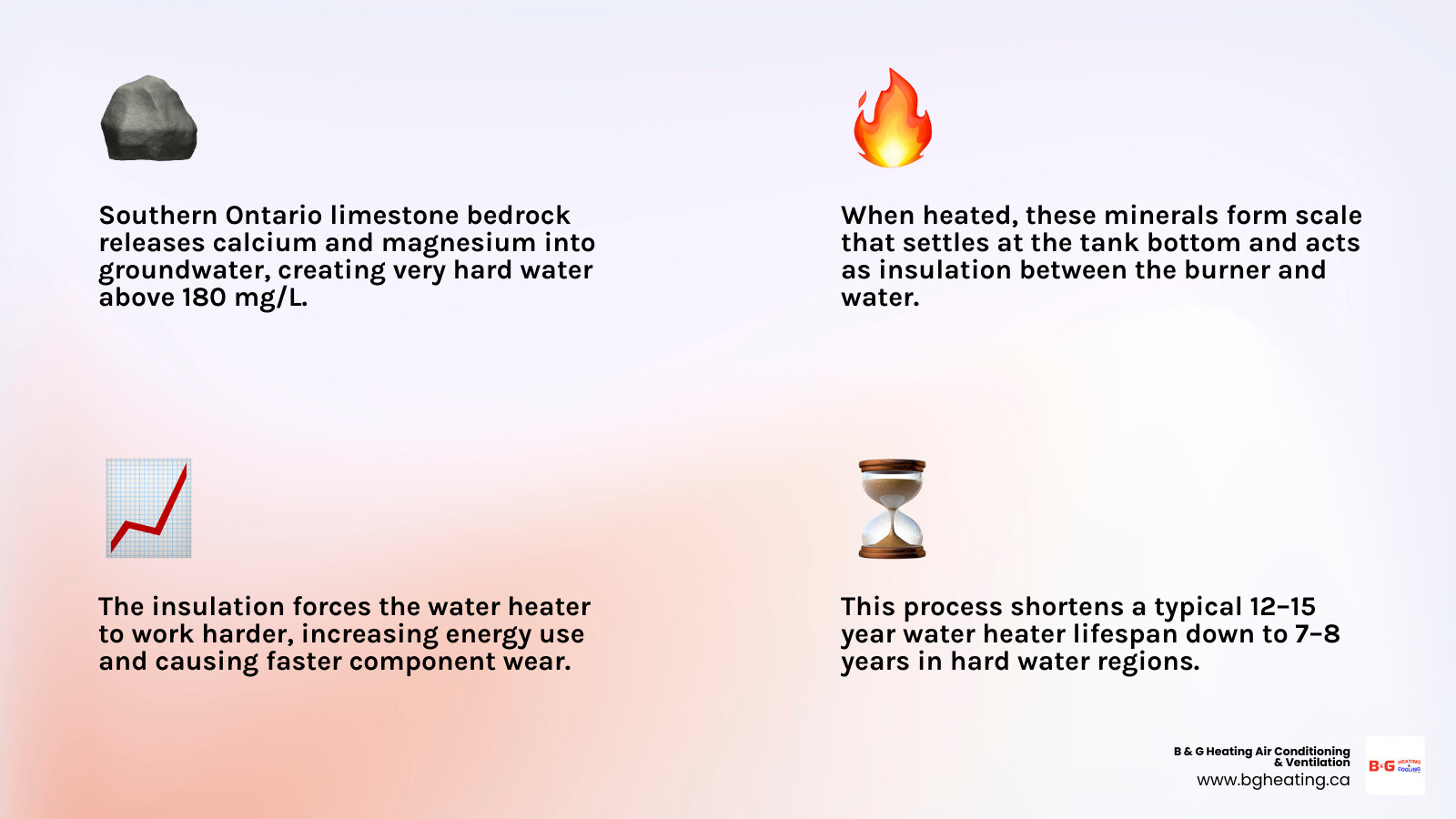
Southern Ontario sits on limestone-rich bedrock, which means groundwater picks up high concentrations of calcium and magnesium before it ever reaches your home. Parts of the region regularly see mineral content exceeding 180 mg/L — the threshold Health Canada classifies as very hard. Whether you’re on municipal water in London or Goderich, or drawing from a private well near Strathroy or Exeter, your water heater is quietly working against a buildup problem that compounds every year.
Most homeowners in the region don’t find out about hard water damage until something breaks. The damage is gradual, easy to miss, and expensive to ignore. Staying ahead of it is far cheaper than reacting after a failure.
The Geological Cause of Hard Water in Southern Ontario
To understand why our water is so mineral-dense, we have to look beneath our feet. Southern Ontario’s geology is dominated by ancient limestone bedrock. Limestone is composed primarily of calcium carbonate. As rain falls and trickles down through the soil into groundwater aquifers, it acts as a natural solvent, dissolving the limestone and absorbing calcium and magnesium ions along the way.
Because many municipalities in our service areas—such as Kitchener, Waterloo, Guelph, and parts of Brantford—rely heavily on groundwater aquifers rather than surface water from the Great Lakes, their tap water is exceptionally hard. For example:
- Waterloo & Kitchener: Frequently exceed 300 mg/L (18+ grains per gallon), placing them among the hardest municipal water supplies in the country.
- Brampton: Ranges between 200–250 mg/L (12–15 grains per gallon).
- Hamilton & Burlington: While drawing primarily from Lake Ontario (which is moderately hard at around 120–160 mg/L), outlying areas and private wells still struggle with extreme mineral levels.
Whether your home is connected to a municipal water system or a private well, these dissolved minerals remain in the water until they are heated. When heated, a chemical reaction occurs that turns these dissolved minerals into solid limescale. To learn more about how regional conditions impact your home’s systems, check out our guide on the Water Heater Lifespan in Southern Ontario 101.
How Hard Water in Southern Ontario Shortens Water Heater Life
So, how exactly does how hard water in southern ontario shortens water heater life manifest inside your system? It all comes down to heat and chemistry.
When your water heater turns on, the heating elements (in electric models) or the bottom of the tank (in gas models) become extremely hot. This heat forces dissolved calcium carbonate and magnesium out of the liquid solution. These minerals precipitate as solid particles, settling directly onto the hottest surfaces inside the tank.

This process leads to several critical issues:
- Sediment Insulation: Over time, these mineral deposits create a thick, chalky layer of scale at the bottom of the tank or around the heating elements. Limescale is an excellent thermal insulator. Instead of the heat transferring directly into the water, it has to fight through a rocky barrier first.
- Reduced Energy Efficiency: Because of this insulating layer, a water heater with just 1 inch of sediment buildup requires 10% more energy to heat the same amount of water.
- Severe Thermal Stress: To heat the water through the scale barrier, the burner or heating elements must run much longer and hotter. This extra strain forces the water heater to run 30% longer to reach your desired temperature, causing the steel tank to expand and contract excessively. Over time, this thermal stress weakens the protective glass lining of the tank, leading to tiny cracks, rust, and ultimately, a catastrophic tank leak.
- Premature Failure: While a standard tank water heater in a soft-water region can easily last 12 to 15 years, untreated hard water in Southern Ontario routinely cuts that lifespan down to just 7 or 8 years.
If you suspect your system is already struggling under the weight of mineral buildup, it is important to recognize the Signs You Need Water Heater Repair before a minor drop in efficiency turns into a major flood.
Warning Signs and Mitigating Hard Water Damage
Your water heater won’t usually fail silently; it will try to warn you that sediment is taking over. Keep an eye and an ear out for these common warning signs in your home:
- Rumbling or Popping Noises: If your water heater sounds like a boiling kettle or makes loud popping and cracking noises, this is a classic sign of advanced scale buildup. Water becomes trapped beneath the hardened sediment layer at the bottom of the tank. When the burner heats this trapped water, it boils and turns to steam, popping violently as it escapes through the scale.
- Reduced Hot Water Pressure: Mineral scale doesn’t just stay in the tank; it can migrate into your hot water pipes and fixtures. If you notice a gradual drop in hot water pressure while your cold water pressure remains strong, scale is likely clogging your plumbing. If this sounds familiar, read our tips on Troubleshooting Low Hot Water Pressure.
- Running Out of Hot Water Quickly: As sediment builds up at the bottom of the tank, it physically takes up space, reducing the overall volume of hot water your tank can hold.
- Fluctuating Water Temperatures: If your showers constantly cycle between hot and cold, the thermostat is likely being insulated or confused by surrounding scale buildup.
To mitigate this damage, we highly recommend flushing your water heater tank at least once a year. Flushing washes away loose, unhardened mineral sediment before it has the chance to bake onto the bottom of the tank and solidify into rock.
Understanding How Hard Water in Southern Ontario Shortens Water Heater Life in Tankless Systems
Many homeowners switch to tankless systems, assuming that removing the storage tank solves the hard water problem. Unfortunately, tankless water heaters are actually more sensitive to hard water than traditional tanks.
In a tankless water heater, water is heated instantly as it passes through a compact, highly efficient copper heat exchanger. Because the passageways inside the heat exchanger are incredibly narrow, even a small amount of mineral scaling can quickly restrict water flow and cause the unit to overheat.
Without proper pre-treatment or annual maintenance, a tankless unit operating in high-hardness areas like Kitchener, Waterloo, or Brampton can experience complete heat exchanger failure in as little as 3 to 5 years.
To keep your high-efficiency system running smoothly, check out our Tankless vs Tank Water Heater Ontario Homeowners Guide and learn about essential preventative care in our guide on All About Tankless Water Heater Maintenance in Canada.
Preventing How Hard Water in Southern Ontario Shortens Water Heater Life with Water Softeners
The single most effective way to protect your water heater—and the rest of your home’s plumbing—is by installing a whole-home water softener.
Water softeners work through a process called ion exchange. Inside the water softener’s resin tank are millions of tiny, negatively charged plastic beads. As hard municipal or well water flows through the tank, the positively charged calcium and magnesium ions stick to the resin beads. In exchange, the system releases a tiny, harmless amount of sodium or potassium ions into the water.
When choosing a water softener for Southern Ontario’s demanding water conditions, keep these factors in mind:
- Resin Quality: Look for systems utilizing 10% cross-link resin. This commercial-grade resin is highly durable and resists degradation from the chlorine commonly used in municipal water treatments in places like Mississauga and Brampton.
- Demand-Initiated Regeneration (DIR): Modern softeners should only regenerate when necessary based on your actual water usage, rather than on a simple timer. This can save your household significantly on salt and water usage over the year.
- Proper Sizing: Sizing is critical. A family of four in Hamilton (moderate hardness) requires a different capacity system than a family of four in Waterloo (extreme hardness).
By stopping minerals at your home’s point of entry, you ensure that only soft water enters your water heater, completely eliminating scale accumulation. If you are considering upgrading your setup, read our guide on Choosing the Right Water Heater to see how a softener fits into your home’s mechanical ecosystem.
Repair vs. Replacement: Making the Right Decision
If your water heater is already showing signs of hard water distress, how do you decide whether to repair or replace it?
We recommend using the 50% rule: if the cost of a repair exceeds 50% of the cost of a brand-new unit, replacement is almost always the smarter, more reliable choice. Furthermore, you should consider the age of your system. If your tank is over 8 years old and has never been flushed in a hard-water area, the internal damage is likely extensive.
Use this table to help evaluate your options:
| Scenario | Recommended Action | Why? |
|---|---|---|
| Active tank leak from the base | Replace Immediately | A leaking outer shell indicates irreversible internal corrosion. It cannot be repaired. |
| Failed heating element or thermostat (under 6 years old) | Repair | These parts are easily swapped out, and a Timely Water Heater Repair will restore performance. |
| Heavy rumbling noises in a tank over 10 years old | Replace | The tank is nearing the end of its natural life, and flushing at this stage may actually trigger a leak by disturbing old rust. |
| Scale buildup in a system under 5 years old | Flush & Maintain | A professional flush can clear out loose sediment and restore efficiency before permanent damage occurs. |
If it turns out your system is beyond saving, don’t panic. Understanding Time for Water Heater Replacement and knowing What to Expect Water Heater Replacement can take the stress out of the process. Upgrading to a modern, high-efficiency model is an excellent way to Upgrade Your Aging Water Heater System and cut down on monthly utility bills. When you’re ready, always opt for Professional Water Heater Installation to ensure your new investment is set up for maximum efficiency and longevity.
Frequently Asked Questions About Southern Ontario Hard Water
Is municipal water in Southern Ontario treated for hardness?
No. Municipal water treatment facilities focus strictly on safety standards—removing harmful bacteria, pathogens, and chemical contaminants to ensure the water is safe to drink. They do not remove dissolved minerals like calcium and magnesium because hard water is completely safe to consume. Removing these minerals at a municipal scale is not cost-effective, which is why mineral retention remains high and domestic water softening is left to individual homeowners.
How often should I flush my water heater in a hard water area?
In very hard water regions like Kitchener, Waterloo, and Brampton, we highly recommend flushing your water heater at least once a year. If you do not have a water softener installed, semi-annual flushing (every six months) is even better to prevent sediment from baking into solid rock at the bottom of the tank.
Can an anode rod protect against hard water scale?
No, an anode rod does not prevent scale. The sacrificial anode rod is designed solely for corrosion protection. It attracts corrosive elements in the water so they eat away at the rod rather than the steel tank itself. While vital for preventing rust, the anode rod has no chemical effect on dissolved calcium and magnesium, meaning it cannot stop scale from forming.
Conclusion
The geological reality of Southern Ontario means that hard water is something we all have to live with—but your water heater shouldn’t have to suffer for it. Taking a proactive approach to water heater maintenance and water softening doesn’t just protect your appliances; it saves you from high utility bills, premature replacement expenses, and the headache of sudden breakdowns.
At B & G Heating, we have spent years helping homeowners in Hamilton, Burlington, Oakville, Brampton, Mississauga, Kitchener, Waterloo, and the surrounding areas keep their home comfort systems running flawlessly. Whether you need a professional system flush, a timely repair, or are looking to install a new, high-efficiency water heater paired with a whole-home water softener, our family-owned team is here to help.
Protect your home and your peace of mind. Explore our comprehensive services and find the perfect comfort solutions for your household by visiting the B & G Heating Air Conditioning & Ventilation Services and Products page today!