


How Long Does Mini Split Installation Take? A Timeline Overview
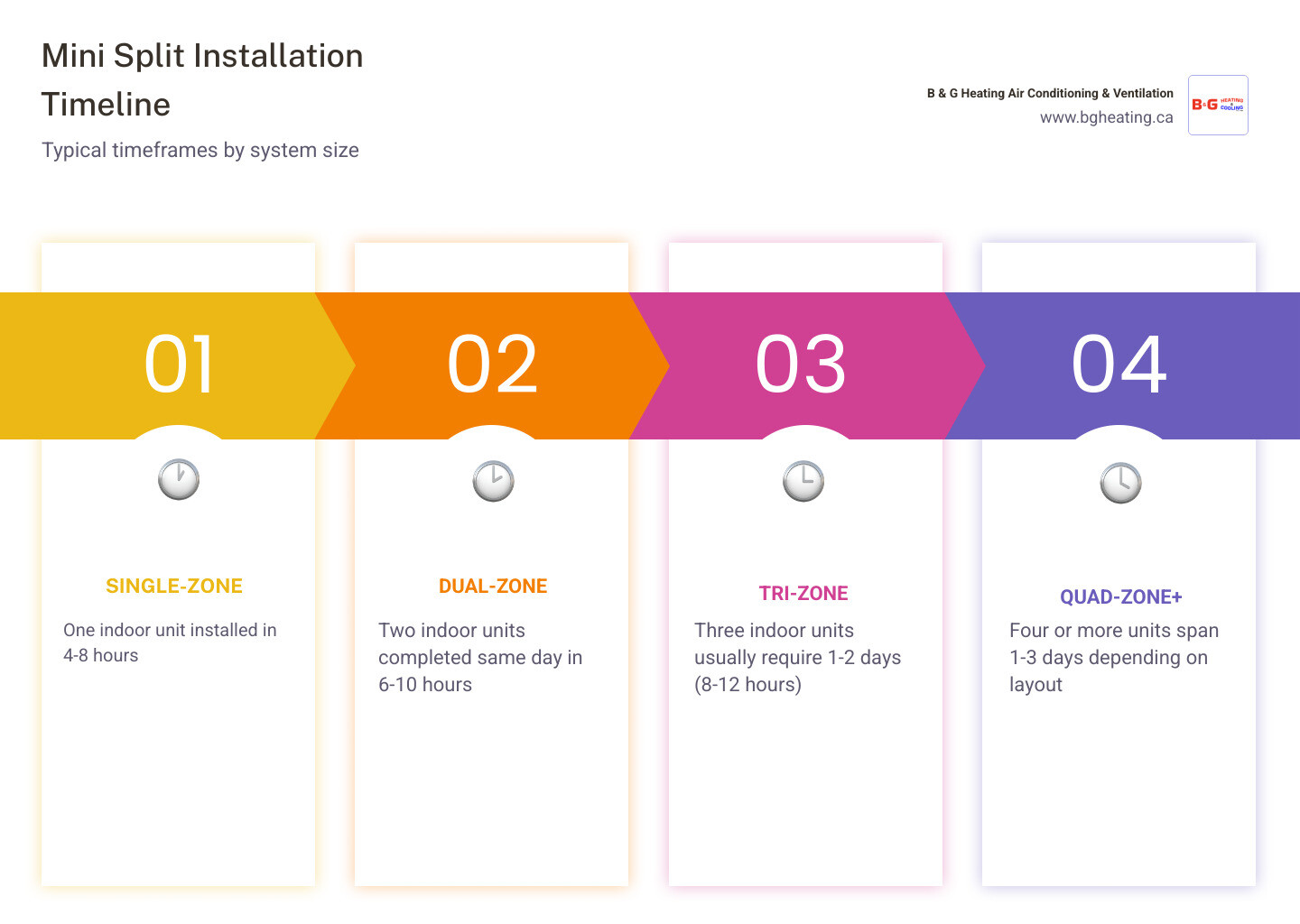
How long does mini split installation take depends mainly on how many indoor units you need and how complex your home’s layout is. For most Hamilton homeowners, a single-zone system is done in a single day. Larger multi-zone setups can stretch across two or three days.
Here is a quick breakdown:
| System Type | Typical Installation Time |
|---|---|
| Single-zone (1 indoor unit) | 4 to 8 hours |
| Dual-zone (2 indoor units) | 6 to 10 hours (1 day) |
| Tri-zone (3 indoor units) | 8 to 12 hours (1 to 2 days) |
| Quad-zone (4+ indoor units) | 1 to 3 days |
Those are the general ranges under normal conditions with a professional two-person crew. Your actual timeline can shift depending on your home’s electrical setup, wall materials, and how far the refrigerant lines need to run.
It is worth knowing upfront that a faster installation is not always a better one. Proper vacuuming, pressure testing, and refrigerant charging take time — and skipping those steps leads to problems down the road.
When planning a home comfort upgrade, timing is everything. Whether you are living in a historic home in Dundas or a modern build in Oakville, knowing what to expect on installation day helps you plan your schedule without unnecessary disruptions.
While a traditional central air conditioner replacement swaps existing equipment using your current ductwork, a ductless mini split system is built from the ground up. This means we are mounting indoor air handlers, positioning an outdoor condenser, drilling access holes through your exterior walls, running line sets, and establishing dedicated electrical connections.
Despite these steps, professional efficiency ensures that the process is remarkably streamlined. Because these systems do not require extensive ductwork installations, we can complete the work in a fraction of the time it would take to install a traditional ducted system. Understanding What Are the Benefits of Ductless Mini Splits in Ontario? highlights why this minimal disruption is a major selling point for local homeowners looking to maximize their energy efficiency and comfort.
Under normal conditions, a professional two-person HVAC crew can install a single indoor unit and outdoor condenser in about half a day. As you add more indoor zones to cover multiple rooms, the timeline naturally scales up. However, even complex multi-zone installations rarely exceed three days of on-site work.
How Long Does Mini Split Installation Take for Single-Zone Systems?
A single-zone mini split system consists of one indoor air handler connected to one outdoor condenser. This setup is incredibly popular for heating and cooling home additions, sunrooms, master bedrooms, garages, or small open-concept bungalows.
For a standard single-zone system, how long does mini split installation take is typically 4 to 8 hours.
If the indoor unit is mounted on an exterior wall, the installation is highly straightforward. The indoor mounting bracket is secured directly to the wall studs, a single three-inch hole is drilled at a slight downward angle to the outside, and the line sets are routed directly through to the outdoor unit sitting just on the other side of the wall.
This “back-to-back” configuration is the quickest setup possible. If we do not run into any electrical challenges or structural hurdles, our crew can often have your new single-zone system fully operational, tested, and running in as little as four to five hours.
How Long Does Mini Split Installation Take for Multi-Zone Setups?
Multi-zone systems are designed to provide customized comfort across different rooms or “zones” in your home. Each indoor unit operates independently, allowing you to cool your upstairs bedrooms while keeping your main floor living space at a different temperature. To explore how these setups function, you can read more on how to Maximize Comfort with Ductless Mini Split Systems.
For multi-zone setups, the installation timeline expands:
- Dual-Zone (2 Indoor Units): Usually completed in 1 day (6 to 10 hours). With a skilled two-man crew, both indoor units can often be mounted and connected to a single outdoor condenser in a single, full day of work.
- Tri-Zone (3 Indoor Units): Typically takes 1 to 2 days (8 to 12 hours of total labor). The exact time depends on how far apart the indoor units are and how difficult it is to route the refrigerant lines back to the outdoor condenser.
- Quad-Zone (4+ Indoor Units): Generally takes 2 to 3 days. When dealing with four or five zones, we are running hundreds of feet of line sets, navigating multiple floors, and ensuring each line is perfectly sealed, insulated, and hidden behind protective line covers (slimducts).
As a general rule of thumb, each additional indoor unit adds roughly 2 to 3 hours of installation time to the project.
Key Stages of a Professional Ductless Installation
To understand why a professional installation takes several hours, it helps to look at the step-by-step process. A proper installation is a precise sequence of structural, electrical, and refrigeration work.
Here are the key stages our professional team goes through during a standard installation:
1. Site Assessment and Layout Planning (30 to 60 Minutes)
Before any tools are unpacked, we walk through the home with you to confirm the exact placement of the indoor air handlers and the outdoor condenser. We verify that the indoor units have proper clearance (usually 6 to 12 inches below the ceiling) and that the outdoor unit will have adequate airflow and protection from heavy winter snowbanks.
2. Mounting the Indoor Unit(s) (1 to 2 Hours Per Unit)
We secure the heavy-duty metal mounting plates to your wall studs using lag bolts. Ensuring these plates are perfectly level is critical; if the indoor unit is even slightly tilted, the condensation water will not drain properly, leading to water dripping down your interior drywall.
3. Drilling the Pass-Through Hole (30 to 45 Minutes Per Hole)
We drill a three-inch hole through the exterior wall. This hole must be drilled at a slight downward angle toward the outside to allow gravity to carry the condensate drain water away. If your home has wood siding, this is quick. If we are drilling through brick, stone, or concrete, we use specialized diamond-core drill bits, which take longer.
4. Running and Connecting the Line Sets (1 to 2 Hours)
The line set contains two copper refrigerant pipes, a communication cable, and a condensate drain line. We carefully bundle these together, wrap them in protective insulation, and feed them through the wall hole. We then bend and flare the copper lines to connect them to the indoor and outdoor units.
5. Installing the Outdoor Condenser (1 to 2 Hours)
The outdoor unit must be placed on a level, vibration-resistant surface. We mount it either on a heavy-duty concrete plastic pad on the ground or secure it to the side of your home using steel wall brackets. In our region, we lift the condenser on snow stands to keep it clear of winter accumulation.
6. Electrical Connections (1 to 2 Hours)
Mini splits require a dedicated electrical circuit (typically 240-volt, 20 to 30 amps). We run outdoor-rated wiring from your main electrical panel to an outdoor electrical disconnect box mounted near the condenser, then connect it directly to the unit.
7. Vacuum Testing and Leak Checks (1 to 2 Hours)
This is the most critical step of the entire process. We connect a specialized vacuum pump to the refrigerant lines to pull all air, moisture, and non-condensable gases out of the system. We must pull the vacuum down to at least 500 microns and hold it there to ensure there are absolutely no micro-leaks in the copper connections.
8. Releasing Refrigerant and Commissioning (30 to 60 Minutes)
Once the vacuum test is successful, we open the service valves to release the pre-charged refrigerant into the lines. We then power on the system, test it in both heating and cooling modes, measure the temperature split across the coils, and ensure the system is operating at peak manufacturer specifications.
If you are located in the Hamilton area, our team at B & G Heating Air Conditioning & Ventilation handles this entire sequence with precision. Homeowners in the region can learn more about our local services by visiting our Ductless Mini Split HVAC Services Hannon On page.
Factors That Can Speed Up or Delay Your Installation
No two homes are built exactly alike, which means no two installations are identical. Several real-world variables can either speed up our progress or add hours to the timeline.
- Electrical Panel Capacity: A mini split requires a dedicated circuit. If your existing electrical panel has open slots and enough amperage, running the wiring is quick. However, if your panel is completely full or requires an upgrade to handle the new load, this can add several hours to the job or require a coordinated visit from an electrician.
- Line-Set Run Length and Complexity: Standard line sets are pre-charged for runs between 15 and 25 feet. If your indoor unit is far away from the outdoor condenser — such as running lines from a third-story bedroom down to the ground — we have to route the lines through attics, crawlspaces, or closets. Long runs require custom copper cutting, brazing, and adding extra refrigerant charge, which adds time.
- Wall Materials: Drilling through drywall and vinyl siding takes minutes. Drilling through double-brick walls, plaster-and-lath, or solid poured concrete foundation walls requires heavy-duty rotary hammers and core drills, which can add one to two hours per hole.
- Home Accessibility: If our technicians have to work in tight crawlspaces, cluttered basements, or high up on extension ladders to mount third-story units, the work naturally moves slower to ensure safety and precision.
- Permitting and Inspections: Depending on your specific local municipality in Ontario, securing electrical or building permits can add administrative time before the physical installation even begins. To understand the rules in our province, check out our guide: Do You Need a Permit for Mini Split in Ontario?.
DIY vs. Professional Mini Split Installation Timelines
With the rise of “easy DIY” mini split kits online, many homeowners wonder if they should tackle the installation over a weekend to save on labor. While DIY kits exist, comparing the timeline and risks of a DIY project versus hiring professionals is eye-opening.
| Aspect | DIY Installation | Professional Installation |
|---|---|---|
| Time Investment | 12 to 16+ hours (usually spread over a weekend) | 4 to 8 hours (completed in a single day) |
| Tools Required | Must buy or rent vacuum pumps, micron gauges, torque wrenches, and core drills | Crew arrives with all specialized diagnostic and installation tools |
| Refrigerant Handling | Only pre-charged lines are legal; traditional systems require EPA/ODP certification | Fully licensed technicians legally handle and adjust refrigerant levels |
| Warranty Protection | Often voided if not installed or commissioned by a licensed HVAC professional | Full manufacturer warranty and workmanship guarantees remain intact |
| Safety Risks | Risk of electrical shock (240V wiring) and costly refrigerant leaks | Licensed, insured, and safety-trained professionals handle all hazards |
While a handy homeowner might spend a full Saturday and Sunday reading manuals, running to the hardware store for forgotten fittings, and struggling to level the mounting plates, a professional crew completes the work in a single afternoon.
More importantly, professional installation safeguards your investment. If a DIY connection is even slightly loose, the refrigerant can slowly leak out over 12 to 18 months. Because mini splits rely on precise refrigerant charges, a small leak will cause the system to freeze up, lose efficiency, or suffer compressor failure.
Additionally, keeping your system running smoothly year-round requires proper care. Once installed correctly, knowing How to Maintain a Ductless Mini Split in Canadian Winters will ensure your system delivers reliable heating even when the temperature drops well below freezing.
Frequently Asked Questions About Ductless Timelines
Does the type of indoor unit affect the installation time?
Yes, the physical style of the indoor air handler plays a major role in how long the installation takes:
- Wall-Mounted Units: These are the fastest to install. They mount directly onto the surface of the wall and require no structural modifications.
- Floor-Mounted Consoles: These sit low on the wall near the floor. They are also relatively fast to install but may require creative line-set routing depending on whether the lines go through the floor or the wall.
- Ceiling Cassettes: These units sit flush with your ceiling. Installing them is much more labor-intensive because we must cut into the ceiling drywall, modify or frame out the ceiling joists to support the unit, and run a dedicated drain pump line. This can add half a day of labor per unit.
- Ducted Slim-Duct Units: These are hidden in attics or drop-ceilings and connect to small runs of ductwork. Because they involve framing, duct connections, and grille installations, they typically take one to two days to complete.
How does new construction compare to retrofitting an existing home?
In a new construction project or a major home renovation where the wall studs are completely exposed (open framing), running the refrigerant lines and electrical wires is incredibly fast. We do not have to worry about fishing lines through finished walls or drilling blindly through exterior materials. However, because we must coordinate with other trades, the installation is split into two phases: the “rough-in” stage before drywall goes up, and the “final fit” stage after painting is complete.
In an existing home retrofit, we must work around finished drywall, plaster, trim, and landscaping. While we complete the entire installation in a single continuous visit, we must move slower and take extra precautions to protect your floors, furniture, and walls. Any drywall cutting must be done carefully to avoid hidden plumbing or wiring.
What can homeowners do to prepare for installation day?
You can help our installation crew work as efficiently as possible and minimize the overall installation time by taking a few simple steps before we arrive:
- Clear the Work Areas: Move furniture, artwork, and breakables away from the walls where the indoor units will be mounted. We need a clear path and a few feet of working space.
- Provide Electrical Access: Ensure the path to your main electrical panel is completely clear and unlocked. We will need to access it frequently to run new wiring and install breakers.
- Prep the Outdoor Site: Clear away any brush, weeds, patio furniture, or storage items from the area where the outdoor condenser will be placed.
- Secure Your Pets: Keep your dogs or cats in a safe, quiet room away from the noise and open doors.
Conclusion
When you ask, “how long does mini split installation take?” the answer is reassuring: for most homes, you will be enjoying customized, energy-efficient comfort in less than 24 hours.
At B & G Heating Air Conditioning & Ventilation, we pride ourselves on delivering prompt, professional, and tidy installations. As a trusted, family-owned HVAC company serving Hamilton, Burlington, Oakville, Stoney Creek, Grimsby, and the surrounding areas, we bring decades of combined experience to every job. We do not cut corners on critical steps like vacuum testing and system commissioning, ensuring your system runs at peak efficiency for years to come.
Ready to upgrade your home’s comfort with a hassle-free installation? Contact our team today to schedule an assessment or learn more about our Professional Ductless Mini Split HVAC Services.