


Why Ontario Homeowners Need to Understand Heat Pump Efficiency Thresholds
At what outdoor temperature does a heat pump lose efficiency in Ontario is one of the most common — and most important — questions homeowners ask before making a heating decision. Here’s a quick answer before we dig deeper:
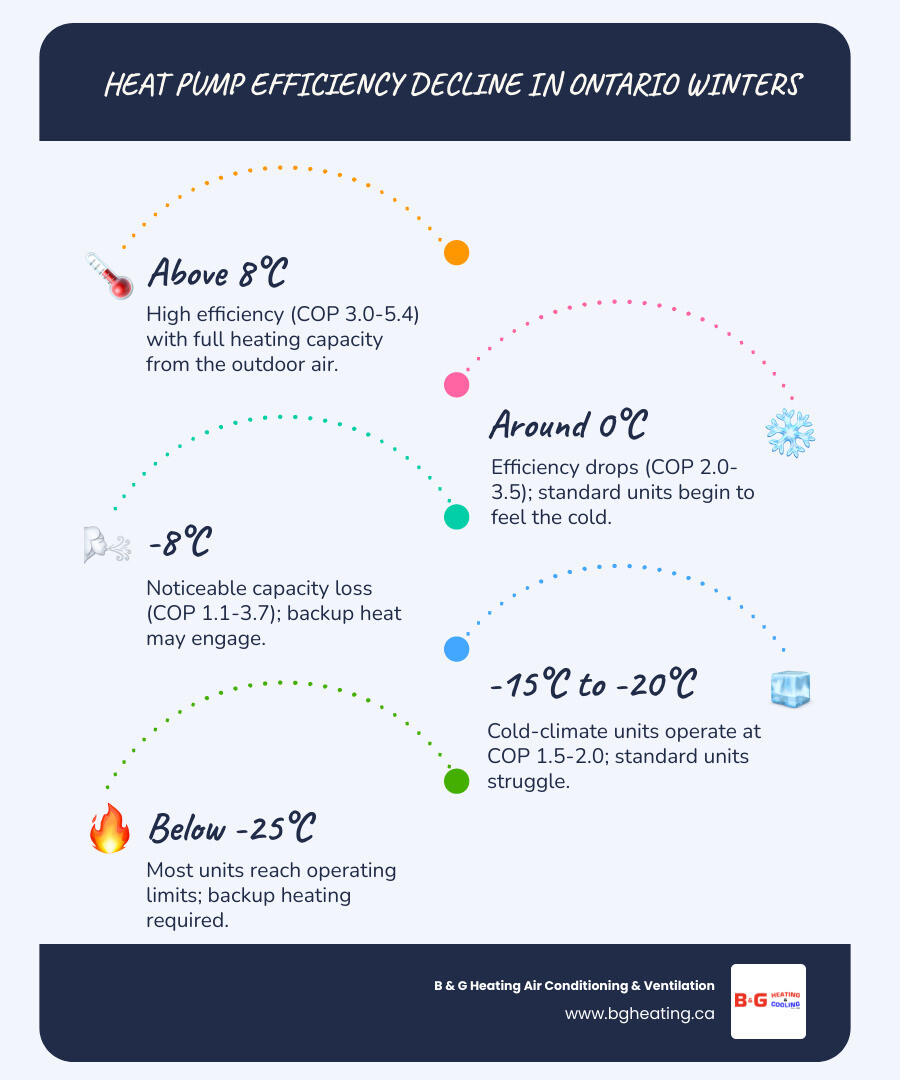
Heat Pump Efficiency by Outdoor Temperature (Ontario)
| Outdoor Temperature | Typical COP Range | What to Expect |
|---|---|---|
| Above 8°C (46°F) | 3.0 – 5.4 | High efficiency, full capacity |
| Around 0°C (32°F) | 2.0 – 3.5 | Efficiency begins to decline; standard units feel it most |
| -8°C (18°F) | 1.1 – 3.7 | Noticeable capacity drop; backup heat may engage |
| -15°C to -20°C | 1.5 – 2.0 | Cold-climate units still operate; standard units struggle |
| Below -25°C | Near minimum | Most units at or near operating limit; backup heat required |
Ontario winters regularly push temperatures well below freezing — and in cities like Ottawa or Sudbury, extreme cold snaps below -25°C are a real part of the season. So it makes sense that homeowners across Hamilton and the surrounding area want to know whether a heat pump can actually keep up when it matters most.
The short answer is: heat pumps don’t simply stop working at one magic number. Efficiency declines gradually as temperatures drop, not all at once. The bigger question is at what point your specific system can no longer meet your home’s heating demand on its own — and what happens after that.
Understanding this helps you choose the right system, set realistic comfort expectations, and avoid being caught off guard during a cold snap.
At What Outdoor Temperature Does a Heat Pump Lose Efficiency in Ontario?
The honest answer is that there is no single outdoor temperature where every heat pump suddenly becomes ineffective. Heat pump performance follows a curve, not a cliff.
As the outdoor air gets colder, the system has less available heat to collect, so two things happen:
- heating capacity drops
- efficiency, usually measured by COP, drops too
For many standard air-source systems, the first noticeable decline often starts around 0°C to 8°C, with more obvious reduction below freezing. Many efficient traditional units can maintain full heating capacity down to roughly 32°F, or 0°C, but below that point they usually begin losing output and efficiency.
Ontario adds another layer to the conversation because winter conditions vary a lot from Hamilton and Burlington to more inland or colder parts of the province. That is why the more useful number is often your system’s balance point, not just its minimum operating temperature.
A heat pump may still run below its balance point, but it may no longer be able to heat the whole home by itself.
At what outdoor temperature does a heat pump lose efficiency in Ontario for standard air-source systems?
For standard air-source heat pumps, efficiency typically starts to slide once temperatures move below freezing, and older models can struggle even earlier. Many older or basic single-stage systems saw major performance drops around -5°C to -10°C, especially in draftier homes.
In practical terms, this means:
- the system runs longer to maintain the same indoor temperature
- supply air feels cooler than furnace air
- auxiliary or supplemental heat may turn on more often
- comfort can become less consistent during cold snaps
This does not mean the unit has failed. It means the heat pump is doing what it can while outdoor conditions get tougher.
For many homes in southern Ontario, the thermal balance point may land somewhere around the moderate sub-zero range, but it depends heavily on insulation, air leakage, window quality, ductwork, and equipment sizing. A well-upgraded home can stay on heat pump operation longer than a leaky older one.
At what outdoor temperature does a heat pump lose efficiency in Ontario for cold-climate heat pumps?
Cold-climate heat pumps are built specifically for winter performance. Many can maintain strong output much lower than standard models, and some are designed to keep delivering full or near-full heating capacity down to around 5°F, which is about -15°C.
Newer cold-climate units in Ontario commonly have minimum operating temperatures in the range of:
- -15°C
- -20°C
- -25°C
Some premium systems can continue operating even lower, but the key point is that operating is not the same as operating efficiently enough to carry the whole home alone.
What helps these systems perform better includes:
- variable-speed inverter compressors
- improved coil and heat exchanger design
- better refrigerant control
- in some cases, vapor injection technology for low-temperature output
For homeowners asking at what outdoor temperature does a heat pump lose efficiency in Ontario, the answer for a cold-climate model is usually “later and more gradually” than with a standard system.
Why efficiency loss is gradual, not a sudden stop
A lot of winter confusion comes from expecting furnace-style behaviour. Furnaces blast hotter air. Heat pumps usually deliver lower-temperature air over longer cycles. So when it is cold outside, people often think, “It feels less hot, so it must not be working.”
Usually, it is working.
What changes gradually as outdoor temperature falls:
- COP declines
- capacity declines
- defrost cycles become more frequent in cold, damp weather
- backup heat may stage in
- thermostat settings may trigger lockout or handoff
That last point matters. Sometimes a system appears to stop heating with the heat pump because the thermostat or control board has a compressor lockout temperature set. In that case, the equipment did not “quit” from cold – it followed its control strategy.
How Modern Heat Pumps Perform in Ontario’s Cold Weather

Modern heat pumps are dramatically better in winter than the systems many homeowners remember from years ago. If your mental picture of a heat pump is “works great in October, gives up by January,” that picture is outdated.
If you want a refresher on system basics, our guide on how heat pumps work for heating and cooling explains the heating cycle and why cold-weather design matters.
Modern variable-speed and cold-climate heat pumps vs older models
Older heat pumps were often single-stage. They were either on or off, with limited ability to match the home’s changing heat loss. That made them less efficient and less comfortable in Ontario’s shoulder seasons and cold snaps.
Modern systems improve cold-weather performance with:
- variable-speed compressors that modulate output
- inverter technology for steadier operation
- better low-temperature refrigerant management
- improved defrost controls
Many of today’s efficient traditional systems can hold 100% heating capacity down to about 0°C. Cold-climate models can push that much lower, with some delivering strong performance down to about -15°C.
Compared with older units, that means:
- less temperature swing indoors
- fewer hard on-off cycles
- better part-load efficiency
- improved comfort during long winter runs
And yes, “running a lot” is often normal. A properly sized inverter system may run for long stretches in cold weather because that is how it maintains comfort efficiently. It is more marathon runner than sprinter.
What HSPF2 tells Ontario homeowners about winter efficiency
HSPF2 is one of the most useful ratings for Ontario homeowners because it reflects seasonal heating efficiency. In a heating-dominant climate, this matters more than a flashy cooling number.
In simple terms:
- a higher HSPF2 generally means better seasonal heating efficiency
- higher-rated systems often perform better across a wider range of winter temperatures
- it is still important to check low-temperature capacity data, not just the headline rating
A strong HSPF2 does not guarantee that a unit will carry your home alone at -20°C, but it is a good sign that the system is designed for better heating-season performance.
For more on efficiency ratings, see our article on heat pump efficiency and SEER ratings explained.
Typical minimum operating temperatures in Ontario winters
Most newer air-source heat pumps have a minimum operating temperature somewhere between -15°C and -25°C. That is the general range where many models reach their lower operating limit.
Important distinction:
- minimum operating temperature means the unit can still function
- balance point means the unit can still meet the home’s heating demand
Those are not the same thing.
A heat pump may still technically operate at -20°C while still needing backup heat because the house is losing heat faster than the equipment can replace it.
Balance Point, Backup Heat, and Hybrid System Decisions
This is where the conversation becomes practical. Homeowners do not just want to know the coldest number on a brochure. They want to know whether the house will stay comfortable.
When supplemental or backup heating takes over below the balance point
The thermal balance point is the outdoor temperature where your heat pump’s heating output matches your home’s heat loss. Below that point, supplemental heat is needed to make up the difference.
Backup heat may come from:
- electric resistance strips
- a gas furnace in a dual-fuel system
- another approved supplemental heat source built into the design
This is normal system behaviour, not a sign of failure.
A second concept is the economic balance point, which is the temperature where it makes more sense to switch to another heat source based on utility rates and system efficiency. That number varies by home and setup, so we focus first on thermal balance and comfort.
When to choose a cold-climate heat pump vs a hybrid system in Ontario
For many homes around Hamilton, Ancaster, Burlington, Stoney Creek, Oakville, Brantford, Grimsby, and nearby communities, a cold-climate heat pump can be an excellent fit, especially if the home is:
- well insulated
- reasonably airtight
- properly sized using a real heat-loss calculation
- equipped with suitable ductwork or ductless indoor units
A hybrid or dual-fuel setup often makes more sense when:
- the home is older and draftier
- the existing furnace is in good condition and can serve as backup
- the duct system is already built around furnace-style heating
- the homeowner wants automatic handoff during colder weather
In short, cold-climate heat pumps are often the better choice when the house and system are designed for them. Hybrid systems are often the better choice when reliability through deeper cold and existing furnace integration are top priorities.
Recommended thermostat and control settings for Ontario homeowners
Good controls can make a good system feel great. Bad controls can make a good system feel confusing.
For most Ontario homes, we generally recommend discussing these settings with a qualified installer:
- compressor lockout temperature based on actual equipment data
- auxiliary heat staging that does not bring backup on too early
- steady winter setpoints instead of aggressive setbacks
- proper dual-fuel switchover logic if a furnace is involved
A few homeowner-friendly rules of thumb:
- do not use emergency heat unless there is a fault or a technician tells you to
- avoid deep overnight setbacks in very cold weather
- expect warmer, not furnace-hot, supply air from a heat pump
- confirm lockout settings before assuming the unit stopped working
Air-Source vs Ground-Source Heat Pumps in Ontario
Ground-source, also called geothermal, and air-source heat pumps both move heat rather than create it through combustion. But they do not deal with winter in the same way.
How ground-source systems compare in cold-climate efficiency
Ground-source systems pull heat from the earth, where temperatures stay much more stable than outdoor air. Because their heat source is steadier, they usually maintain higher and more consistent winter efficiency.
Benefits in cold weather include:
- more stable COP
- more consistent heating output
- less sensitivity to outdoor air temperature swings
- reduced need for defrost because there is no outdoor air coil icing the same way
That makes ground-source very effective for Ontario winters from an efficiency standpoint.
Why air-source systems are more sensitive to outdoor temperature swings
Air-source systems rely on whatever outdoor conditions are happening right now. On a damp, windy, freezing day, they have a tougher job than they do on a crisp but milder day.
They are more affected by:
- falling outdoor temperatures
- frost buildup on the outdoor coil
- defrost cycle interruptions
- snow blockage or poor placement
- capacity drop at lower temperatures
That sensitivity does not make air-source a bad option. It just means the equipment choice, installation quality, and backup strategy matter more.
Comparing air-source and ground-source heat pumps for Ontario winters
| Feature | Air-Source Heat Pump | Ground-Source Heat Pump |
|---|---|---|
| Winter efficiency stability | Changes with outdoor air temperature | More stable through winter |
| Low-temperature performance | Declines as air gets colder | More consistent |
| Defrost needs | Yes, in many winter conditions | Minimal |
| Backup heat need | Common in colder weather or lower-performing homes | Less frequent, depending on design |
| Installation complexity | Lower | Higher |
| Best fit | Most existing homes with proper design | Homes suited to loop installation |
Installation and Maintenance Factors That Protect Winter Efficiency
Even the best equipment can underperform if it is poorly installed or neglected. In Ontario winters, details matter.
For a closer look at winter icing and system behaviour, read our step-by-step guide to the heat pump defrost cycle for Ontario homeowners.
Proper sizing and ductwork for Ontario heating performance
Heat pumps should be sized using an actual heat-loss calculation, not a rough square-foot guess. In Ontario, CSA F280 is the standard reference for residential load calculations.
Why proper sizing matters:
- oversized systems can short cycle and reduce seasonal efficiency
- undersized systems may rely too heavily on backup heat
- ductwork must move enough air for lower-temperature heat delivery
- high static pressure can hurt performance and comfort
Heat pumps are not plug-and-play furnace replacements in every house. The home’s airflow, insulation, and heat loss all affect winter results.
Outdoor unit placement, snow clearance, and defrost performance
Outdoor placement can protect or punish winter efficiency.
Best practices include:
- mounting the unit above expected snow level
- maintaining clear airflow around the coil
- allowing room for defrost water to drain away
- avoiding locations where drifting snow or roof runoff can bury the unit
If the outdoor unit is blocked by snow or trapped in ice, efficiency drops fast. Even a great heat pump cannot breathe through a snowbank.
Maintenance issues that reduce efficiency in cold weather
A few small maintenance issues can quietly steal winter performance:
- dirty air filters
- blocked indoor returns or supply vents
- outdoor coil packed with debris or ice
- refrigerant charge problems
- sensor or defrost control faults
If your system is running longer, frosting heavily, struggling to maintain temperature, or switching oddly between modes, it may be time for service. Our article on signs you need heat pump repair can help you spot the difference between normal winter operation and an actual problem.
Real-World Ontario Performance, Savings Expectations, and FAQs
Real-world performance is where expectations need to stay grounded. A heat pump can be very efficient and still work harder as the weather gets colder. Both things can be true.
If you are considering ductless options for additions, room-by-room comfort, or homes without full duct systems, our guide to the benefits of ductless mini splits in Ontario is a helpful next read. And if available programs are part of your planning, review our information on the Canada Greener Homes Grant.
How efficiency and energy use change as outdoor temperatures fall
Research-backed COP ranges show how performance shifts with weather:
- at about 8°C, many air-source heat pumps operate in roughly the 2.0 to 5.4 COP range
- by about -8°C, many drop into roughly the 1.1 to 3.7 range
That means the system usually still delivers more heat than the electricity it uses, but not as impressively as it does in mild weather.
As temperatures fall, homeowners typically see:
- longer run times
- more frequent defrost cycles
- lower delivered capacity
- greater chance of backup heat engagement
- more noticeable differences between standard and cold-climate models
Can a heat pump heat a whole Ontario home during extreme cold?
Sometimes yes, sometimes no – and that is not a dodge.
A whole-home heat pump strategy can work very well when the home is:
- well insulated
- air sealed
- properly sized
- equipped with cold-climate rated equipment
- designed with realistic backup planning where needed
During extreme cold snaps, some homes can rely mostly on the heat pump, while others need backup heat to hold the setpoint. Two houses on the same street can have very different results if one is tighter and better insulated than the other.
Common winter questions homeowners ask
Here are the most common things we hear from Ontario homeowners:
- Why does my heat pump seem to blow cool air?
- Why is it running almost nonstop?
- Is defrost mode normal?
- Should I switch to emergency heat?
- Does the unit stop working at -20°C?
- When should I call for service?
Quick answers:
- Cooler supply air than a furnace is normal.
- Long run times in cold weather are often normal for variable-speed systems.
- Defrost is normal. Thick ice that never clears is not.
- Emergency heat is usually for faults, not routine cold weather.
- Many heat pumps still run at -20°C, but capacity may be lower.
- Call for service if the home cannot maintain temperature, ice buildup does not clear, airflow is poor, or the system is making unusual noises.
Conclusion
There is no single universal answer to at what outdoor temperature does a heat pump lose efficiency in Ontario. Standard systems often begin to lose noticeable heating efficiency around freezing and below, while modern cold-climate models can continue operating effectively much deeper into sub-zero weather. The real issue is not just when efficiency drops, but when your heat pump reaches the balance point where backup heat becomes necessary.
For homeowners in Hamilton, Hannon, Ancaster, Burlington, Brantford, Oakville, Stoney Creek, Grimsby, and surrounding areas, the best results come from choosing the right equipment, sizing it properly, setting it up with smart controls, and maintaining it well.
At B & G Heating, we help homeowners make sense of winter heat pump performance without the jargon overload. If you are comparing options or want to improve the performance of your current system, explore our heat pump services in Hannon to learn more.