


Average Lifespan: How Long Does a Tankless Water Heater Last in Southern Ontario?
#
How long does a tankless water heater last in Southern Ontario is one of the most common questions homeowners ask before making the switch from a traditional tank. The short answer: with proper maintenance, most tankless units last 15 to 20 years — and many reach 20 years or more. That’s nearly double the 8 to 12 years you can expect from a conventional storage tank.
Here’s a quick comparison to set the stage:
| Water Heater Type | Average Lifespan in Southern Ontario |
|---|---|
| Tankless (with annual maintenance) | 15-20+ years |
| Tankless (without maintenance) | As low as 8-10 years |
| Traditional tank (with maintenance) | 10-12 years |
| Traditional tank (without maintenance) | 6-8 years |
But lifespan isn’t just about the technology — it’s about where you live and how well you maintain the unit. Southern Ontario’s hard water, cold winter groundwater temperatures, and older home infrastructure all play a real role in how long your tankless water heater will actually last. Understanding these local factors is the difference between a unit that runs strong for two decades and one that fails years too early.
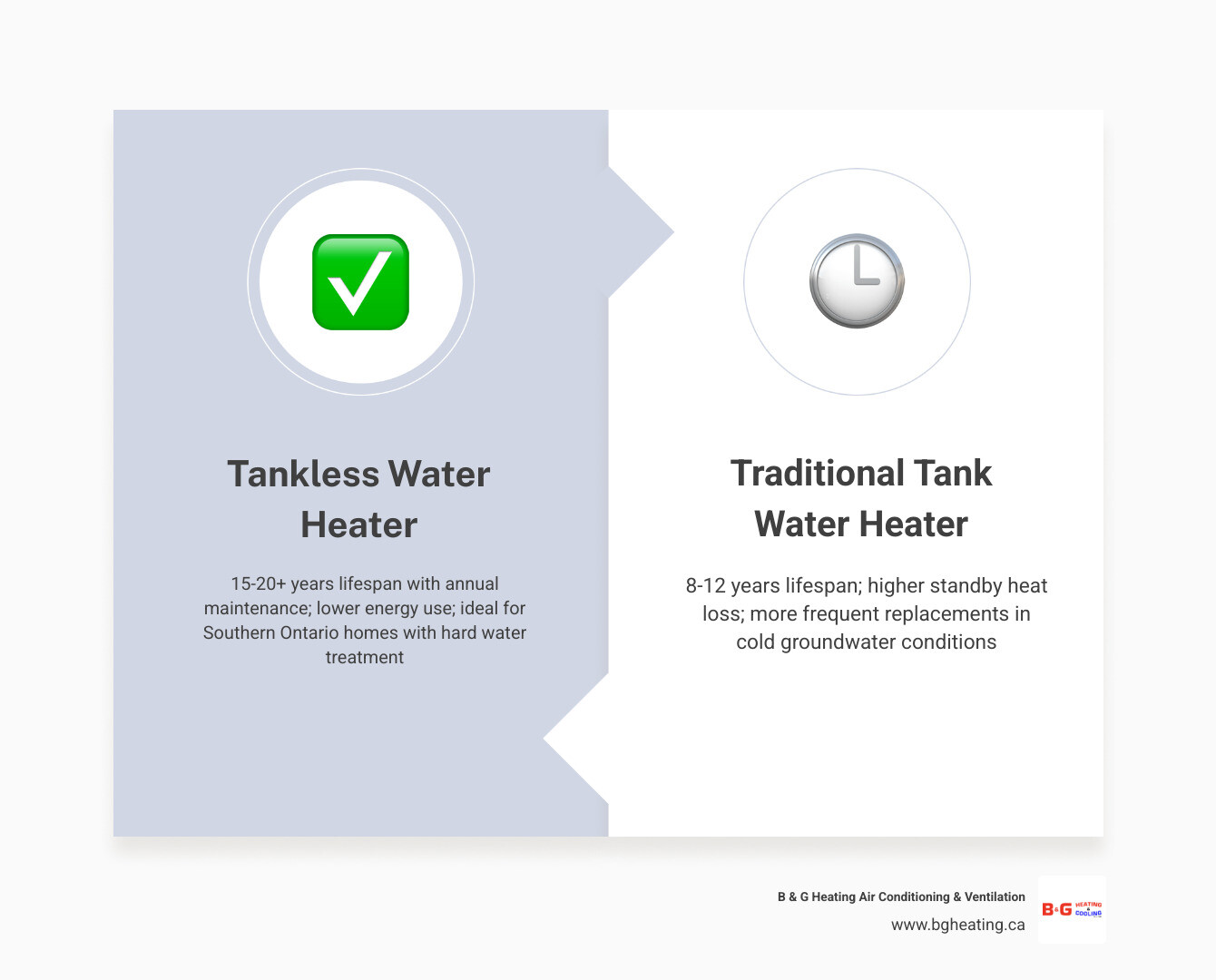
When we look at the numbers, tankless systems are a clear winner in terms of longevity. While traditional hot water tanks struggle to make it past the decade mark in our region, a high-quality tankless unit is designed to stand the test of time.
Traditional tanks are constantly exposed to standing water, which accelerates rust, corrosion, and sediment settling at the bottom of the drum. This continuous exposure is why so many homeowners find themselves reading about the Water Heater Lifespan in Southern Ontario 101 when their traditional tanks suddenly spring a leak.
Tankless systems, on the other hand, operate on-demand. They only heat water when a tap is turned on, meaning they do not store water. This lack of standing water dramatically reduces the rate of internal corrosion.
However, to get the absolute most out of your investment, you have to understand the unique environmental pressures of our region. If you are comparing your options, our Tankless vs Tank Water Heater Ontario Homeowners Guide provides an excellent breakdown of how these systems stack up side-by-side.
| Feature | Tankless Water Heaters | Traditional Tank Water Heaters |
|---|---|---|
| Average Lifespan | 15 to 20+ Years | 8 to 12 Years |
| Energy Efficiency | 80% to 98% UEF | 60% to 70% UEF |
| Space Required | Minimal (Wall-Mounted) | Large Floor Footprint |
| Water Supply | Endless (On-Demand) | Limited to Tank Capacity |
| Primary Failure Cause | Mineral Scale Buildup | Tank Corrosion & Leaks |
Key Factors Affecting Tankless Longevity in Ontario
The life expectancy of any heating appliance in Southern Ontario is heavily influenced by local conditions. For water heaters, the two most significant environmental factors are water quality and seasonal temperature swings.
Our geographic region is famous for its rich soil, beautiful landscapes, and unfortunately, incredibly hard municipal water. From the Niagara Escarpment down through Hamilton, Haldimand, and Brantford, the water traveling to our homes carries a heavy load of dissolved minerals.
To learn more about how these minerals impact household appliances, read our guide on Mineral Buildup 101 How It Destroys Water Heaters in Hard Water Areas.
Water Hardness and the Need for Descaling
When hard water is heated, dissolved calcium carbonate and magnesium precipitate out of the liquid and solidify. In a tankless system, this process happens directly inside the copper or stainless steel heat exchanger. As water flows through these narrow pathways, a thin layer of scale begins to coat the metal.
This scale acts as an unintended layer of insulation. The burner has to run hotter and longer to transfer heat through the scale and into the water. This extra thermal stress can overheat the heat exchanger, eventually leading to microscopic cracks and catastrophic leaks.
To prevent this, annual descaling is absolutely mandatory. This process involves pumping a food-grade descaling solution (or pure white vinegar) through the system to dissolve the mineral deposits. For a complete breakdown of what this service looks like, check out All About Tankless Water Heater Maintenance in Canada.
Winter Groundwater Temperatures and System Sizing
Southern Ontario winters are cold, and that means our groundwater temperatures drop significantly. In the depth of January, the water entering your home from municipal pipes can be as cold as 4°C.
To deliver a comfortable shower at 49°C, your tankless water heater has to achieve a “temperature rise” of 45°C. This is a massive workload compared to the summer months, when incoming water is much warmer.
If a system is undersized for these winter conditions, it will struggle to keep up. It may throttle the water flow to ensure it can reach the target temperature, leading to frustrating pressure drops.
If you are currently experiencing this issue, our guide on Troubleshooting Low Hot Water Pressure can help you identify whether your water heater is the culprit. Properly sizing the unit during installation ensures it doesn’t have to run at maximum capacity for months on end, preserving its lifespan.
Condensing vs. Non-Condensing Models
If you are looking to install or upgrade your system, you will have to choose between two main types of tankless water heaters: condensing and non-condensing. Both have distinct advantages, but they differ in efficiency, venting requirements, and long-term maintenance needs.
If you are trying to decide which style fits your household best, we suggest reading about Choosing the Right Water Heater to understand the core differences.
Condensing Units and Acidic Condensate
Condensing tankless water heaters are the gold standard of energy efficiency. They feature a secondary heat exchanger that captures extra heat from the exhaust gases before they leave the home. This process cools the exhaust to the point where the water vapor condenses back into liquid, achieving Uniform Energy Factor (UEF) ratings of up to 0.98.
However, this condensation process produces a highly acidic byproduct. Condensing systems must be equipped with a condensate neutralizer cartridge filled with alkaline media to neutralize the liquid before it drains into your home’s wastewater system.
Additionally, because the exhaust is cool, these units can be vented using inexpensive PVC or CPVC piping. If you are preparing to transition to a high-efficiency system, our guide on how to Upgrade Your Aging Water Heater System covers all the preparation steps.
Non-Condensing Units and Venting Requirements
Non-condensing units are simpler in design but slightly less efficient. They do not capture the latent heat from exhaust gases, which means their exhaust remains incredibly hot.
Because of these high exhaust temperatures, non-condensing systems cannot use plastic PVC vents. Instead, they require specialized, corrosion-resistant Category III stainless steel venting.
While non-condensing units don’t require a condensate neutralizer, the specialized venting can make retrofits in older homes more complex.
Installation Considerations for Older Ontario Homes
Southern Ontario is home to beautiful, historic properties. From century homes in downtown Hamilton and Dundas to older suburban developments in Burlington and Mississauga, installing modern HVAC equipment often requires creative solutions.
When transitioning to a tankless system, there are two primary infrastructure hurdles: gas lines and venting. To make sure your home is ready, we highly recommend reading about Professional Water Heater Installation or exploring local services like Water Heater Installation Hannon On to see how these upgrades are handled in your neighborhood.
Gas Line Upgrades and TSSA Rules
A traditional water heater has a relatively small burner because it has all day to slowly heat up 40 or 50 gallons of water. A tankless unit, however, must flash-heat water instantly as it rushes through the heat exchanger. This requires a much larger burner — often rated up to 199,000 BTUs.
Because of this high demand, older homes with standard 1/2-inch gas lines usually require an upgrade to a 3/4-inch or 1-inch dedicated gas line.
In Ontario, all gas work is strictly regulated by the Technical Standards and Safety Authority (TSSA). A licensed G2 gas fitter must perform a comprehensive gas load calculation for your property to ensure that running your water heater won’t starve your furnace or fireplace of fuel.
Venting and Infrastructure Challenges
Venting a tankless water heater in an older home can be tricky. Traditional tanks often vent naturally up through an existing chimney. Tankless units, however, require direct or power venting.
For condensing units, this means running two PVC pipes (one for fresh air intake, one for exhaust) out through a sidewall. Drilling these vent paths through thick, double-wythe historic brick or fieldstone foundations requires specialized equipment and careful sealing to protect the structural integrity of your home.
Warning Signs Your Tankless Unit is Nearing End of Life
Like any mechanical system, a tankless water heater will eventually let you know when it is tired. Recognizing these warning signs early can save you from an unexpected cold shower or water damage.
If your system is acting up, look through our list of Signs You Need Water Heater Repair or start planning ahead by reading about Time for Water Heater Replacement.
- Fluctuating Water Temperatures: If you experience sudden bursts of cold water during a shower (often called a “cold water sandwich”), your heat exchanger or gas valves may be failing.
- Reduced Hot Water Flow: If your hot water pressure drops significantly while cold water pressure remains normal, it is a classic sign of severe internal scale blockage.
- Frequent Error Codes: Modern tankless units are highly computerized. If your display screen is constantly flashing error codes related to ignition failure, venting issues, or temperature sensors, the unit is struggling.
- Strange Noises: Clicking, knocking, or humming sounds from the unit usually point to a failing fan motor, burner issues, or massive scale buildup.
Understanding How Long Does a Tankless Water Heater Last in Southern Ontario Without Maintenance
If a tankless water heater is installed in Southern Ontario and completely ignored, its lifespan will drop dramatically. Without annual descaling, a high-output system in a hard-water area like Hamilton or Brantford can suffer terminal heat exchanger failure in as little as 8 to 10 years.
The cost of replacing a cracked heat exchanger out of warranty is often high enough that homeowners choose to replace the entire unit instead. If you find yourself in this situation, our local specialists can assist with Water Heater Repair Hannon On to see if your system can still be saved.
Determining How Long Does a Tankless Water Heater Last in Southern Ontario with Hard Water
For homeowners who want the ultimate peace of mind, pairing a tankless water heater with a whole-home water softener or a dedicated scale prevention system is a game-changer. By removing calcium and magnesium before the water ever reaches the water heater, you virtually eliminate scale buildup.
With a water softener in place and light routine maintenance, a tankless system can easily cruise past the 20-year mark with peak efficiency. If you are planning a complete system overhaul, check out What to Expect Water Heater Replacement and explore local options like Water Heater Replacement Hannon On to see how we can design the perfect setup for your home.
Frequently Asked Questions About Tankless Water Heaters
Do tankless water heaters require gas line upgrades in older Ontario homes?
Yes, in many cases they do. Because tankless systems heat water instantly, they require a much larger volume of gas than a traditional tank. Older homes built before 1990 typically have 1/2-inch gas lines.
Upgrading to a dedicated 3/4-inch line is usually necessary to ensure the unit operates safely and doesn’t interfere with your home’s other gas appliances. To ensure this work is done safely and legally, always hire a licensed professional for your Professional Water Heater Replacement.
How often should a tankless water heater be descaled in Southern Ontario?
In most areas of Southern Ontario, particularly along the Hamilton-Niagara corridor, Kitchener-Waterloo, and Haldimand County, we recommend descaling your tankless water heater at least once a year.
If you do not have a water softener and your municipal water is exceptionally hard, checking the system every six months is a smart preventative measure. If you need assistance setting up a maintenance schedule, our local experts at Water Heater Services Hannon On are always here to help.
Are there rebates or incentives for tankless water heaters in Ontario in 2026?
As of June 2026, the rebate landscape in Ontario has shifted. While older programs like the federal HER+ have closed, local utility providers like Enbridge Gas still offer various home efficiency rebates and conservation incentives for installing ENERGY STAR certified high-efficiency appliances.
Additionally, manufacturers frequently offer promotional warranties and rebates during peak replacement seasons. It is always best to speak with us directly to see what current programs your new system might qualify for.
Conclusion
A tankless water heater is a fantastic, long-term investment for your Southern Ontario home. By delivering endless hot water on demand and lasting up to two decades, it easily outperforms traditional hot water tanks. However, the key to unlocking that 20-year lifespan lies in professional installation and consistent local maintenance.
At B & G Heating Air Conditioning & Ventilation, we have spent years helping homeowners throughout Hamilton, Burlington, Oakville, and the surrounding regions stay comfortable. Whether you need a routine annual flush, a quick repair, or a brand-new installation, our friendly, family-owned team is here to provide quality workmanship you can trust.
Don’t wait for your old water heater to leave you shivering. Schedule professional water heater services today and let us keep your home’s hot water flowing reliably for years to come!