


What Rebates Reduce AC Replacement Cost in Ontario in 2026
If you’re wondering what rebates reduce AC replacement cost in Ontario, here’s a quick answer:
| Program | Who It’s For | Max Rebate |
|---|---|---|
| Home Renovation Savings Program (HRS) | Most Ontario homeowners | Up to $7,500 (heat pump) |
| Canada Greener Homes Affordability Program (CGHAP) | Low-to-moderate income households | Varies by upgrade |
| Oil to Heat Pump Affordability Program (OHPA) | Oil-heated homes | Up to $15,000 |
| Enbridge Gas Home Efficiency Rebate | Enbridge Gas customers | Up to $6,500 |
| Save on Energy (IESO) | Electrically heated Ontario homes | Stacks with HRS |
| Municipal Programs (e.g., Toronto HELP) | Select municipalities | Varies by location |
Replacing an AC system is one of the bigger home expenses Ontario homeowners face — and many people don’t realize how much money is sitting on the table through government and utility rebate programs. In 2026, Ontario has one of the richest rebate stacks in the country, built around the Home Renovation Savings Program delivered jointly by Enbridge Gas and Save on Energy (IESO). When combined with federal programs like CGHAP and municipal loan options, the total public contribution toward a qualifying home retrofit can land anywhere between $5,000 and $18,000 depending on your situation and the upgrades you choose.
One real-world example: a homeowner in Wasaga Beach invested roughly $18,000 in a heat pump and insulation upgrades and walked away with $11,500 in rebates — plus a 30% drop in monthly gas costs. That kind of outcome is possible when you know which programs to stack and how to follow the application steps correctly.
The catch? These programs have specific rules around eligible equipment, application timing, and documentation. Getting any of those steps wrong can mean losing your rebate entirely. This guide walks you through everything you need to know to claim what you’re owed.
Understanding What Rebates Reduce AC Replacement Cost in Ontario
In 2026, the landscape of home cooling has shifted. The provincial government and utilities are no longer just focused on “standard” air conditioners; instead, they are heavily incentivizing technology that provides both cooling and heating efficiently. This is why you will see the term “heat pump” appear in almost every rebate discussion.
The primary driver for these incentives is the Home Renovation Savings Program (HRS). Funded through the IESO conservation framework—a massive $10.9 billion provincial investment—this program aims to lower greenhouse gas emissions while helping us keep our homes comfortable. Understanding the importance of AC replacement goes beyond just staying cool; it’s about integrating your home into a more sustainable energy grid.
To qualify for the most significant rebates, equipment must typically be ENERGY STAR certified or meet specific “cold climate” performance ratings. This ensures that the systems being installed actually deliver the promised energy savings. While the upfront investment for these high-efficiency systems can be higher than a basic unit, knowing what should you expect to pay to replace your air conditioner helps you see that the net cost after rebates often makes the premium system the more affordable choice in the long run.
How the Single-Upgrade Path Simplifies Your Cooling Project
If you are only looking to replace your cooling system and don’t want to deal with a full home energy audit, the “Single-Upgrade Path” is your best friend. This path was designed to be streamlined and user-friendly.
Under this route, you don’t need a pre-retrofit energy assessment. You simply choose eligible equipment from the approved list, have it installed by a licensed professional, and submit your application. This is ideal for homeowners who need a quick replacement because their current unit has failed. When choosing the right AC replacement, you’ll want to ensure the specific model is registered with the program to avoid a “rebate rejection” surprise. That you generally have a 60-day window from the date of purchase to get your paperwork submitted.
Maximizing Savings Through the Bundled-Upgrade Path to Discover What Rebates Reduce AC Replacement Cost in Ontario
For those who want to maximize their savings, the “Bundled-Upgrade Path” is the gold standard. This path requires a professional EnerGuide assessment (an energy audit) both before and after the work is done. While this adds a step, it unlocks much higher rebate tiers.
By taking a whole-home approach, you can stack your AC or heat pump replacement with other measures like attic insulation or air sealing. For example, while a heat pump alone might get you a significant rebate, pairing it with insulation could increase your total return by thousands of dollars. This path essentially picks up where the old Canada Greener Homes Grant left off, providing a comprehensive way to overhaul your home’s efficiency.
Eligibility Requirements for 2026 Ontario Energy Incentives
To ensure the rebate money is well-spent, the province has set strict eligibility criteria. First and foremost, the property must be your primary residence. Rental properties or secondary cottages often fall under different commercial programs or may not qualify for the residential HRS rebates.
Your home must also be grid-connected and you must be a customer of a participating utility, such as Enbridge Gas or a local electric utility under the Save on Energy umbrella. Because the average lifespan of central AC in Ontario is about 15 to 20 years, these programs are designed to encourage homeowners to move toward modern technology when their old systems inevitably reach the end of the road.
Documentation Needed to Secure What Rebates Reduce AC Replacement Cost in Ontario
We cannot stress this enough: keep your receipts! The most common reason rebates are denied isn’t because the equipment was wrong, but because the paperwork was incomplete. You will need:
- Itemized Invoices: These must show the model numbers of both the indoor and outdoor units.
- Proof of Payment: A cleared check or a “paid in full” receipt.
- AHRI Certificates: This document proves that your specific combination of equipment meets the efficiency standards required by the rebate program.
- Installation Dates: Clear evidence of when the work was completed.
Reviewing the points to consider before purchasing a new HVAC system can help you prepare your file from day one.
Contractor Standards for Successful Rebate Claims
In Ontario, you can’t just have a handy neighbor install your system if you want the rebate. The installation must be performed by a licensed HVAC technician. These professionals ensure the system is sized correctly and installed according to manufacturer specifications.
When you are deciding when to consider AC replacement, look for a contractor who is familiar with the Home Renovation Savings Program. They should be able to provide you with the exact model numbers and AHRI certificates needed for your application. Furthermore, professional installers will handle necessary permits, which is often a hidden requirement for rebate validation.
Comparing Heat Pumps vs. Traditional AC for Maximum Rebates
If you are looking for the biggest check from the government, the heat pump is the clear winner. While traditional central air conditioners provide excellent cooling, they don’t contribute to the province’s heating decarbonization goals. As a result, standard AC units receive much smaller incentives (or none at all) compared to air-source or ground-source heat pumps.
| Feature | Traditional Central AC | Air-Source Heat Pump |
|---|---|---|
| Cooling Ability | Excellent | Excellent |
| Heating Ability | None | High Efficiency (even in winter) |
| Rebate Eligibility | Limited/None | Up to $7,500 |
| Operational Savings | Standard | High (replaces gas/oil use) |
Deciding between the two often comes down to the ultimate guide to AC repair vs replace. If your current furnace is also aging, a heat pump or a hybrid heating system (a heat pump paired with a gas furnace) offers the most strategic way to use rebates to offset the cost of a total system upgrade.
Why Heat Pumps are the Focus of What Rebates Reduce AC Replacement Cost in Ontario
The push for heat pumps is tied to Ontario’s environmental goals. Since heat pumps move heat rather than generating it through combustion, they are incredibly efficient. In fact, cold climate heat pumps can be three times as efficient as a traditional furnace.
With the removal of the federal fuel charge for certain heating types and the shift toward electricity-based efficiency, the operating costs for heat pumps are becoming increasingly competitive. By choosing a heat pump, you are essentially getting a high-end air conditioner that also slashes your winter heating bills.
Step-by-Step Guide to Claiming Your Ontario HVAC Rebates
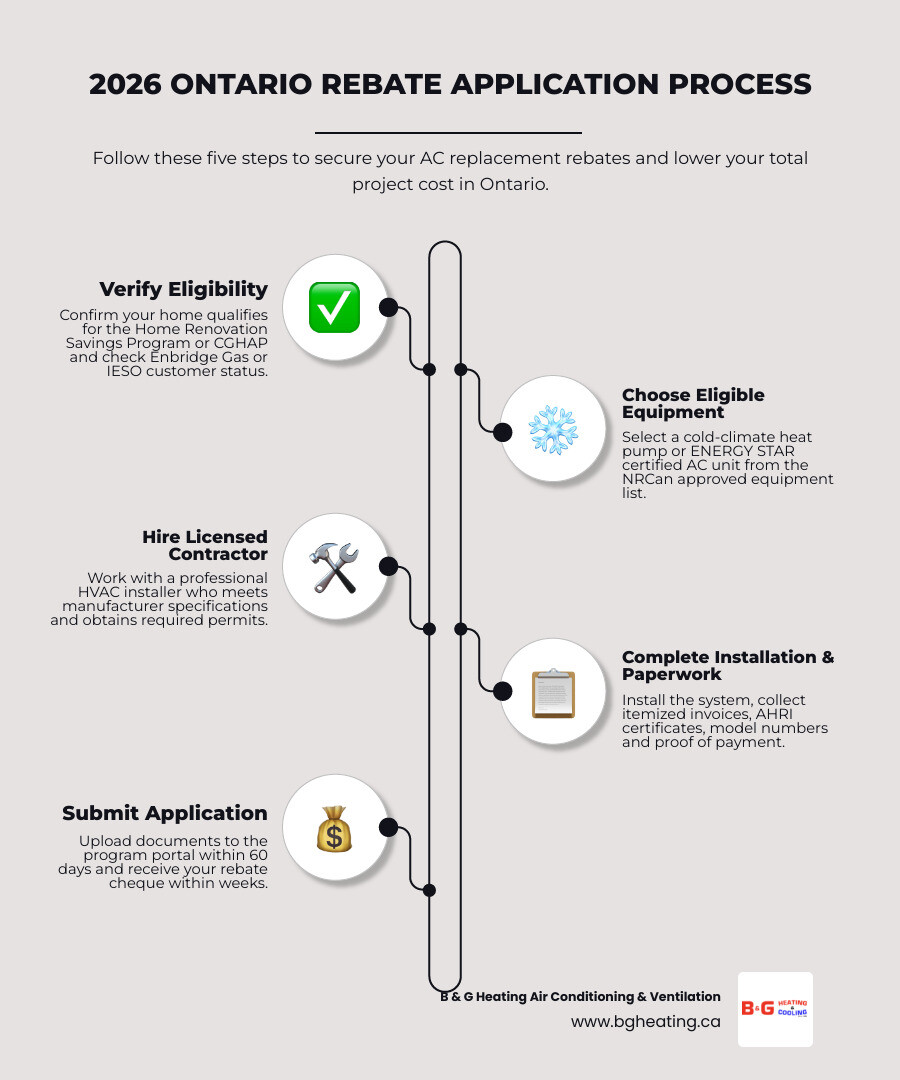
Navigating the process doesn’t have to be a headache. If you follow these steps, you can ensure a smooth application:
- Start with an Audit (Optional but Recommended): If you want the big “bundled” rebates, book a pre-retrofit EnerGuide audit.
- Choose Your Equipment: Work with us to select a system from the NRCan approved list.
- Get Quotes: Ensure the quotes include model numbers and mention the rebate eligibility.
- Professional Installation: Have our licensed technicians install the system to manufacturer and program standards.
- Post-Retrofit Audit: If you did the first audit, you must do a second one to verify the energy savings.
- Submit Documentation: Upload your invoices and certificates to the Home Renovation Savings Program portal.
- Receive Your Cheque: Most homeowners receive their rebate cheque within 16 weeks of the final submission.
Frequently Asked Questions about Ontario AC Rebates
Can I stack Enbridge rebates with federal programs like CGHAP?
Yes, in many cases you can! The Home Renovation Savings Program is designed to work alongside federal initiatives. If you are a low-to-moderate-income household, the Canada Greener Homes Affordability Program (CGHAP) provides even deeper support. You can also look into municipal loan programs, such as Toronto’s HELP, which provides low-interest financing that stays with the property, not the person.
Do I need an energy audit for a simple AC replacement?
If you are using the “Single-Upgrade Path” for a standalone heat pump or smart thermostat, you typically do not need an energy audit. However, if you want to access the higher rebate amounts or combine the AC work with insulation and windows, the audit is mandatory. The good news? The program often reimburses up to $600 of the audit cost if you complete at least one qualifying upgrade.
What common mistakes lead to rebate rejection?
The biggest mistake is starting work before your pre-retrofit audit is completed (for the bundled path). Other pitfalls include choosing equipment that isn’t on the official “Approved” list, providing vague invoices that don’t list model numbers, or missing the 60-day application deadline for single upgrades.
Conclusion
We know that keeping your home comfortable in Ontario’s unpredictable climate is a top priority. At B & G Heating Air Conditioning & Ventilation, we’ve spent years helping families in Hamilton, Burlington, Oakville, and across the Niagara region navigate the complexities of HVAC upgrades. Whether you’re in Stoney Creek, Waterdown, or Grimsby, we are here to ensure you get the best system for your home while leaving no rebate money on the table.
Don’t let the paperwork intimidate you. Our team of experts understands exactly what rebates reduce AC replacement cost in Ontario and can guide you through the selection and installation process from start to finish. We pride ourselves on quality workmanship and customer satisfaction, ensuring your new system provides reliable comfort for years to come.
Ready to upgrade your home’s comfort and save? Schedule your rebate-eligible consultation today and let us help you maximize your savings.